- Population:1.5M (2023)
- Area:311 km²
- Elevation:519 m
- Timezone:CET/CEST
- IATA:MUC
Overview
Munich pairs alpine proximity and engineering excellence with gemütlichkeit and beer gardens.
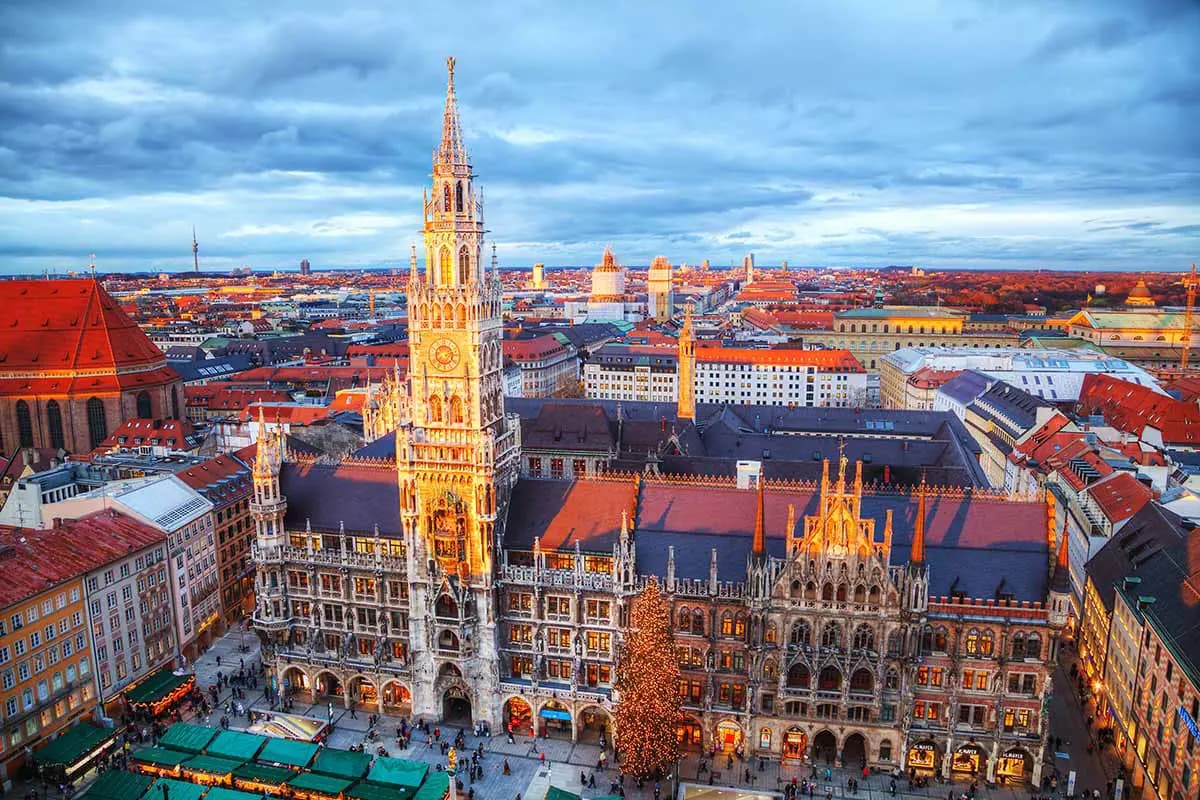
Munich's Marienplatz at dusk during the Christmas season, with the iconic Glockenspiel tower of the Neues Rathaus illuminated against the evening sky
© andreykr / Adobe Stock
Travel
Munich delivers the full Bavarian experience—a sophisticated metropolis where beer hall culture meets world-class museums, where cutting-edge automotive engineering stands alongside baroque palaces, and where the Alps rise just an hour to the south. This is Germany's third-largest city, yet it retains the warmth and accessibility that define Bavaria's famous gemütlichkeit. The historic Altstadt centers on Marienplatz, where the Gothic Neues Rathaus stages its famous Glockenspiel performance three times daily. Beyond the medieval core, you'll find the vast Englischer Garten (larger than Central Park), world-renowned art collections in the Kunstareal museum district, and beer gardens where locals gather under chestnut trees to enjoy Mass steins and pretzels the size of dinner plates. Munich's efficient MVV transport network connects everything from BMW's futuristic headquarters to Nymphenburg Palace's sprawling baroque gardens, while S-Bahn lines whisk travelers to Alpine lakes and mountain peaks in under an hour. Whether you're here for Oktoberfest's legendary beer tents, the Deutsches Museum's engineering marvels, or simply to soak up the laid-back Bavarian vibe in Viktualienmarkt's open-air food market, Munich manages to feel both cosmopolitan and cozy—a rare combination that keeps visitors coming back.
Marienplatz forms Munich's beating heart—a pedestrianized square dominated by the neo-Gothic Neues Rathaus (New Town Hall), whose 85-meter tower hosts the famous Glockenspiel that performs daily at 11am, noon, and 5pm (March–October). Crowds gather to watch the mechanical figures reenact two Bavarian stories: a 1568 wedding tournament and the Schäfflertanz coopers' dance. The Altes Rathaus (Old Town Hall) anchors the square's eastern edge, while radiating cobblestone streets lead to landmarks like the twin-domed Frauenkirche (the cathedral's onion domes are Munich's symbol), St. Peter's Church (climb 299 steps for panoramic views), and the medieval Viktualienmarkt food market. This compact Altstadt is best explored on foot—every corner reveals centuries of history, from Renaissance facades to hidden courtyards where locals drink coffee in quiet biergartens.
Frequently asked questions
Transport & airports
Diplomatic missions in Munich
38 embassies based in this city, grouped by region.
This overview comes from Visaja's worldwide missions database (visaja.com), checked against official government sources; for binding answers, the mission itself always has the final word.