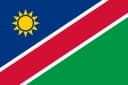
Namibia
Namibia is a southern-African country bordering Angola, Zambia, Botswana, South Africa and the Atlantic. About 2.6 million people live across roughly 825 000 km², more than France and the UK combined, which makes it one of the most thinly populated countries on earth: desert, savanna and a cold Atlantic coast. English is the official language, German and Afrikaans remain widely spoken, and the Namibia Dollar (N$) trades 1:1 with the South African Rand. Most visitors from Europe and North America need a visa on arrival that can be paid online in advance, and international flights land at Hosea Kutako International Airport (WDH) outside Windhoek, typically via Johannesburg, Cape Town, Addis Ababa, Doha or a European hub.
Visa Requirements for Namibia
Namibia runs a three-tier system by passport. Twenty-two nationalities — including Brazil, Singapore, Indonesia, Malaysia, Russia, Kenya, South Africa and most other SADC states, plus Hong Kong, Macau, Cuba and Jamaica — enter visa-free for holidays. Eighty-nine listed nationalities — among them the United Kingdom, the United States, Canada, Ireland, Australia, New Zealand, Germany, most of the EU, Japan, South Korea and 28 African states on a parallel list — can use Visa on Arrival. Under the official May 2025 fee schedule, adults and travellers aged 12 or older from listed African countries pay N$1,200, while those from other listed countries pay N$1,600; children aged 6–11 pay half and children under six pay nothing. A holiday visa may be granted for up to 90 days and multiple entry, which matters for itineraries crossing back into South Africa or Botswana. Although eligible travellers can apply physically on arrival, the Ministry of Home Affairs, Immigration, Safety and Security recommends applying online in advance through its official e-services portal, paying the fee electronically and carrying the issued e-visa. Passports must be valid for at least six months and contain at least three blank pages. Visa on Arrival is processed only at designated ports of entry, so self-drive travellers crossing from South Africa, Botswana, Angola or Zambia should confirm their border post is on the current list before finalising the route. Visitors from countries outside both the exempt and Visa-on-Arrival lists — including India, Nigeria, China and the Philippines — must obtain an e-visa before travelling. Travellers under 18 should carry an international birth certificate showing both parents, or a certified English translation, particularly where surnames differ or one parent is travelling alone. Work, volunteering, study, journalism, filming and long-stay travel require separate permits and cannot be regularised under a Visa on Arrival.
Visa types
For citizens of 22 nationalities — Brazil, Singapore, Indonesia, Malaysia, Russia, Kenya, Hong Kong, Macau, Cuba, Jamaica and most other SADC member states (South Africa, Botswana, Zambia, Zimbabwe, Angola, Lesotho, Eswatini, Mozambique, Malawi, Tanzania, Mauritius, Seychelles) — for holidays and short visits.
Guides
Namibia is the country travellers come to when they want the silence of empty landscape together with the infrastructure that makes a self-drive trip realistic without a guide — fuel stations, mobile signal on the main routes, rest camps inside the national parks and a thriving private lodge sector. Most trips run as a loop of long gravel days out of Windhoek, so how self-drive actually works here decides more about the journey than the list of stops. The empty road between two lodges is part of the trip, not the gap between its sights.
Namibia travel guide →
The full guide — the waterhole circuit, the dunes, the granite north-west, the Skeleton Coast and the self-drive loop.
Money in Namibia →
Namibia dollars, the rand peg and cash planning — the practical money guide.
Getting around Namibia →
The physics of gravel, where the 4x4 zones really come from, fuel-range habits and why dusk is the dangerous hour.
Health & safety in Namibia →
Two risk profiles — town and bush — plus malaria's real map, desert heat, camp habits and the evacuation reality.
Cities & planning
Plan your trip
Booking links go to our partner Trip.com — we may earn a commission at no extra cost to you.
Regions
Embassies & missions
Europe · 10
Americas · 2
Asia · 2
Africa · 1
Oceania · 1
Accredited missions for Namibia
Argentine Embassy in Pretoria
Based in Pretoria, South Africa
Australian High Commission in Pretoria
Based in Pretoria, South Africa
Austrian Embassy in Pretoria
Based in Pretoria, South Africa
High Commission of Canada in Pretoria
Based in Pretoria, South Africa
Embassy of Chile in Pretoria
Based in Pretoria, South Africa
Colombian Embassy in Pretoria
Based in Pretoria, South Africa
Embassy of Ireland in Lusaka
Based in Lusaka, Zambia
Italian Embassy in Pretoria
Based in Pretoria, South Africa
Mexican Embassy in Pretoria
Based in Pretoria, South Africa
New Zealand High Commission in Pretoria
Based in Pretoria, South Africa
Embassy of Switzerland in Pretoria
Based in Pretoria, South Africa
Frequently asked questions
It depends on your passport. Twenty-two nationalities (including South Africa and most SADC states) are visa-exempt outright. Eighty-nine more — including the UK, US, Canada, Australia and most of the EU — use Visa on Arrival, paying online in advance or at the border. Everyone else needs an e-visa before travelling.
Not for the core route — Sossusvlei's tarred spur road, Etosha and the Quiver Tree route are manageable in a sedan. A 4x4 is essential for Kaokoland, the Marienfluss, Sandwich Harbour and parts of Damaraland.
Most itineraries run 12-16 days in a clockwise or counter-clockwise loop out of Windhoek, covering Sossusvlei, Etosha, Damaraland and the coast. Shorter trips can focus on just Etosha and Sossusvlei in about a week.
Planning a trip to Namibia? Check what you need to enter and apply online in minutes.
Treat this Visaja page as your starting point: verify the current rules directly with the official source before you submit an application.