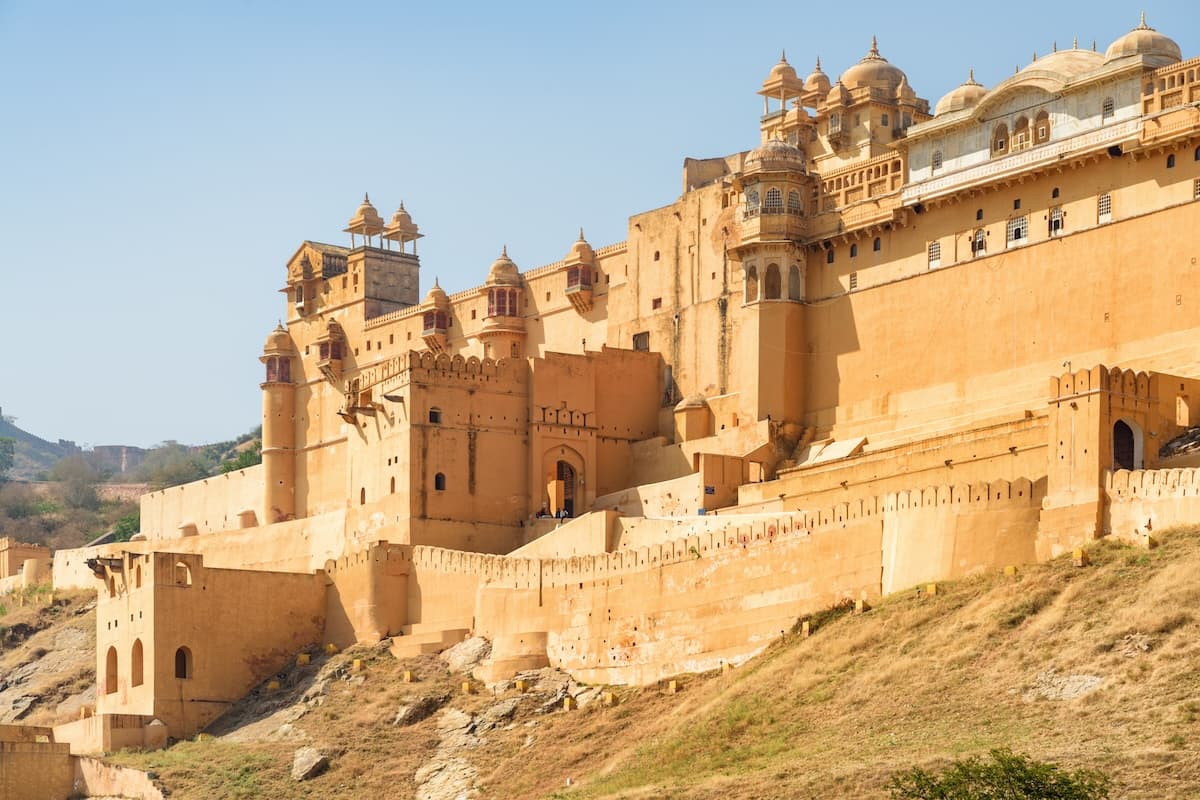
Do you need a visa for India?
Yes — almost certainly. India does not run a visa-free regime for the major Western source markets. Most foreign visitors apply for the e-Visa online and pick one of three popular Tourist tiers — 30-day, 1-year or 5-year, all multiple-entry. You upload a passport scan and a passport-style photo, and the approval letter arrives by email within three to five working days. Holders of Indian-origin OCI or PIO cards do not need a tourist visa at all and travel as lifetime visitors alongside their current foreign passport.
Travelling on a US, UK, Australian, Canadian, Irish or New Zealand passport? Our per-market editions cover the direct-flight gateways from your home airports, the Indian consulate that handles your area, and the travel advisories specific to your country: US, UK, Australia, Canada, Ireland or New Zealand.
Below: which visa route applies to whom, how the three popular Tourist tiers compare and which trip each one suits, what to have ready before you apply, the OCI track for the Indian diaspora, when you also need a restricted-area permit, the FRRO trap on long stays, the e-Visa moment at the airport, and the questions travellers actually ask.
- Tourist e-Visa: The default path for around 190 nationalities. The major source markets — US, UK, EU member states, the Schengen area, Australia, Canada, New Zealand, Ireland, Japan, South Korea — are all on the list. Three popular Tourist tiers (30-day, 1-year and 5-year, all multiple-entry) plus a quieter 6-month multiple-entry variant (the e-T2V). Tier choice depends on the shape of the trip, not the passport. Pakistani nationals are explicitly excluded from the e-Visa; the consular sticker route applies instead.
- OCI or PIO card holder — no tourist visa needed: Persons of Indian Origin who hold an Overseas Citizen of India (OCI) card travel as lifetime visitors alongside their current foreign passport. PIO cards were folded into the OCI framework in 2015; older PIO cards still work in practice but no new ones are issued. From 1 May 2026 the e-OCI digital system is the default channel for the application and for re-linking a renewed passport.
- Off-list passport — consular sticker visa: Passports not on the e-Visa list (refreshed annually by India's Ministry of Home Affairs) apply at an Indian embassy or consulate in their country of residence. Sticker visa in the passport, longer processing, more documentation. The standard path for nationalities outside the e-Visa list.
- Restricted-area permits — on top of the visa, not instead of it: Several frontier areas sit under the Protected Area Permit (PAP) or Restricted Area Permit (RAP) regime: Arunachal Pradesh, Nagaland, Manipur and Mizoram in the Northeast; parts of Sikkim and Ladakh near the China-Tibet border; and parts of the Andaman & Nicobar Islands. The permit is required in addition to the e-Visa or sticker visa, never instead of it.
Cruise port-of-call exception
Cruise itineraries calling at Mumbai, Goa (Mormugao) or Mangalore on Indian-government-approved vessels are a special case: passport holders from a defined list receive a port-of-call e-Visa equivalent on arrival. It covers shore-day excursions only — you cannot disembark and continue inland on the same itinerary. Travellers planning to step off the ship for the full Indian programme need a regular Tourist e-Visa filed in advance.
- 30-day multiple-entry — for the short tourism trip: Valid for 30 days from first arrival, with multiple entries allowed inside that window. The default choice for first-time visitors planning a single two-to-four-week loop: the Golden Triangle, a Kerala backwater fortnight, a Goa beach week, a Mumbai-and-coast detour. Simplest application, simplest fee, by far the most-used tier.
- 1-year multi-entry — for the flexible visitor: Multiple entries inside a 365-day window from the grant date, with stay capped at 180 days per calendar year. The right tier for split trips — a winter month now and the Himalayas later — and for repeat tourism inside a single year. Same application form as the 30-day tier; same processing time.
- 5-year multi-entry — for the long-horizon traveller: Multiple entries inside a 5-year window from grant, capped at the same 180 days per calendar year. Suits Persons of Indian Origin without an OCI card who visit family two or three times a year, business consultants on recurring trips and slow-travel photographers, writers and yoga teachers who return repeatedly. Removes the application step from every subsequent trip across those five years.
Beyond the three popular tiers
Three other categories run alongside the popular Tourist tiers. The 6-month multiple-entry e-Tourist Visa (e-T2V) suits travellers who want a longer window — a stay of up to six months, with the freedom to leave and re-enter within that period. The Business e-Visa covers trade-fair attendance, conference participation, sales calls and short consulting work; it requires an Indian-side invitation letter and does not double as a Tourist visa for paid work. The Medical e-Visa and its associated Medical Attendant e-Visa cover treatment trips to Indian hospitals; admission letter required, with a slot for the accompanying family member.
Before you open the e-Visa application
A short pre-trip checklist prevents avoidable rejections and surprises. Passport validity: a minimum of six months from the date of application, with at least two blank pages for immigration stamps. Renew at home if you are inside that window — the consular passport-renewal route from inside India is slow.
The passport-style photo must be a JPG file between 10 KB and 1 MB, equal height and width, full face front view, eyes open, no spectacles, plain light or white background with no shadows. The portal rejects oversize files and shadowed backgrounds without telling you which one is the problem, so check the dimensions and the lighting before you upload.
The address-in-India field appears on every application. For tourism, the name and phone number of your first hotel and its city are enough — you do not need to list every onward leg. For a yoga school, ashram or language course, use the institution's official registered address.
Sensitive nationalities and origins. Travellers naturalised from a sensitive-relation country — Pakistan above all — or with parents or grandparents who held that citizenship, face extra paperwork and a longer processing window. The bilateral framework refreshes every year. If this applies to your passport, our per-market editions list the current paperwork; if not, the standard track applies.
Children and minors each need their own e-Visa application tied to their own passport — the parent's e-Visa does not cover the child. Include the international long-form birth certificate naming both parents in the upload bundle, plus a parental-consent document if the child travels with one parent or a guardian.
Yellow Fever certificate. Travellers arriving within six days of departure from a Yellow Fever-endemic country must present a valid International Certificate of Vaccination at Indian immigration. India treats 29 listed African countries and 13 listed Central or South American countries as endemic. The certificate becomes valid ten days after the vaccine and is recognised internationally for life. Without one, you face quarantine of up to six days at a designated facility — a real risk on itineraries that begin or transit through the listed countries.
The OCI track — for the Indian diaspora
OCI eligibility covers former Indian citizens and the children, grandchildren and great-grandchildren of Indian citizens. The card grants visa-free lifetime entry to India, the right to live and work in the country, broadly the same standing as Indian citizens in everyday matters (residence, banking, education) and the right to own non-agricultural property. It does not grant the right to vote, to hold public office or to own agricultural land.
The 2026 re-linking rule is friendlier than the framework it replaced. The OCI card needs re-issuance once — when a new passport is issued after the cardholder reaches age 20. For any later passport renewal between ages 21 and 50, the card does not need re-issuance: the cardholder updates the new passport details on the designated government portal within three months, free of charge. Above 50 the same portal-update rule applies; the old re-issue-at-50 step has been retired.
From 1 May 2026 the e-OCI digital system rolled out under the Citizenship Amendment Rules, 2026 is the default channel for the application and for the passport-update process. The system is fully online and paperless. Carry the OCI card and the linked foreign passport at immigration. If the linked passport has been replaced and the portal update has not been completed, complete it before flying.
Getting to India in 2026
Air India has finished the Vistara merger. It now runs as the single Indian flag carrier on one integrated long-haul schedule out of Delhi, Mumbai, Bengaluru and Kochi, with the legacy Vistara codes retired from new bookings. IndiGo's widebody fleet now serves more European and Gulf cities directly than at any earlier point, opening up budget-tier direct flights on a growing list of routes. Together they have cut a connection out of the typical Europe-to-India and US-to-India journey on a meaningful share of routes.
The traditional one-stop options remain plentiful. Major European carriers run direct service to Delhi, Mumbai and Bengaluru from their primary hubs. Emirates via Dubai, Qatar Airways via Doha, Etihad via Abu Dhabi and Turkish Airlines via Istanbul provide one-stop coverage from almost anywhere. Total flight time from northern Europe to Delhi or Mumbai is eight to nine hours direct, or twelve to sixteen with one stop. From the US East Coast, direct flights take around fourteen hours; one-stop journeys add another four to eight. Per-market direct-flight gateways from your home airports sit in our per-market editions.
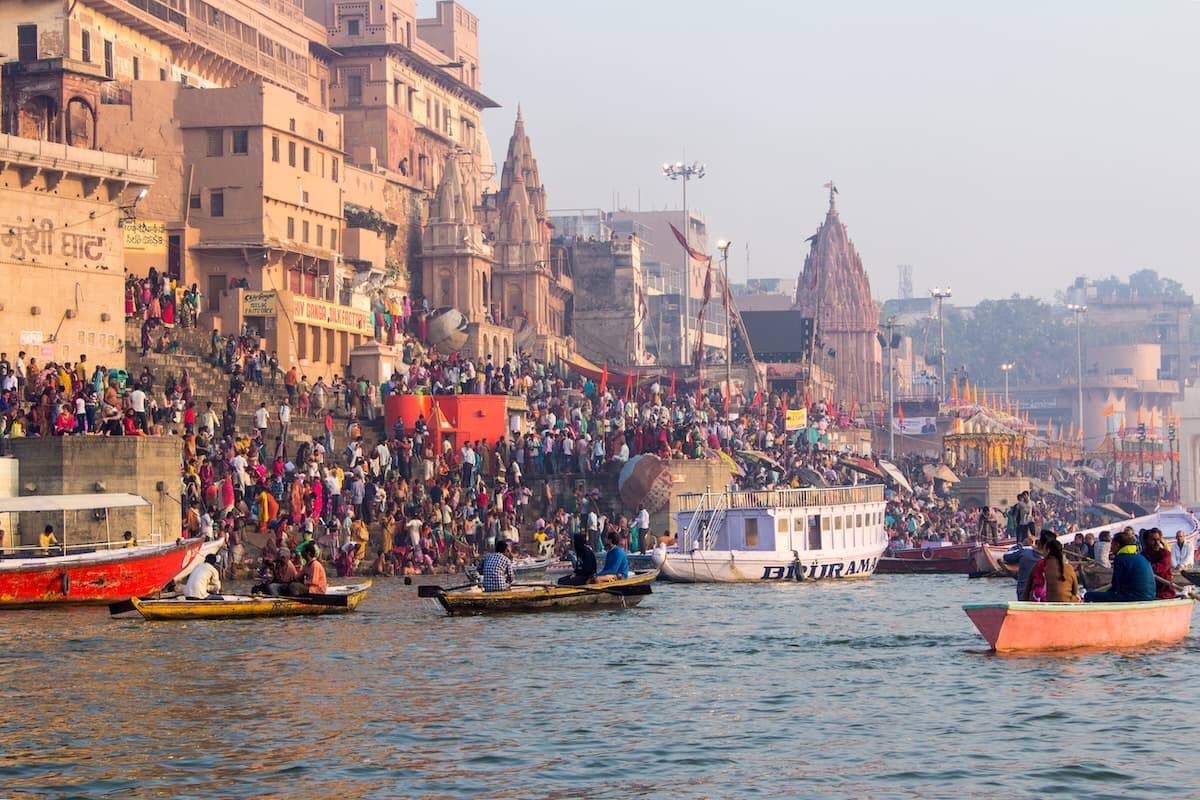
Varanasi at Diwali — the ghats along the Ganges fill with oil lamps and ceremonial fires during the festival of lights, one of the most layered spiritual experiences a first-time visitor can plan a trip around.
Liubov / Adobe Stock
- Golden Triangle — Delhi, Agra and Rajasthan: Delhi for the Mughal capital layer and the Lutyens' precinct, Agra for the Taj Mahal as a day or overnight trip, Jaipur as the gateway into Rajasthan's forts and palaces. Add Udaipur, Jodhpur and Pushkar for a second week. The 30-day Tourist e-Visa is sufficient and the full route stays inside the general e-Visa zone — no special permits.
- South India — Kerala backwaters and Tamil temples: Fly into Kochi for Kerala's backwaters, hill stations and Ayurveda traditions, then continue east into Tamil Nadu for the great Chola temples, Chennai's classical-music season and Pondicherry's Franco-Tamil coast. Twelve to sixteen days is comfortable. Quieter than the Golden Triangle in November to February; the 30-day Tourist e-Visa covers it.
- Goa heritage and beach — the Konkan loop: Goa in a week pairs the UNESCO churches at Old Goa and the Fontainhas heritage quarter in Panaji with North or South Goa beaches, the Anjuna market and a Dudhsagar Falls day. Extend along the Konkan Railway down into northern Karnataka for Gokarna and Hampi if you have two weeks. The 30-day Tourist e-Visa is sufficient.
- Mumbai gateway and Maharashtra hinterland: Land in Mumbai for the Victorian-Gothic and Art-Deco UNESCO ensemble, the food scene and the Elephanta Caves, then add Maharashtra's Ajanta and Ellora caves out of Aurangabad, Pune as a Maratha-history-plus-vineyard alternative and the Konkan coast. The 30-day Tourist e-Visa works; pair with Kolkata on the opposite coast for three weeks.
Restricted areas — PAP, RAP and where they apply
Most first-time visitors never encounter a restricted-area permit. The Golden Triangle, the Kerala-Tamil Nadu classical loop, Goa, Mumbai and Maharashtra, Varanasi and the Gangetic plain, Karnataka, and most of Andhra Pradesh and Telangana all sit inside the general e-Visa zone with no extra paperwork. The permit regimes apply at the country's sensitive borders.
Protected Area Permits (PAP) cover foreign-national entry to Arunachal Pradesh, Nagaland, Manipur, Mizoram, parts of Sikkim and parts of Ladakh near the China-Tibet border. The Arunachal PAP runs through licensed tour operators with a fixed itinerary; it is not a walk-in application. Nagaland's PAP is easier outside the December Hornbill Festival peak. Restricted Area Permits (RAP) cover parts of the Andaman & Nicobar Islands and a smaller subset of Sikkim and northeastern frontier zones; since 2018, thirty inhabited Andaman islands no longer require an RAP for foreign visitors. From 2026, Sikkim's RAP for foreign nationals is issued through the e-FRRO portal online — no physical permits at the border any more. The Inner Line Permit (ILP) is the parallel regime for Indian citizens in the same regions; foreign nationals follow PAP or RAP instead.
FRRO — the 180-day continuous-stay rule
Foreigners who stay in India for more than 180 continuous days in a single visit must register with the Foreigners Regional Registration Office (FRRO) within 14 days of crossing day 180. The rule applies to long-stay tourists on the 1-year or 5-year multi-entry tier just as it does to student and employment visa holders. Most short-trip travellers never trigger it: the 30-day tier rules it out by definition, and most multi-entry tourist trips stay well under six months in any single visit. The threshold is continuous stay, not aggregate days in the year — leaving and returning resets the clock.
What catches people is exactly that continuous-stay reading. If you arrive on a multi-entry e-Visa, stay 100 days, leave for a fortnight to Sri Lanka, Nepal, Bhutan or the Maldives and return for another 90 days, the counter resets and FRRO does not trigger. If you stay inside India and only travel between states the day count keeps running. Yoga-school students, long-stay digital nomads in Goa or Mysuru and Vipassana retreatants from Europe or North America hit the rule regularly without expecting to. The process itself is now fully online through the e-FRRO portal — paperless, cashless and ordinarily without an office visit; the office only calls you in if something on the application needs sorting out. OCI cardholders and children below twelve are exempt. Treat day 175 as the latest comfortable moment to open the application.
At the e-Visa counter
Thirty-three Indian airports operate e-Visa counters, including Delhi (DEL), Mumbai (BOM), Bengaluru (BLR), Chennai (MAA), Hyderabad (HYD), Kochi (COK), Kolkata (CCU) and the major regional hubs, alongside nineteen seaports and four land border crossings (Raxaul, Rupaidiha, Darranga and Jogbani). After disembarking, head to the immigration counter labelled e-Visa, present the printed PDF approval letter or its digital version on your phone alongside the passport, and submit fingerprints and a digital photograph. Stamping takes five to fifteen minutes depending on the queue. Carry the PDF printed and separately from your hand luggage — a phone battery flat at the wrong moment is a small but real risk.
Health and insurance
Travel insurance is not legally required for entry, but private hospitals at the major destinations charge international rates, and a serious illness or accident can mean repatriation costs that local hospital cash payments do not cover. Confirm that your home-country policy is valid for the duration of the trip and for what you will be doing (motorbikes, trekking, diving). The Yellow Fever certificate is the only mandatory health document at the border, and only on the conditions described above. Routine recommended vaccinations — Hepatitis A and B, typhoid, tetanus boosters, regional Japanese encephalitis for rural northeastern trips — are travel-medicine standard rather than Indian-government rules; speak to a travel-medicine practitioner six to eight weeks ahead.
India's Ministry of Home Affairs sets the e-Visa fee in US dollars per nationality, refreshed annually, and the portal shows you the exact figure once your passport is entered. As a current-of-writing reference, the popular Tourist tiers run around USD 25 for the 30-day tier, USD 40 for the 1-year and USD 80 for the 5-year; Business and Medical tiers carry separate fee schedules. A visa-service partner adds a moderate handling fee on top of the government fee in exchange for native-language support, document review and status monitoring. Check the current rate on the portal when you start the application — the portal price is authoritative.
For a one-off three-week India trip, no — the 30-day tier covers it for less money. The 5-year tier earns its keep on repeat visits and split itineraries: a slow-travel writer cycling between Goa winters and Manali summers, a Person of Indian Origin without an OCI card who visits family two or three times a year, a business consultant running quarterly meetings. The 180-day-per-calendar-year stay cap still applies, so the long tier does not turn India into a residence route — it just removes the application step from every subsequent trip.
The Persons of Indian Origin (PIO) card was merged into the Overseas Citizen of India (OCI) framework in 2015. Existing PIO cards remain valid in practice but are no longer issued; new applicants receive an OCI card. OCI grants visa-free lifetime travel to India, the right to live and work in the country, parity with Indian citizens on most rights of residence and on most financial-services access, and the right to own non-agricultural property. It does not grant the right to vote, to hold public office or to own agricultural land.
Incredible India — Official India Tourism Portal
The Ministry of Tourism's official visitor portal — destination guides by state and theme, the experience-led travel calendar and an overview of registered hosts and operators. Available in English and several other languages.
Archaeological Survey of India
The federal body that maintains India's protected monuments — the Taj Mahal, Khajuraho, Ajanta-Ellora, Hampi, Konark and around 3,600 others — with site information, opening hours and the online ticketing portal.
Airports Authority of India
Live arrivals and departures, terminal maps and ground-transport options for the AAI-operated airports including Kolkata, Chennai and the regional networks. Delhi (DEL) and Mumbai (BOM) have separate operator portals.
IHR Point of Entry — Yellow Fever vaccination
The Indian Ministry of Health and Family Welfare's IHR Point of Entry page listing the Yellow Fever endemic countries the border treats as triggering a certificate requirement, the transit rule and the quarantine protocol for travellers without a valid certificate.
Need help with the Indian visa application or eligibility check?
Apply for India visa