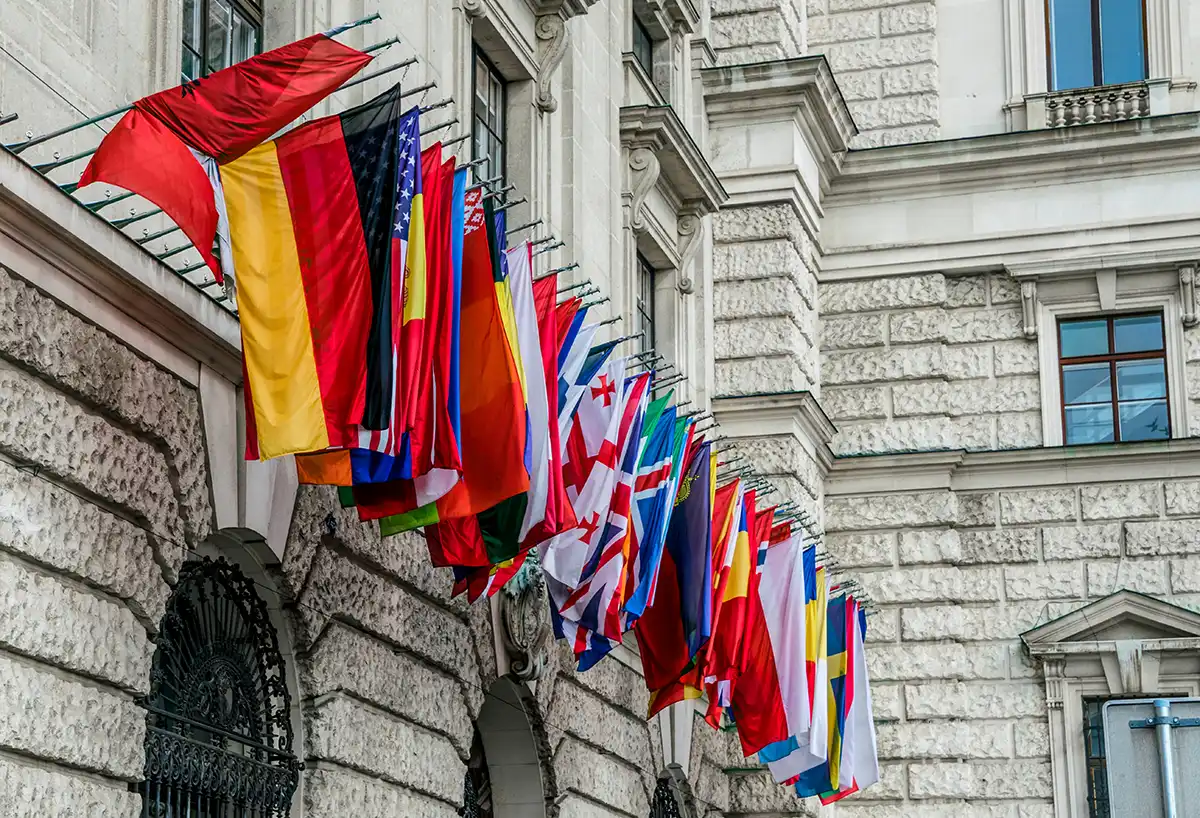
Almost every country with a meaningful foreign-policy footprint runs a diplomatic service of some kind. The US Foreign Service, the FCDO, the Auswärtiges Amt, Switzerland's EDA, Spain's Cuerpo Diplomático, France's Quai d'Orsay, Italy's MAECI, India's IFS, Brazil's Itamaraty, the foreign services of Australia, Canada, Mexico, Argentina and a hundred others — they differ in size, prestige and pay band, but they share something structural. Joining one means agreeing to a working life across five to seven postings, decided largely by the institution, in countries it chooses for you.
Most public conversation about the diplomatic career fixates on one question: what does an ambassador actually earn? That's understandable. Salary information from foreign services is publicly available in most democracies, and the ambassadorial title carries enough prestige that people expect the paycheck to match. The actual answer is more layered. The base salary is rarely the figure the public imagines, the allowance system reshapes the picture in unpredictable ways, and the most important part of the compensation never appears on any government pay table.
That gap between the public image and the actual answer is where this becomes useful for anyone seriously considering — or simply curious about — a diplomatic career: what does an ambassador really earn, and which postings actually shape a foreign service career?
What an ambassador actually earns — across foreign services
Across the major foreign services, the pattern is remarkably consistent. Entry-level diplomats earn somewhere between roughly USD 50,000 and USD 80,000 a year on the home base, depending on country, qualification and step. Solid for a graduate-level civil service entry; well below what an equivalent qualification might attract in elite consulting, in technology or in finance. By mid-career — running embassy sections, leading consulates, holding regional briefs — that base grows into a comfortable senior civil-service range. At ambassadorial level, base pay at major posts generally runs between USD 150,000 and USD 300,000 a year before any allowances, with the very top ranks (Career Ambassador in the US, Permanent Under-Secretary in the UK, Staatssekretär in Germany, the top Lohnklasse in Switzerland, top Verwendungsgruppe in Austria) reaching higher.
What matters as much as the base is what sits on top of it. Every major foreign service operates an overseas-allowance system: cost-of-living adjustments for expensive posts, hardship differentials for difficult ones, danger pay for high-threat or active-conflict postings, housing provided in kind, dependent education paid for, and language incentives for officers who serve in operationally demanding languages. On a hardship post in Khartoum, an evacuated post like Kabul-pre-2021, or a high-cost post like Tokyo or Geneva, the allowance package can substantially exceed the base salary.
But the most interesting part of this compensation does not appear on any pay statement, in any service. The real "pay" of a diplomatic career is something structural: a working life across continents, children who grow up multilingual, the access that comes from representing a country in rooms where bilateral and multilateral decisions are made, and the long-tail influence of having served in places that, decades later, still shape how a foreign-policy community thinks. That form of compensation explains, more than any pay grade in any foreign service, which postings inside a system are genuinely fought over.
- Strategic weight of the receiving country for the sending country's foreign-policy, economic and security interests
- Visibility from the capital — work read by the foreign minister, the prime minister or the head of state accelerates a career
- Quality of life on post: housing, schools, climate, medical access, security, and family fit
- Language and operational complexity — operationally demanding languages bring incentive pay and disproportionate workload
- Hardship and security profile: the harder the post, the higher the allowance, and the more career-shaping the tour

Which postings get fought over in any foreign service rarely comes down to base pay. Mandate, representation, daily life and operational pressure carry far more weight.
LIGHTFIELD STUDIOS / Adobe Stock
China is the single bilateral relationship the rest of US foreign policy now bends around — and the embassy that runs it is one of the most consequential in the world.
If one post inside any major foreign service today functions as a modern prestige indicator, it is the embassy in Beijing. The example most often used — for size, visibility and operational stakes — is the US Embassy in Beijing. The US-China relationship is the file the rest of American foreign policy now organises itself around, and the embassy operates inside that pressure every day, supported by US consulates in Shanghai, Guangzhou, Hong Kong, Chengdu, Shenyang and Wuhan.
What makes a Beijing posting career-defining for diplomats from any major service — American, British, German, French, Swiss, Spanish, Indian or otherwise — is not comfort. Air quality, surveillance pressure on diplomats, restricted mobility, demanding hours dictated by foreign capitals' time zones. It is one of the most operationally taxing capitals in the diplomatic world. But for an officer with the language and the China focus, a tour there reshapes a career trajectory like few other assignments.
China as a country needs little introduction. The civilizational depth, the economic weight, the geopolitical reach. A diplomat who has worked in Beijing — for whichever service — carries a kind of file authority for the rest of their career.
If your country has any global ambition at all, Washington is the embassy you build your senior diplomats around.
Every major foreign service treats its ambassador to the United States as a senior appointment. The German Embassy in Washington is a useful illustration. The transatlantic file — NATO, intelligence cooperation, trade and standards, Ukraine support, climate diplomacy, the technology and standards-setting agenda — all routes through embassies in DC, and the bilateral relationships visible there are typically the most-watched bilateral files in each sending country's foreign-policy community.
For German diplomacy specifically, Washington carries weight that is hard to overstate. Germany's economic and security posture is densely interconnected with American policy. A German Embassy in Washington tour belongs in the same career conversation as a tour in Paris or Beijing — and arguably above either, depending on the file at the moment. Equivalent statements hold for the British, French, Italian, Japanese, Korean, Australian, Mexican and other major ambassadors to the United States.
The cost of the Washington post, for any service, is its density. Visibility from the home capital is constant, the pace is set by Washington's hours, the political tempo of US administrations reshapes the file every four years. But it is precisely that density that makes the Washington post one of the few assignments that almost every major foreign service designs senior careers around.
For a European or near-European country, Paris is one of the most operationally substantive posts the foreign service offers.
Paris is the European post that combines two things rarely in the same place: strategic operational depth, and a quality of life that diplomats and their families can actually enjoy. The British Embassy in Paris is a useful illustration. The UK-France relationship — defence under Lancaster House, intelligence cooperation, climate diplomacy, post-Brexit trade and mobility files — is operationally dense, and the bilateral consular footprint is one of the largest in any European post.
The same shape applies elsewhere. The German Embassy in Paris runs the Franco-German axis on which European integration has rested for sixty years. The Spanish, Italian and Polish embassies in Paris matter for different reasons but share a common feature: the operational reality of a European post that takes the European file seriously. And the destination itself — France — is a place diplomatic families can live well, with cultural depth and short reach to the rest of the continent.
What makes a Paris tour distinctive across foreign services is that it does not force the usual trade-off between career-defining work and family-supporting life. Both can run on a high plane. That combination is rarer than the diplomatic-service brochure usually admits.
Far from the front pages, deeply substantive on intelligence and Pacific files, and one of the most livable assignments any foreign service offers.
The US Embassy in Wellington is one of the most geographically distant tours in the American Foreign Service — and one of the most liveable. The bilateral file with New Zealand does not run on big-headline issues; it runs on the substantive: Five Eyes intelligence cooperation, Pacific Islands strategy, climate and ocean diplomacy, a steady tourist and study flow of citizens in both directions, a deeply aligned democratic partnership.
What Wellington offers — and what equivalent posts in Canberra, Reykjavik or Helsinki offer for other foreign services — is the rare combination of substantive work and high family quality of life. A small walkable capital, clean air, intact natural environment, schools that work for diplomatic families, and a host society generally welcoming to foreign diplomats. For families that want a tour where childhood can have weekends in national parks rather than weekends in motorcades, posts like Wellington are quietly prized.
The trade-off is distance. A return to the home capital is twenty-plus hours of flying, headquarters calls happen at New Zealand night, and major-event participation in the home country requires planning. But the post offers something foreign-service career boards have started to recognise more openly: a tour at a livable, strategically interesting post is not a career detour. It is a chapter in its own right.
An active conflict-zone post, in a country where European and transatlantic foreign policy is concentrated daily.
Any honest answer to what a diplomatic career involves has to include the hardship post. The Swiss Embassy in Kyiv is one example among many: an embassy operating in a country at war since 2022, with reduced staffing, consular services routed via the embassy in Bucharest, and an operational mandate that has expanded — not contracted — under those conditions.
What the hardship post asks of a diplomat is something the comfortable posts don't. Security protocols that govern daily life, family-status restrictions, shortened rotations, and the operational tempo of working under crisis conditions. These tours come with hardship differentials and danger pay in every major service — but the financial premium is the smallest part of what makes them count. They demonstrate that an officer can run a mission under stress, deliver foreign policy when the standard operating environment collapses, and be trusted with the next file at the next level of seniority.
Ukraine also offers something the public conversation about the country tends to flatten. The Carpathian Mountains, the old Black Sea trading and port cities, the cultural depth and literary tradition that long predates the current conflict. Diplomats who serve in Kyiv know a Europe that the Western European imagination too often reduces to the war.
Embassy, consulate and honorary consulate are not the same career experience
Anyone considering a diplomatic career should understand the difference between embassy, consulate and honorary consulate postings. This distinction is consistent across foreign services and matters for what a tour actually means.
An embassy posting concentrates political representation, government-to-government interlocution, and coordination across all sections — political, economic, public affairs, consular, defence. A consulate or consulate-general posting puts an officer closer to consular practice and citizen-services workload and offers a different kind of leadership track. An honorary consulate is something else again — typically a part-time appointment held by a private citizen of the host country, with limited services and no career path inside the sending country's foreign service.
For anyone moving from general interest to concrete career planning, the page on the diplomatic career is a natural next step — across services and across the entry routes they each maintain.
Careers — US Department of State
The official US Foreign Service careers portal. FSO, Foreign Service Specialist, Civil Service tracks; FSOT, Qualifications Evaluation Panel and Oral Assessment process; benefits and pay tables.
Civil Service Fast Stream — UK Diplomatic Service
The main graduate entry route into the UK Foreign, Commonwealth and Development Office. Eligibility, application timeline, and the structure of the FCDO Diplomatic Service career.
Karriere im Auswärtigen Dienst — Auswärtiges Amt
The German Foreign Office's career portal. Higher service (Attaché-Lehrgang in Berlin-Tegel), upper service, and specialist career paths, plus the annual selection process.
Karriere Diplomatie — Schweizer EDA
Switzerland's Federal Department of Foreign Affairs (EDA / FDFA) career page for the diplomatic and consular service. Selection process, training, and a federal wage system spanning 38 wage classes.
“The real compensation in a diplomatic career — in any major foreign service — doesn't appear on any pay table. It shows up in the places you've lived, the relationships you've built, and the question of which postings diplomats actually compete for inside the system when the salary stops being the criterion.”
If the criterion is the bilateral file the rest of foreign policy bends around, Beijing is the clearest case in this selection — for whichever service holds the chair. If the criterion is the post that signals seniority across every foreign-service community, Washington is hard to overtake. If genuine European weight matched to a livable daily life is the priority, Paris carries its own gravity. If quality of life on a distant but strategic file matters more than visibility at the top, Wellington and posts like it have a quietly outsized career value. And if the criterion is the hardship tour that defines a generation of careers, Kyiv is the example this article cannot leave out.
Read this way, the question that started here — what does an ambassador really earn — turns out to be the wrong frame. The right question is which postings a diplomat would actually fight for inside their own foreign service if pay band weren't the criterion. The real compensation of this career is not the monthly base. It is the sum of the places lived, the relationships built, and the rooms where, for a few years at a time, a diplomat was the voice of a country.