Windhoek
Ordna visum vid ankomst- Befolkning:486 169 (2023)
- Yta:5 133 km²
- Höjd över havet:1 650 m
- Tidszon:CAT (UTC+2, no DST)
- IATA:WDH
- Valuta:Namibia Dollar (N$/NAD), pegged 1:1 to the South African Rand (ZAR). Rand circulates and is accepted everywhere; N$ is not accepted in South Africa. ATMs are abundant on Independence Avenue, in the malls (Maerua, Wernhil, The Grove, Town Square) and at the airport. Card payment including contactless is universal.
- Stadsdelar:City Centre (Independence Avenue spine) · Klein Windhoek (restaurant belt) · Eros (older quieter suburb) · Olympia (residential / Austrian honorary consulate)
Översikt
Windhoek is Namibia's quiet, surprisingly green capital — a Wilhelmine-Lutheran spire, a few good restaurants, and the country's only major airport, sitting on a 1 700-metre plateau where every Namibian road trip starts and ends.
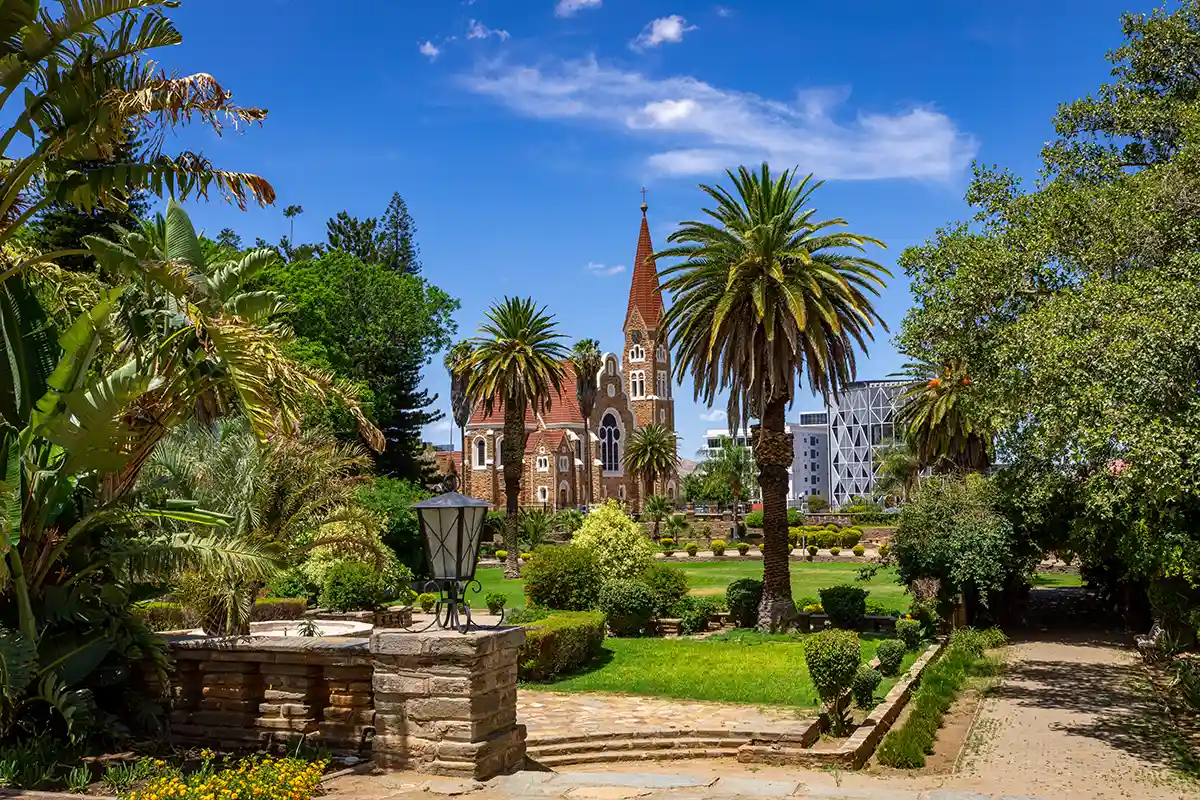
Christuskirche (1907–1910), det tysk-lutherska landmärket i hjärtat av Windhoek, sedd över Tintenpalast-trädgårdarna (parlamentet).
© Curioso Photography / Adobe Stock
Historia
Windhoek's modern history begins in 1840, when the Oorlam leader Jonker Afrikaner settled by the thermal springs and built the first stone houses on the site. The Schutztruppe officer Curt von François re-founded the city in 1890 as the administrative seat of German South-West Africa, building the Alte Feste fort to control the springs. German rule continued until the territory passed to the Union of South Africa in 1915; the South African administration retained the city as the capital of the South-West African mandate, and the Tintenpalast (1913) was completed as the seat of legislative authority. Katutura on the city's western edge dates from a 1959 urban-restructuring period; the Old Location Cemetery is a small memorial site nearby. Namibia became independent on 21 March 1990 after a SWAPO-led independence movement that began in 1966; the Tintenpalast became the seat of the post-independence parliament, the Heroes' Acre south of the city was inaugurated as a national-memorial garden in 2002, and the Independence Memorial Museum was opened on the hill behind the Alte Feste in 2014.
Kultur
Game meat is the city's signature — kudu, oryx (gemsbok), springbok and zebra appear on most serious menus alongside South-African-style braai (barbecue), eisbein (pork knuckle) and schnitzel. Joe's Beerhouse is the iconic full-Namibian-experience restaurant; Leo's at the Castle inside the Heinitzburg is the most atmospheric fine-dining option; The Stellenbosch Tasting Room is the city's serious wine address. The Windhoek Lager and Tafel Lager brewed locally by Namibia Breweries Ltd are the standard everyday beers; the craft-beer scene has emerged around Camelthorn and the Stellenbosch tasting room. Apfelstrudel, Schwarzwälder Kirsch and serious sourdough bread survive from the German colonial period at the Craft Café, the Stellenbosch and any of the half-dozen central Konditoreien. Festivaler: Windhoek Karneval (WIKA, April — German-tradition Mardi Gras), Independence Day (21 March — Heroes' Acre south of the city), Namibian Tourism Expo (May, Windhoek Show Grounds), Heritage Day (4 May — public holiday), Oktoberfest Windhoek (late October — Sport Klub Windhoek). Museer: Independence Memorial Museum, National Museum of Namibia (Owela & Alte Feste sections), TransNamib Railway Museum, Bushman Art Gallery.
Praktisk info
Säkerhet: Generally safe by day; walking the central streets after dark is discouraged. Petty theft (bag-snatching, phone-theft) is the main concern; use Bolt/Lefa after sunset rather than walking. Avoid Katutura at night without a local guide; daytime township tours are well-organised and safe. Standard urban precautions apply. Språk: English is the official language and widely spoken. German is widely spoken in restaurants, banks and the older central businesses (about 30 000 Namibians have German as a first language). Afrikaans is widely understood. Oshiwambo and Otjiherero are heard in Katutura. Valuta: Namibia Dollar (N$/NAD), pegged 1:1 to the South African Rand (ZAR). Rand circulates and is accepted everywhere; N$ is not accepted in South Africa. ATMs are abundant on Independence Avenue, in the malls (Maerua, Wernhil, The Grove, Town Square) and at the airport. Card payment including contactless is universal.
Resa
Windhoek is small for a capital — fewer than 500 000 people in the greater urban area — but it carries an unusual weight in Namibian life. It is the country's only city of any size, the seat of every national institution, the home of the only international airport with intercontinental traffic, and the start and end of nearly every self-drive itinerary in the country. The city sits in a basin on the central plateau at 1 700 metres above sea level, which makes the climate mild and dry year-round: daytime temperatures of 25–30 °C in the dry winter (May–October), warmer summer days with afternoon thunderstorms (December–March), cool nights that can drop below 10 °C even in summer. The architectural personality of the centre is German-Wilhelmine, a Bavarian-spa-town-meets-South-African-modernism that comes from the 1884–1915 German colonial period: the Christuskirche Lutheran spire, the Alte Feste fortress, the Tintenpalast (the 'ink palace' that now houses parliament) and a sprinkling of half-timbered villas in Klein Windhoek. Independence Avenue is the city's main spine, running roughly north-south, with the Independence Memorial Museum on the hill above the old fort and the National Museum (Owela section) and the wide Zoo Park lawn at the centre. The Hosea Kutako International Airport (WDH) is 45 kilometres east of the city — a 35-to-45-minute drive depending on traffic, no rail link, taxis and pre-booked shuttles only. The Eros Airport (ERS) on the south-east edge of the city handles domestic and charter flights to Sossusvlei, the Skeleton Coast and the safari lodges. The food scene runs from the famous Joe's Beerhouse (the country's signature game-meat restaurant) to the more refined Stellenbosch Tasting Room, the Leo's at the Castle wine cellar in Klein Windhoek's Heinitzburg, the Craft Café in the Namibia Craft Centre, and a strong specialty-coffee scene in the southern Klein Windhoek and Eros neighbourhoods. Most visitors spend one or two nights in Windhoek bookending a longer Namibia self-drive — long enough to collect a rental 4x4, recover from a long-haul flight, eat a proper game-meat braai and visit a museum, before driving north to Etosha or south-west to Sossusvlei.
The Wilhelmine Centre: Christuskirche, Alte Feste & Tintenpalast
The hilltop block at the head of Independence Avenue is the densest layer of Wilhelmine-era Windhoek. The Christuskirche (Christ Church) — the brick-and-sandstone neo-Romanesque Lutheran church with its 24-metre spire, designed by Gottlieb Redecker and inaugurated by Kaiser Wilhelm II in 1910 — is the city's most photographed landmark. Across the road, the Alte Feste (Old Fort, 1890) is the original Schutztruppe garrison from which the German colonial occupation was administered; it now houses part of the National Museum collection. Behind the Alte Feste, the Tintenpalast (Ink Palace, 1913) — the elegant low building that houses Namibia's parliament — sits in the Parliament Gardens (sometimes still called the Tintenpalast Gardens), one of the loveliest small public parks in southern Africa, with mature palms, an art-nouveau lamp grid and one of the city's two equestrian statues. The Independence Memorial Museum (the unmistakable golden-glass tower opened in 2014) rises above the colonial-era buildings on the same hill, presenting the country's pre-colonial, colonial and independence histories across five floors — its rooftop café offers the best panoramic view of the city.
Independence Avenue, Zoo Park & the Modern Centre
Independence Avenue (the former Kaiserstrasse, renamed at independence in 1990) is Windhoek's main commercial spine. The pedestrianised southern stretch runs past the Zoo Park (a green block of lawn and acacias that is the centre's main meeting place — the Stone Age elephant skeleton uncovered in the 1960s is marked with two small sculpted elephants on the lawn), the Bundeshalle and Sanlam Centre office towers, the Wernhil Park shopping centre and the post office. The Town House, Windhoek's city hall, sits in front of the Zoo Park. The Goethe-Institut Namibia and the bigger book shops (Book Den, Logos) are on the eastern side streets. Independence Avenue runs north past the Khomasdal turn-off and south past Mandume Ndemufayo Avenue to the township of Katutura — the original urban-segregation displacement zone created in 1959, today the demographic majority of the city.
Independence Memorial Museum & National Museum
The Independence Memorial Museum — a five-storey gold-and-glass tower built by a North-Korean studio and opened in 2014 — is the city's flagship museum. The collection covers Namibia's pre-colonial, colonial and modern history across five floors, from Khoekhoegowab and Bantu-speaking societies through the German colonial period (1884–1915), the South African mandate to 1990, and the road to independence. The displays are open and well-curated; the upper floors include a panoramic café with a view across the city. The Owela section of the National Museum of Namibia, a few blocks south, focuses on ethnology and traditional material culture. The Alte Feste section, in the old fort, holds the military and colonial-period collections. The TransNamib Railway Museum at the train station is a smaller curiosity for railway enthusiasts.
Klein Windhoek, Olympia & the Suburban Restaurant Belt
Klein Windhoek and Olympia are the leafy residential neighbourhoods east and south of the centre, climbing the hillsides above the Klein Windhoek River. They concentrate Windhoek's better restaurants, several boutique guesthouses, and the city's wine and craft-beer scene. Joe's Beerhouse on Nelson Mandela Avenue is the unmissable Namibian institution — a maze of timber-and-thatch rooms decorated with rifles, oxen horns and aircraft propellers, serving game meat (kudu, oryx, springbok, crocodile, zebra), pork knuckle, schnitzel, and Windhoek Lager from giant boots. The Stellenbosch Tasting Room is the more refined wine-and-tasting-menu alternative on Jan Jonker Road. Leo's at the Castle inside the Heinitzburg (one of three small 'castles' built by Count von Schwerin in the 1910s — now a small boutique hotel) is the city's most atmospheric fine-dining room. Hilltop Guesthouse, Galton House and the Heinitzburg are good central-suburb places to stay; the Olive Grove and Vondelhof are quieter Eros-neighbourhood alternatives.
Namibia Craft Centre, Penduka & the Market Day
The Namibia Craft Centre, in the historic Old Breweries Building on Tal Street, is the city's central crafts hub — fifty-plus stalls organised by region and craft type, selling Owambo basketry, Himba leather and ochre body-creams, Namibian gemstones, San (Khoisan) ostrich-egg-shell jewellery, soapstone and wirework, and contemporary Namibian art. The Craft Café in the same building is the city's nicest courtyard café and the venue from which the Swiss Honorary Consulate operates. Penduka (a women's craft cooperative on the western edge of the city, on the Goreangab Dam) is the more rural-experience option — a longer drive out but a different kind of stop, with women weaving on the porch and a small lakeside café. The Old Location Cemetery near Penduka is one of the country's most important memorial sites — the burial ground for the 1959 Katutura forced-relocation victims. Bushman Art Gallery and the Karakulia Weavery in town complete the city's serious-craft circuit.
Day Trips: Daan Viljoen, Avis Dam & the Khomas Hochland
Windhoek's immediate hinterland is the Khomas Hochland — the mountainous plateau that surrounds the city on all sides — and offers a handful of half-day options. The Daan Viljoen Game Reserve, 24 km west of the city on the C28 toward Swakopmund, is a small National Park inside the Khomas highlands with springbok, kudu, blue wildebeest, eland and giraffe; the loop drive and the Wag-'n-Bietjie hiking trail make a relaxed half day, and the simple Sun Karros chalets are an alternative first or last night to staying in the city. The Avis Dam on the eastern edge of the city is the local cycling and birdwatching reservoir — a 2-hour loop on bicycle or foot is a good morning. The C26 west toward Swakopmund passes through the Bosua Pass, an impressive gravel descent through the Khomas highlands that ends 4–5 hours later at the Atlantic — many Windhoek-to-Swakopmund drivers take it as an alternative to the faster B2 tar road. The Heja Lodge area south of the city (the Auas Mountains) offers eland and the Auas hiking trails. The Aris Hot Springs 35 km south on the B1 are a less-developed alternative to the Erongo's better-known thermal pools.
Hosea Kutako Airport, Eros Airport & Getting In and Out
The Hosea Kutako International Airport (WDH) is 45 km east of central Windhoek on the B6 — a 35–45 minute drive depending on traffic. There is no rail or scheduled bus link; all transfers are by taxi (around N$ 500–600 fixed-rate one way), pre-booked shuttle (cheaper, around N$ 250–350), or rental car. Most visitors collect their 4x4 rental at the airport and drive in. The airport has a fixed-rate taxi rank, basic duty-free, a couple of cafés and a single coffee bar in the arrivals hall; the international departures area has more substantial seating. The Eros Airport (ERS) on the south-east edge of the city handles domestic flights — the scheduled Air Namibia services have ended, but Westair Aviation and FlyNamibia operate to Walvis Bay, the safari lodges, Sossusvlei and the Skeleton Coast. The TransNamib railway runs night trains from Windhoek to Walvis Bay and Keetmanshoop, but they are slow, irregularly maintained, and used almost exclusively by Namibian passengers; tourists rarely take them. Long-distance buses (Intercape) run from Windhoek to Cape Town, Johannesburg and Victoria Falls — a viable budget option for overland travellers.
Practical Windhoek — Money, Safety, Connectivity
Windhoek is safe by Southern-African standards but not as safe as a European capital. The centre is fine during the day; opportunistic crime (bag-snatching, phone theft) is the main concern, and walking the centre after dark is discouraged in favour of taxis (Bolt operates in Windhoek as 'Lefa'). The Katutura township is generally safe to visit on a guided township tour during the day, less so independently and at night. ATMs are abundant on Independence Avenue, in the malls (Maerua, Wernhil, The Grove, Town Square) and at the airport — both N$ and ZAR work everywhere. Card payment including contactless is universal in the centre, in restaurants, fuel stations and the malls. Mobile data on MTC and Telecom Namibia is reliable in the city; pre-paid SIMs are sold at the airport (Vehicle 1 or Vehicle 2 doors) and in the MTC shops in the malls. The city operates almost entirely in English; German is widely spoken in restaurants, banks and the older central businesses; Afrikaans is the dominant first language for many Coloured and white Namibians; Oshiwambo and Otjiherero are widely heard in Katutura. The Hosea Kutako International Airport is in the Khomas region but the Eros Airport is technically within Windhoek city limits — both are referred to colloquially as simply 'the airport' depending on context.
Transport och flygplatser
Information for Namibia's primary international gateway (45 km east of central Windhoek) — flight schedules, terminal information, ground-transport options.
Namibia's national railway. Night trains from Windhoek to Walvis Bay and Keetmanshoop — slow, irregular and used mainly by Namibian passengers, but a viable budget alternative for the patient.
Turism och resmålsguider
Official destination marketing organisation. Trip-planning resources, registered-operator directories, festival calendar, and the e-Travel portal for permits.
Bookings for the state-run rest camps inside the national parks — Sesriem (Sossusvlei), Okaukuejo, Halali and Namutoni (Etosha), Hardap, Ai-Ais and others. Books up to 11 months ahead.
Diplomatiska beskickningar i Windhoek
17 beskickningar i den här staden, grupperade efter region.
Europa11
- Austrian Honorary Consulate in Windhoek
- Royal Danish Honorary Consulate in Windhoek
- French Embassy in Windhoek
- German Embassy in Windhoek
- Italian Honorary Consulate-General in Windhoek
- Royal Norwegian Consulate General in Windhoek
- Portuguese Embassy in Windhoek
- Spanish Embassy in Windhoek
- Sveriges Honorärkonsulat i Windhoek
- Swiss Honorary Consulate in Windhoek
- British High Commission in Windhoek
Använd den här Visaja-sidan som utgångspunkt och kontrollera gällande regler direkt hos den officiella källan innan du ansöker.