New York City
- Population:~8.3M (city), ~19.5M (NYC metropolitan area / Tri-State)
- Timezone:ET/EDT
- IATA:NYC
- Currency:USD, with card and contactless payment accepted essentially everywhere — a visitor can go a whole trip without cash. Two local mechanics catch people out: sales tax is added at the register rather than included in the displayed price, and tipping is expected at table service, in bars and in taxis rather than optional. Both belong to the money guide's territory. On cash, the corner-store ATMs in bodegas charge noticeably more than bank-branch machines, so use a bank ATM if you need notes.
- Key Areas:Midtown Manhattan / Times Square · Lower Manhattan / Financial District · Greenwich Village and SoHo · Upper East Side / Museum Mile
Overview
New York City is the largest city in the United States and one of the world's defining metropolises — five boroughs of just over eight million people, 800+ languages, and the country's primary financial, media, fashion, theatre, contemporary-art and immigration capital. Manhattan's grid and skyline, the Statue of Liberty, Central Park, Times Square, Broadway and the Met combine into a single cultural destination matched only by London, Paris and Tokyo in global recognition.
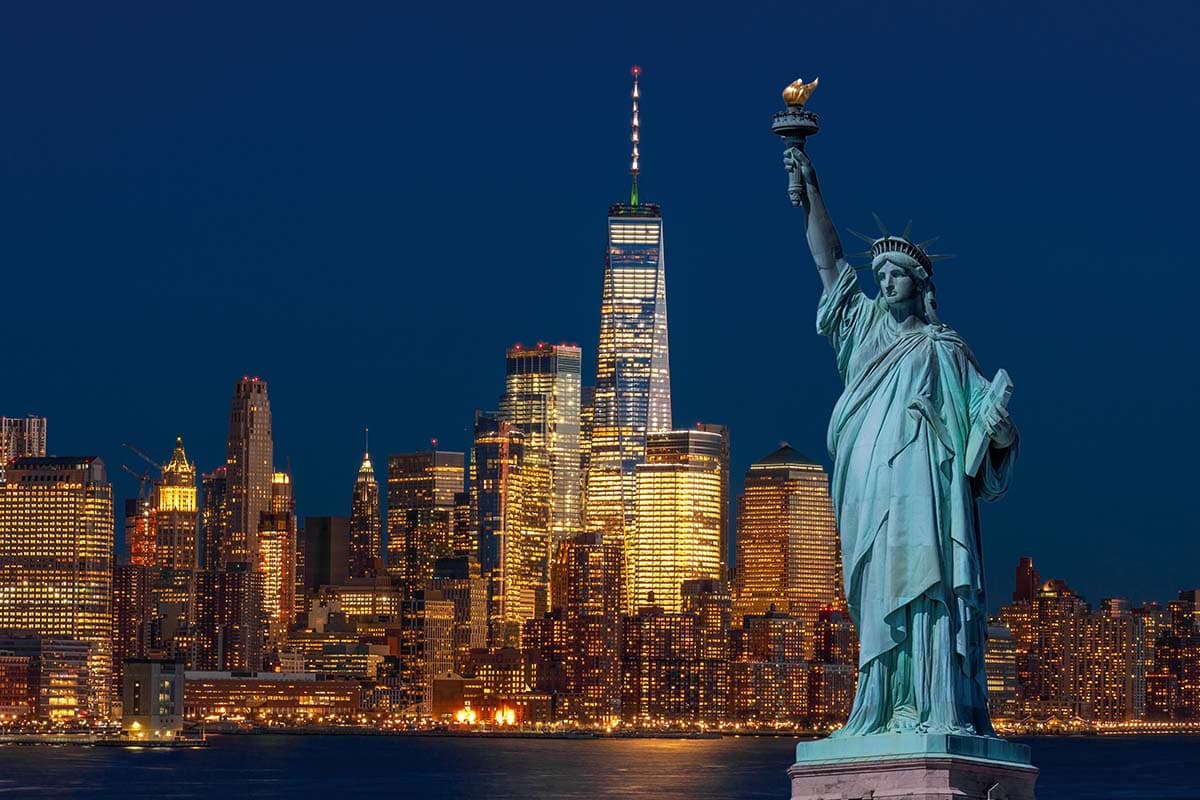
Liberty Island and the downtown skyline — the harbor view that announces New York.
History
New York City was founded as the Dutch trading post New Amsterdam on the southern tip of Manhattan in 1624; the English captured it in 1664 and renamed it New York after the Duke of York. The city served as the first capital of the United States from 1785-1790 — Federal Hall on Wall Street is where George Washington was inaugurated as President in 1789. The 19th century brought explosive growth: the Erie Canal opened in 1825 connecting New York Harbor to the Great Lakes and making New York the dominant American port; Castle Garden and later Ellis Island processed millions of European immigrants; the 1811 Commissioners' Plan imposed the Manhattan grid above 14th Street; Central Park opened in 1857-1873; the Brooklyn Bridge in 1883; the consolidation of the five boroughs into the modern city took effect on 1 January 1898. The 20th century brought the skyscraper (the Flatiron in 1902, the Woolworth in 1913, the Chrysler and Empire State in 1930-1931), the subway (1904), the Harlem Renaissance, the Great Depression and the Stonewall Riots that began the modern LGBTQ+ rights movement on Christopher Street in 1969. The 9/11 attacks in 2001 destroyed the original Twin Towers; the rebuilt One World Trade Center opened in 2014. The post-pandemic recovery has reshaped Midtown office demand and accelerated outer-borough growth, but New York remains the country's principal financial, media, fashion, theatre and immigration capital.
Culture
New York's signature foods include the New York-style thin-crust pizza (Lombardi's, Joe's, Di Fara), the everything bagel with lox and cream cheese (Russ & Daughters on the Lower East Side, Ess-a-Bagel), the pastrami sandwich on rye at Katz's Delicatessen (in business since 1888), the New York-style cheesecake (Junior's), the cheap corner-slice tradition, and the halal-cart chicken-and-rice plate that feeds the city's night shift (the carts at 53rd and 6th the most famous). The diaspora cuisines are deep: Flushing Chinatown for Sichuan, Cantonese, Korean and Taiwanese; Jackson Heights for South Asian and Latin American; Arthur Avenue in the Bronx for Italian-American; Brighton Beach for Russian and Ukrainian. Smorgasburg's open-air food market in Williamsburg (Saturdays) and Prospect Park (Sundays) showcases independent food vendors. Eataly Flatiron and the Chelsea Market are upscale food halls; the city's Greenmarket farmers' markets (Union Square Wednesdays/Fridays/Saturdays the largest) anchor the local-food scene. Festivals: Tribeca Festival (June), US Open tennis (late August - early September), New York City Marathon (first Sunday of November), Macy's Thanksgiving Day Parade (fourth Thursday of November), New Year's Eve Times Square Ball Drop (31 December), Restaurant Week (winter and summer), Lunar New Year in Manhattan and Flushing Chinatown (January-February), Mermaid Parade at Coney Island (June). Museums: Metropolitan Museum of Art (the Met), Museum of Modern Art (MoMA), American Museum of Natural History, Solomon R. Guggenheim Museum, Whitney Museum of American Art, Frick Collection, Brooklyn Museum, 9/11 Memorial and Museum, Tenement Museum.
Practical Info
Safety: New York is generally safe in tourist zones (Times Square, Central Park, Museum Mile, the Financial District, Brooklyn Heights/DUMBO, the High Line). The subway is patrolled and well-used; standard precautions on late-night trains and in less-trafficked stations. Property crime (pickpocketing, phone snatching) is the main concern in tourist density. Outer borough neighbourhoods vary; check the area for late-night travel. Emergency: 911. Subway emergencies: text 911 or use the in-train help points. Language: English. Spanish is the second-most-spoken language (Salvadoran, Dominican, Puerto Rican, Mexican and Colombian communities in particular); Mandarin and Cantonese in Manhattan and Flushing Chinatowns; Russian in Brighton Beach; Bengali, Hindi and Punjabi in Jackson Heights; Korean in Manhattan's K-Town (32nd Street) and Flushing; Arabic in Bay Ridge (Brooklyn) and Astoria. The city counts over 800 languages spoken at home — the most of any city anywhere. Currency: USD, with card and contactless payment accepted essentially everywhere — a visitor can go a whole trip without cash. Two local mechanics catch people out: sales tax is added at the register rather than included in the displayed price, and tipping is expected at table service, in bars and in taxis rather than optional. Both belong to the money guide's territory. On cash, the corner-store ATMs in bodegas charge noticeably more than bank-branch machines, so use a bank ATM if you need notes.
Travel
New York holds more world-class institutions than any trip can get through, so the only useful skill here is choosing. The city is five boroughs consolidated in 1898 — Manhattan, Brooklyn, Queens, the Bronx and Staten Island — with something over eight million people inside the line and nearly twenty million across the wider region, and it rewards depth in one or two layers far more than a sprint across all of them. Two pieces of geography make it manageable. The first is the grid: the 1811 street plan above 14th Street means most of Manhattan can be navigated without a map, while the older tangle south of Houston Street — SoHo, the Village, the Financial District — is where the city looks its age. The second is the subway, which runs all night and reaches everywhere, and which is the single reason a visitor can treat the whole city as available rather than choosing a base and staying near it. What you choose between is unusually stark: a skyline with several of the best observation decks in the world; a museum concentration on one Fifth Avenue mile that would be a national collection anywhere else; the country's most prestigious commercial theatre; a harbour holding both the Statue of Liberty and the memorial at the World Trade Center; and four outer boroughs whose neighbourhoods and food are, for many returning visitors, the actual reason to come back. Four days covers the icons. A week starts to reach the city underneath them.
Midtown Manhattan from 14th to 59th Street is the city's commercial and visual core, anchored by the supertall towers and the most-visited public spaces. The Empire State Building (381 m, completed 1931 in just over a year, formerly the world's tallest from 1931-1970 and again 2001-2012 in NYC) operates two observation decks — the 86th-floor open-air deck and the 102nd-floor enclosed deck — with timed-entry tickets via empirestatebuilding.com strongly recommended to skip queues. Top of the Rock at Rockefeller Center (260 m, three open observation levels) gives the Empire State Building itself in the foreground; Edge at Hudson Yards is a glass-floored cantilevered platform at 30 Hudson Yards. The skyline above Midtown has changed shape in the last decade as a generation of pencil-thin supertalls went up along and near 57th Street — One Vanderbilt at 427 m beside Grand Central and Central Park Tower at 472 m among them — which is why the view from any of the decks looks different from the postcards most visitors arrive holding. Times Square at Broadway and Seventh Avenue (42nd-47th Streets) is the global icon of commercial neon and around 50 million annual visitors; the surrounding Theater District holds the 41 Broadway theatres that define mainstream American commercial theatre. Grand Central Terminal's main concourse with the celestial-mural ceiling and Beaux-Arts marble staircases is open to all (no ticket required). The New York Public Library's Stephen A. Schwarzman Building on Fifth Avenue with the lions Patience and Fortitude, the Rose Reading Room, and the periodic Gutenberg-Bible-grade exhibitions, sits one block from Bryant Park's seasonal ice rink and outdoor reading room. The Chrysler Building's stainless-steel 1930 Art Deco crown remains New York's most beautiful skyscraper to most architectural critics, though its lobby is the only publicly accessible part. Rockefeller Center's December tree lighting and the Saks Fifth Avenue light show across the street draw the season's largest crowds.
Frequently asked questions
Transport & airports
Metropolitan Transportation Authority's official site. Subway, bus, Long Island Rail Road and Metro-North timetables and live status, the OMNY contactless-payment system that has replaced the MetroCard, trip planner, and the AirTrain JFK and AirTrain Newark connections.
Port Authority of New York and New Jersey portal covering the three NYC-region airports — John F. Kennedy International (JFK), LaGuardia (LGA, rebuilt 2022) and Newark Liberty International (EWR) — with flight information, AirTrain links, terminal maps, parking, ground transport and traveller advisories.
Culture & festivals
Official site of the Metropolitan Museum of Art. Plan-your-visit information for the Fifth Avenue main building, the Met Cloisters in Fort Tryon Park (medieval art), special-exhibition timed tickets and the New York State residents' pay-what-you-wish admission.
Official site of MoMA. Plan-your-visit, the rotating-collection guide, special-exhibition booking, the Friday-evening UNIQLO free admission programme (advance reservation strongly recommended), and the MoMA PS1 Queens contemporary outpost in Long Island City.
Broadway League ticket portal — current Broadway shows, official seat maps and direct-from-box-office purchase, plus the TKTS same-day-discount booth schedule at Duffy Square in Times Square (typically 30-50 percent off, queues from late morning for evening performances).
Official government sites
Official portal of the City of New York. Resident services, business licensing, the 311 service-request system, public safety, parks, transportation and the directory of NYC government agencies covering all five boroughs.
National Park Service site for the Statue of Liberty and Ellis Island. Statue Cruises ferry booking from Battery Park, pedestal and crown reservation (weeks ahead in summer), and the National Museum of Immigration on Ellis Island.
Diplomatic missions in New York City
15 embassies based in this city, grouped by region.
This overview comes from Visaja's worldwide missions database (visaja.com), checked against official government sources; for binding answers, the mission itself always has the final word.