
Food guide
Eating Peru: Three Larders and Two Immigrant Cuisines
Peru's reputation as one of the world's great food countries arrived quickly and from a standing start, and visitors often assume it is a matter of fashion. It is not. It rests on two structural facts that took centuries to assemble: a country that contains three entirely separate growing environments within its own borders, and a history of immigration that produced two complete cuisines with their own names, their own restaurants and their own place in ordinary life. Understanding both explains almost everything on a Peruvian menu.
Updated 2026-08-15
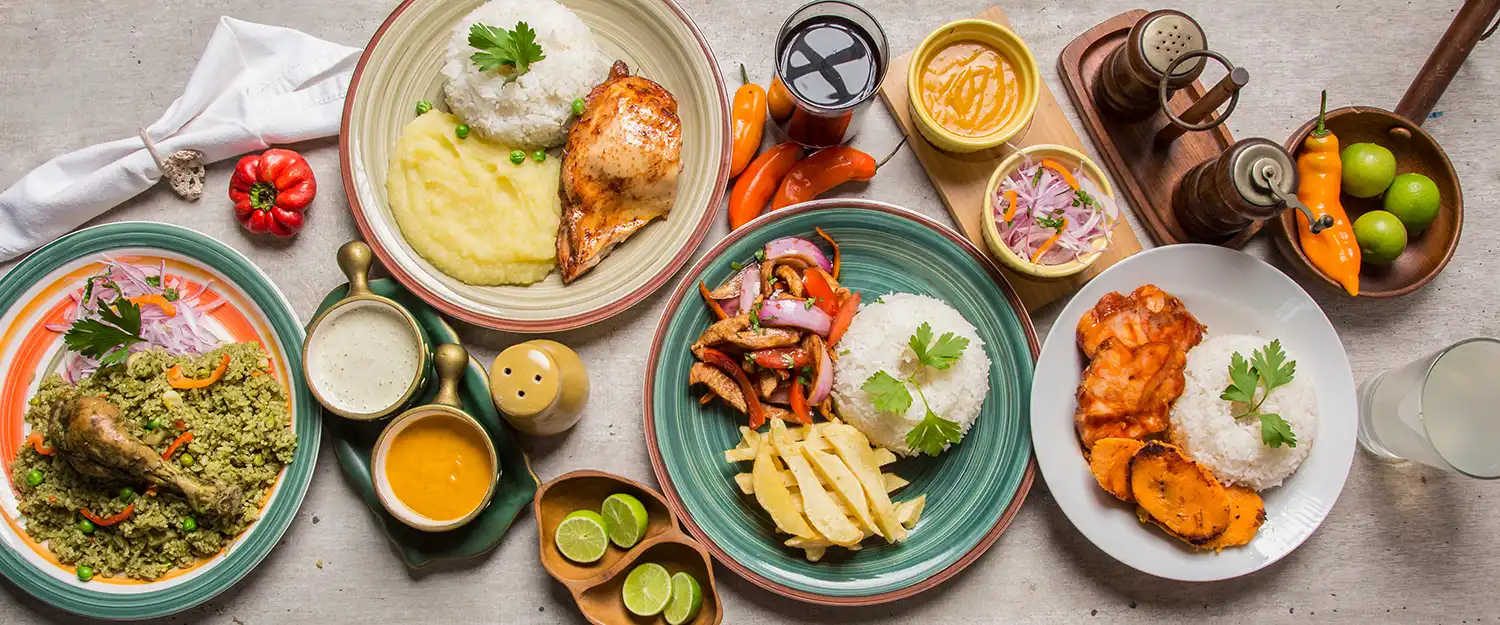
A Peruvian spread: ceviche, causa and cancha — the coastal kitchen at work.
© natrocfort / Adobe Stock
Three larders in one country
Peru is a coastal desert, a high mountain range and a third of the Amazon basin, and each supplies a completely different set of ingredients. The coast is the surprising one: a cold current runs north along this shore, pushing deep nutrient-rich water to the surface, and the result is one of the most productive fisheries on the planet. That is the entire reason a desert coastline became a seafood culture — the desert is above the water, and the water is extraordinarily full.
The mountains supply the starches and the grains, and do it at altitudes where almost nothing else grows: potatoes, maize in dozens of forms, quinoa and its relatives, and the tubers that never travelled abroad. The Amazon adds river fish, palm fruits, and a range of produce that remains largely unknown outside the country and is increasingly the frontier of Peruvian restaurant cooking.
The practical consequence for a visitor is that Peru does not have one national cuisine so much as three regional ones that trade with each other, and a dish's home region tells you a great deal about it. Fish preparations belong to the coast, hearty stews and roasts to the highlands, unfamiliar fruits and river fish to the jungle. Eating well here means eating regionally rather than looking for a single national dish everywhere.
Ceviche is chemistry, not marinade
The dish everyone comes for is more interesting than its description suggests. Ceviche is raw fish cut into cubes and dressed in lime juice with chilli, onion and salt — and the lime is not flavouring it, it is denaturing it. Acid unfolds the proteins in the fish in much the same way heat does, which is why the flesh turns opaque and firms up without ever meeting a pan. It is a chemical cook rather than a metaphorical one.
The crucial thing to know is that modern Peruvian ceviche is a matter of minutes, not hours. The older style left fish in acid long enough to firm through completely; the contemporary version dresses it moments before serving so the outside is cured and the centre is still translucent and soft. The liquid left in the bowl afterwards, sharpened with chilli and fish juices, is called leche de tigre and is drunk on its own, sometimes as a small glass alongside — it is the best part and it is often thrown away by visitors who do not know.
Two conventions follow from the freshness. Ceviche is a lunchtime dish, and a place serving it late in the evening is not working with fish that came in that morning — this is why the best ceviche restaurants close in the afternoon, which reads as inconvenience and is actually a quality signal. And it comes with fixed companions that are not garnish: sweet potato to balance the acid, a large-kernelled boiled corn, and toasted corn for crunch. Eat them together rather than around them.
The potato, and farming a mountain vertically
The potato is native to this region and the scale of what exists here is difficult to convey to anyone who has only met a handful of supermarket varieties. Peru holds thousands of distinct types — different colours, textures, sizes, uses and growing altitudes, many of them local to a single valley — and a highland market stall will carry more genuine potato diversity than most countries possess in total.
That diversity is not decorative; it is a farming strategy. Andean agriculture works vertically rather than horizontally, because a mountainside offers many different climates stacked within walking distance of each other. A single family may work plots at several altitudes at once, growing different crops and different varieties at each — maize low down, potatoes higher, hardy tubers and grazing higher still. Frost, hail, drought and blight tend to strike one band rather than all of them, so spreading the planting across altitudes spreads the risk. It is a sophisticated agricultural insurance system worked out over millennia, and it is the reason the variety exists at all.
The technique that follows from it is worth trying at least once. At high altitude, nights freeze and days are intensely sunny, and highland communities have long used that daily cycle to preserve potatoes — freezing them overnight, treading out the water by day, and repeating until what is left is a light, hard, indefinitely storable product called chuño. It is genuine freeze-drying, invented centuries before the industrial version, and it turns up in highland stews with a texture and taste that will not remind you of a potato at all.
Chifa and Nikkei: two cuisines with their own names
Chinese labourers began arriving in Peru in large numbers from the middle of the nineteenth century, and Japanese immigration followed from the end of it. Both communities cooked, both adapted to local ingredients, and both produced something that is neither the original nor simply Peruvian. The telling detail is that each ended up with its own name — this is not described here as fusion, because Peruvians do not experience it as fusion. It is chifa, and it is nikkei, and both are ordinary.
Chifa is the everyday one and it is everywhere: Peruvian-Chinese restaurants in every town, cooking a repertoire that has been in the country for a century and a half. Its greatest contribution is a beef stir-fry with onion, tomato and soy served with both rice and chips — the two starches together are the joke and the point — which has escaped the chifa restaurant entirely and become one of the dishes Peruvians eat most. If you order one Peruvian dish that is not ceviche, order that.
Nikkei is the more recent influence and the one that shaped the country's restaurant reputation abroad. Japanese technique applied to Peruvian ingredients produced, among other things, a dish of sliced raw fish dressed in a chilli-citrus sauce — recognisably related to both sashimi and ceviche and identical to neither. The precision of Japanese fish handling met a coastline with extraordinary fish, and modern Peruvian fine dining is substantially built on what came out of that meeting.
What to actually order
Beyond ceviche and the stir-fry, a short list covers most of what makes Peruvian food distinctive. Ají de gallina is shredded chicken in a thick, mild, yellow-chilli and walnut sauce — comfort food, and the yellow chilli that defines it appears everywhere here. Causa is cold pressed potato, coloured and flavoured with the same chilli, layered with chicken or seafood like a terrine, and is a good demonstration of what the potato does in this cuisine beyond being a side. Anticuchos are skewers of beef heart marinated and grilled over charcoal, sold on evening streets, and better than the description suggests to anyone hesitant about offal.
In the highlands, look for rocoto relleno — a fiercely hot round chilli stuffed with meat and cheese and baked — and for pachamanca, which is meat, potatoes and beans cooked in a pit with fire-heated stones and covered with earth and leaves. Pachamanca is an occasion rather than a menu item and is worth going out of your way for.
Cuy — guinea pig — should be addressed plainly rather than either hidden or sensationalised. It is a domestic food animal that has been raised in Andean households for thousands of years, it is normal, and it is served whole and roasted at highland celebrations and in restaurants that specialise in it. It is also entirely reasonable to decline, and nobody will press you. What is not reasonable is treating it as a stunt, which is a way of being rude to a culture while eating its food.
Drinking, and the shape of a Peruvian meal
The national drink is a sour made from pisco, an unaged grape spirit distilled here since the sixteenth century, shaken with lime, sugar and egg white. Pisco is worth understanding a little: it is distilled from specific grape varieties, never diluted after distillation and never aged in wood, which is why it tastes of grape rather than of barrel. Neighbouring Chile makes a spirit of the same name by different rules, and which country's is the real thing is a long-running argument you can enjoy without settling.
Non-alcoholic drinking is more interesting than in most countries. Chicha morada is made from purple maize boiled with pineapple, cinnamon and clove, served cold, deep violet and mildly spiced — it is the everyday soft drink and it is genuinely good. Chicha de jora is a different thing entirely: a lightly fermented maize beer of great antiquity, still made and drunk in highland villages, and traditionally advertised by a red flag or a plastic bag on a pole outside the house that is selling it. There is also a bright yellow national soft drink of ferocious sweetness that outsells the global brands here, which is a rare enough achievement to be worth a sip.
Two practical notes. The set lunch served almost everywhere — several courses, aimed at local workers, ordered by pointing at a board — is the country's most reliable eating and the fastest way into ordinary food. And altitude blunts appetite: in Cusco or Puno you will want less than you expect for the first day or two, which is normal, and eating light and often is better than forcing a large meal. Vegetarians do reasonably well given the potato, maize and bean foundations, but should ask directly about stock and lard rather than assuming a vegetable dish is meat-free.