Guangzhou
Get your digital arrival card- Population:18.7M (2020)
- Area:7,249 km²
- Elevation:21 m
- Timezone:CST (UTC+8)
- IATA:CAN
Overview
Guangzhou (Canton) is southern China's great metropolis — the birthplace of Cantonese cuisine, host of the world's largest trade fair, and a subtropical city where morning dim sum, Pearl River night cruises, and two thousand years of maritime trading history define daily life.
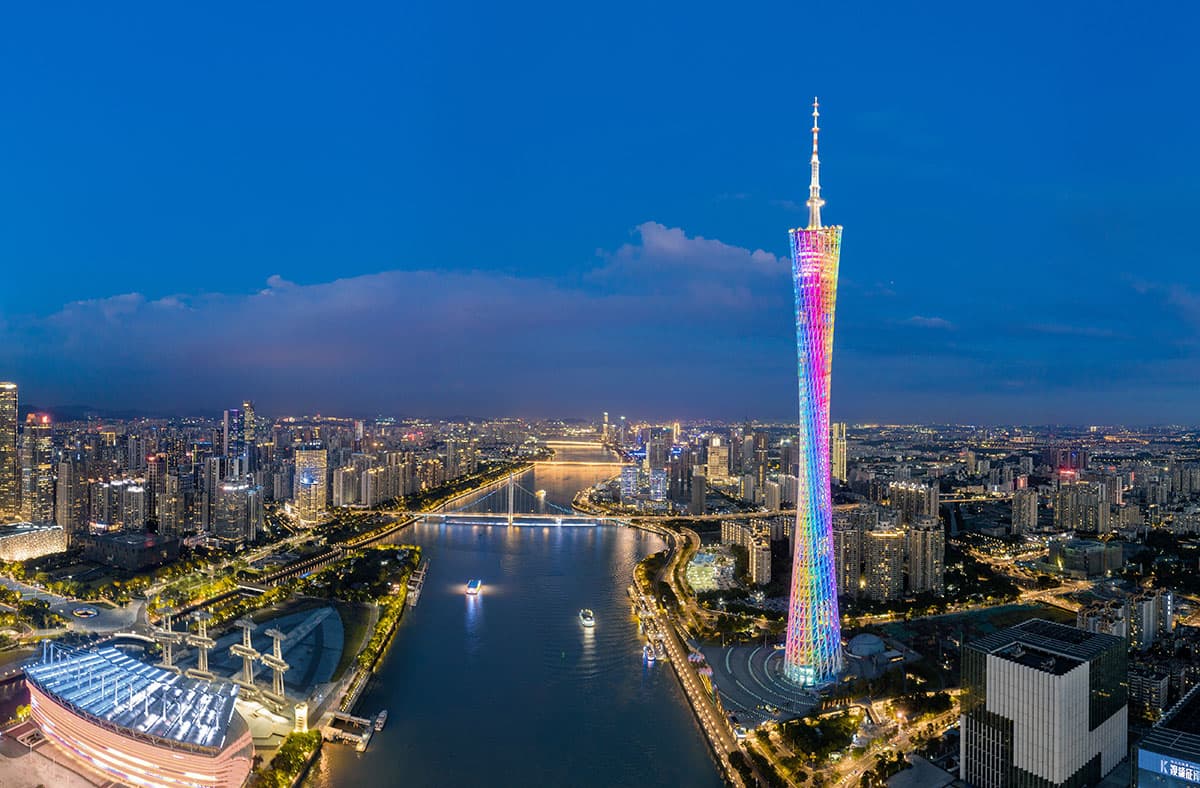
The Pearl River front — Guangzhou's modern face above China's oldest trading river.
© Weiming / Adobe Stock
Travel
Guangzhou invented dim sum, and the morning yum cha ritual — ordering steamer baskets of har gow, siu mai, char siu bao, and cheung fun from trolleys wheeled between crowded round tables — remains the city's defining cultural experience. Beyond the breakfast table, Guangzhou is a 2,200-year-old trading city that was China's primary point of contact with the outside world for centuries: the Maritime Silk Road began here, Arab traders settled in the Tang dynasty, and the Canton System (1757-1842) funnelled all Chinese foreign trade through the Thirteen Factories on the Pearl River bank. Today the Canton Fair (China Import and Export Fair), held each spring and autumn, is the world's largest trade fair by exhibition space and visitor numbers, attracting hundreds of thousands of international buyers. The Chen Clan Ancestral Hall (Chenjiaci), an ornate Qing-dynasty academy dripping with carved wood, brick reliefs, and ceramic ridge decorations, is the finest example of Cantonese decorative architecture. The Pearl River (Zhujiang) night cruise floats past the illuminated Canton Tower (600 metres, with an outdoor observation deck and the world's highest Ferris wheel-style ride), the Haixinsha Island stage, and the glittering Zhujiang New Town CBD. Shamian Island, the former British and French concession, preserves tree-lined avenues and colonial facades in a tranquil pocket. Guangzhou's subtropical climate means lush parks year-round — Baiyun Mountain, Yuexiu Park with its Five Rams sculpture (the city symbol), and the landscaped banks of the Liwan Lake offer green escapes from the urban intensity.
Dim Sum & Cantonese Cuisine
Guangzhou is where Cantonese cuisine — widely regarded as China's most refined regional cooking tradition — originated and continues to evolve. The yum cha (morning tea) ritual is the essential Guangzhou experience: arrive at a teahouse by 7 AM, order pot after pot of chrysanthemum or pu'erh tea, and select bamboo steamers from passing trolleys or a tick-box menu card. The classics are definitive here: har gow (translucent shrimp dumplings), siu mai (pork and shrimp dumplings), char siu bao (barbecue pork buns), cheung fun (rice noodle rolls), and fung zao (phoenix claws — braised chicken feet). Dian Du De, Guangzhou Restaurant (Guangzhou Jiujia), and White Swan Hotel's Jade River are among the institutions. Beyond dim sum, Guangzhou's food culture encompasses roast meats (char siu pork, roast goose, crispy pork belly hanging in shop windows across the city), wonton noodle soup, congee breakfast culture, clay pot rice (bao zai fan), and snake soup in the cooler months. The Shangxiajiu pedestrian street and Enning Road old quarter concentrate street food stalls and traditional eateries.
Chen Clan Academy & Historical Guangzhou
The Chen Clan Ancestral Hall (Chenjiaci), built between 1890 and 1894, is Guangzhou's architectural masterpiece — a sprawling complex of nineteen buildings connected by courtyards, every surface covered with carved granite, brick sculptures, wood carvings, ceramic ridge figures, and iron castings in a dizzying display of Cantonese decorative arts. Now the Guangdong Folk Art Museum, it houses collections of ivory carving, embroidery, and Shiwan pottery. The Temple of the Six Banyan Trees (Liurong Temple), founded in 537 AD, centres on the 57-metre Flower Pagoda — Guangzhou's most venerable Buddhist monument. The Huaisheng Mosque, believed to date from 627 AD, is one of the oldest mosques in China and evidence of Guangzhou's centuries-old Arab trading community. The Museum of the Mausoleum of the Nanyue King preserves the 2,100-year-old tomb of a Nanyue kingdom ruler with jade burial suits and thousands of artefacts. These historical layers — Nanyue kingdom, Tang-dynasty trade port, Qing-dynasty merchant city — give Guangzhou a depth that its modern construction boom tends to obscure.
Pearl River Night Cruise & Canton Tower
The Pearl River (Zhujiang) night cruise is Guangzhou's most popular evening activity — boats depart from the Tianzi Pier near Beijing Road and glide for ninety minutes past the illuminated bridges, the Canton Tower's colour-changing LED display, and the glittering Zhujiang New Town financial district. Canton Tower itself (formally Guangzhou Tower), at 600 metres the third-tallest tower in the world at the time of its construction, offers an outdoor observation deck, a sky-drop ride, and the Bubble Tram — a horizontal Ferris wheel of sixteen glass pods circling the tower's crown. The Haixinsha Island outdoor stage between the tower and the CBD was built for the 2010 Asian Games opening ceremony and now hosts concerts and events. The riverfront promenades on both banks — particularly the south bank walkway in Haizhu district — are where Guangzhou residents walk, exercise, and socialise on warm evenings.
Shamian Island & the Trading Port Heritage
Shamian Island, a sandbank in the Pearl River that served as the British and French concession from the 1860s to the 1940s, is Guangzhou's most atmospheric colonial-era enclave. Tree-lined boulevards, European-style churches, consulate buildings, and trading houses — many now converted to cafes, boutique hotels, and galleries — create a quiet, walkable island connected to the mainland by two short bridges. The contrast with the dense Cantonese street life of Liwan district immediately across the channel is striking. Shamian's heritage is directly linked to the Thirteen Factories (Shisan Hang), the designated trading zone where all foreign merchants were confined during the Canton System era — the factories themselves are gone, but the Thirteen Hongs museum and the surrounding Xiguan district preserve the flavour of old Canton with its arcaded qilou shophouses and traditional medicine markets.
Canton Fair & Business Guangzhou
The Canton Fair (China Import and Export Fair), held each spring (Phase 1-3, April-May) and autumn (Phase 1-3, October-November) at the Pazhou Complex in Haizhu district, is the world's largest trade fair by exhibition space. Each session attracts roughly 200,000 international buyers from over 200 countries. During fair periods, hotel prices surge, taxis become scarce, and the city's international character sharpens — African, Middle Eastern, Southeast Asian, and Latin American traders have established semi-permanent communities in the Xiaobei and Sanyuanli districts, giving Guangzhou a multicultural commercial atmosphere unique in mainland China. Beyond the fair, Guangzhou's wholesale markets are legendary: the Zhongda Fabric Market (the world's largest textile wholesale market), the Yide Road dried food market, and the electronic component markets in Dashadi serve buyers from across the developing world.
Practical Guangzhou
Guangzhou Baiyun International Airport (CAN) is southern China's main hub, with direct flights to most international destinations. Metro line 3 connects the airport to the city centre in roughly 45 minutes. The metro system (16 lines, over 600 kilometres) is extensive and efficient — useful lines include line 1 (Chen Clan Academy, Shamian Island via Huangsha station), line 2 (Baiyun Airport to Guangzhou South Railway Station), and line 3 (airport to Tianhe commercial district). Guangzhou South Railway Station is the southern terminus of the Beijing-Guangzhou high-speed line and connects to Shenzhen (30 minutes), Hong Kong West Kowloon (47 minutes via the Guangzhou-Shenzhen-Hong Kong Express Rail Link), and Zhuhai/Macau (1 hour). Guangzhou is subtropical — hot and humid from May to October (35°C+), mild and pleasant from November to March. The rainy season peaks in April-June. Cantonese is the native language; Mandarin is universally understood; English is limited. Canton Fair periods (April-May, October-November) are the busiest for hotels and transport — book well ahead.
Diplomatic missions in Guangzhou
15 embassies based in this city, grouped by region.
Americas7
Europe6
This overview comes from Visaja's worldwide missions database (visaja.com), checked against official government sources; for binding answers, the mission itself always has the final word.