- Population:1.5M (2023)
- Area:311 km²
- Elevation:519 m
- Timezone:CET/CEST
- IATA:MUC
Overview
Munich pairs alpine proximity and engineering excellence with gemütlichkeit and beer gardens.
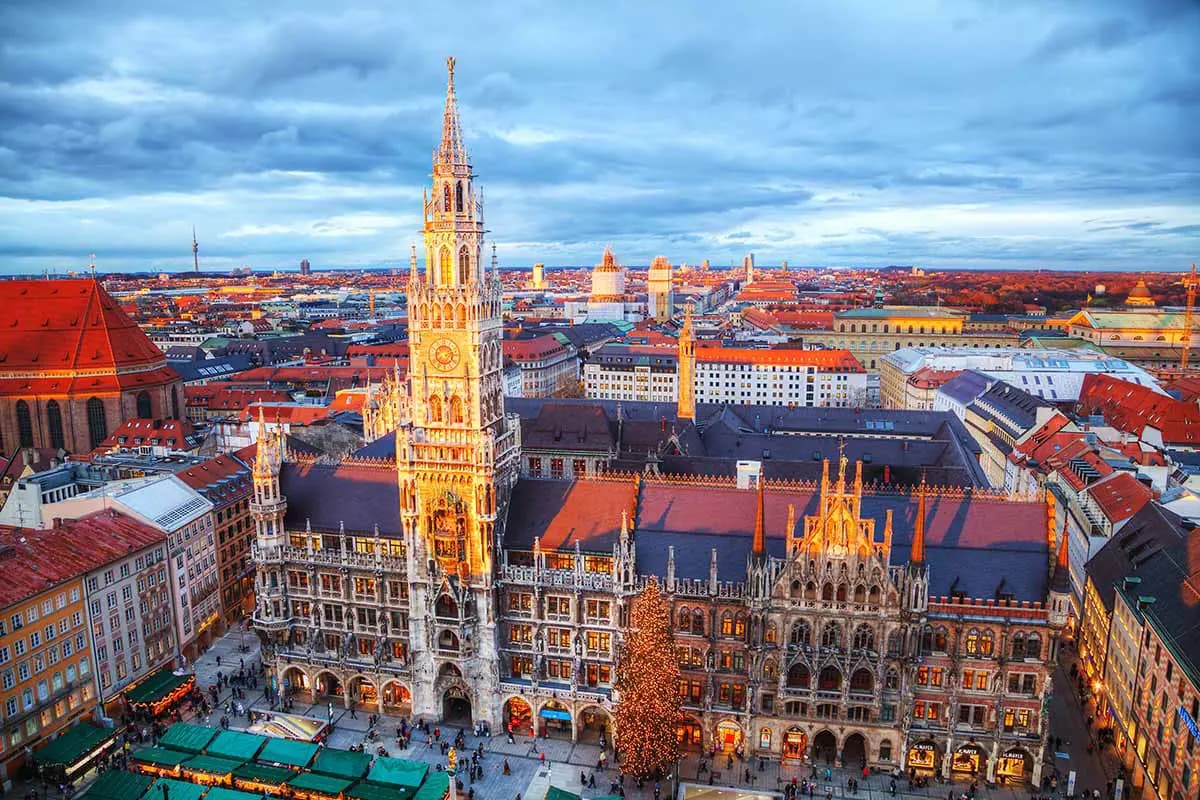
Munich's Marienplatz at dusk during the Christmas season, with the iconic Glockenspiel tower of the Neues Rathaus illuminated against the evening sky
© andreykr / Adobe Stock
Travel
Munich delivers the full Bavarian experience—a sophisticated metropolis where beer hall culture meets world-class museums, where cutting-edge automotive engineering stands alongside baroque palaces, and where the Alps rise just an hour to the south. This is Germany's third-largest city, yet it retains the warmth and accessibility that define Bavaria's famous gemütlichkeit. The historic Altstadt centers on Marienplatz, where the Gothic Neues Rathaus stages its famous Glockenspiel performance three times daily. Beyond the medieval core, you'll find the vast Englischer Garten (larger than Central Park), world-renowned art collections in the Kunstareal museum district, and beer gardens where locals gather under chestnut trees to enjoy Mass steins and pretzels the size of dinner plates. Munich's efficient MVV transport network connects everything from BMW's futuristic headquarters to Nymphenburg Palace's sprawling baroque gardens, while S-Bahn lines whisk travelers to Alpine lakes and mountain peaks in under an hour. Whether you're here for Oktoberfest's legendary beer tents, the Deutsches Museum's engineering marvels, or simply to soak up the laid-back Bavarian vibe in Viktualienmarkt's open-air food market, Munich manages to feel both cosmopolitan and cozy—a rare combination that keeps visitors coming back.
Marienplatz & The Historic Old Town
Marienplatz forms Munich's beating heart—a pedestrianized square dominated by the neo-Gothic Neues Rathaus (New Town Hall), whose 85-meter tower hosts the famous Glockenspiel that performs daily at 11am, noon, and 5pm (March–October). Crowds gather to watch the mechanical figures reenact two Bavarian stories: a 1568 wedding tournament and the Schäfflertanz coopers' dance. The Altes Rathaus (Old Town Hall) anchors the square's eastern edge, while radiating cobblestone streets lead to landmarks like the twin-domed Frauenkirche (the cathedral's onion domes are Munich's symbol), St. Peter's Church (climb 299 steps for panoramic views), and the medieval Viktualienmarkt food market. This compact Altstadt is best explored on foot—every corner reveals centuries of history, from Renaissance facades to hidden courtyards where locals drink coffee in quiet biergartens.
Beer Gardens & Bavarian Beer Culture
Munich takes beer seriously—this is the city of Oktoberfest, the Reinheitsgebot beer purity law, and centuries-old brewing traditions. Traditional beer gardens follow specific rituals: bring your own food (or buy pretzels, radishes, and obatzda cheese spread on-site), order beer by the Maß (1-liter stein), and sit at communal wooden tables under chestnut trees. The Augustiner-Bräu gardens serve Munich's most beloved local brew, while the roughly 3,500-seat Hofbräuhaus tourist spectacle offers brass bands and international crowds. For authentic local atmosphere, head to Hirschgarten (the city's largest beer garden with 8,000 seats), Chinesischer Turm in the Englischer Garten, or Paulaner am Nockherberg. Each of Munich's six major breweries (Augustiner, Paulaner, Hacker-Pschorr, Spaten, Löwenbräu, and Hofbräu) operates traditional beer halls and seasonal gardens—experiencing at least one is essential to understanding Munich's social DNA.
Englischer Garten - Europe's Largest Urban Park
The Englischer Garten sprawls across 3.7 square kilometers (larger than New York's Central Park), offering meadows, forests, streams, and surprising urban phenomena like the Eisbach river surfers who ride a standing wave year-round near Prinzregentenstraße. This 18th-century English landscape garden follows the Isar River's eastern bank through central Munich, providing locals with hiking trails, nude sunbathing areas (FKK zones—yes, this is Munich), and beer gardens like the iconic Chinesischer Turm (Chinese Tower), where thousands gather on summer afternoons. The park's southern entrance at Haus der Kunst leads to the Monopteros hilltop temple, offering skyline views, while the northern reaches become surprisingly wild and forested. Rent a bike to cover the full length, or simply claim a patch of grass near the Japanese teahouse and watch Münchners enjoying their favorite urban escape.
World-Class Museums & Art Collections
Munich's Kunstareal (art quarter) in Maxvorstadt concentrates some of Europe's finest museums within walking distance: the Alte Pinakothek holds Old Masters (Dürer, Rubens, Rembrandt), the Neue Pinakothek covers 19th-century art and Impressionism, and the Pinakothek der Moderne displays modern and contemporary works alongside design and architecture. Nearby, the Lenbachhaus specializes in the Blue Rider expressionist movement (Kandinsky, Marc), while the Brandhorst Museum focuses on post-1945 art (Warhol, Twombly, Koons). Beyond the Kunstareal, the Deutsches Museum on an island in the Isar ranks as the world's largest science and technology museum—allocate at least half a day to explore its mining tunnels, musical instruments, aerospace hall, and hands-on physics exhibits. The Museum Brandhorst's neon facade and the NS-Dokumentationszentrum's powerful examination of Munich's role in Nazi history round out a museum landscape unmatched outside Berlin.
Nymphenburg Palace & Royal Munich
The sprawling Nymphenburg Palace complex showcases Bavarian royal grandeur on a scale that rivals Versailles—this former summer residence of the Wittelsbach dynasty features a 600-meter-long baroque palace facade, lavish rococo interiors (including Ludwig II's birth room), and 200 hectares of formal gardens with fountains, pavilions, and canals. The Marstallmuseum displays ornate royal carriages, while the Porzellanmanufaktur Nymphenburg still produces hand-painted porcelain using 18th-century techniques. The palace sits 6km northwest of the city center (easy tram connection), making it a half-day excursion that feels worlds away from urban Munich. In the city center, the Residenz—the former city palace of the Wittelsbachs—offers another dose of royal opulence with its treasure chambers, Renaissance courtyards, Cuvilliés Theatre's rococo masterpiece, and sprawling Hofgarten that locals use as a lunchtime retreat.
Oktoberfest & Festival Culture
Oktoberfest transforms Munich every September–October (despite the name, it runs mostly in September), when six million visitors descend on the Theresienwiese fairgrounds for the world's largest beer festival. The two-week event features 14 massive beer tents (each seating thousands), carnival rides, traditional costumes (Lederhosen and Dirndls), roasted chicken and pork, and enough beer to fill several Olympic swimming pools. Reservations for tent tables are essential for weekends; weekday mornings offer easier walk-in access. Beyond Oktoberfest, Munich's festival calendar includes Starkbierzeit (strong beer season in March), Tollwood (summer and winter cultural festivals), and countless smaller neighborhood fests. The city's festive spirit peaks in beer gardens on warm evenings and in Christmas markets (Christkindlmarkt) come December, when Marienplatz and surrounding squares fill with wooden stalls selling Glühwein and handcrafted gifts.
BMW World & Engineering Heritage
Munich's identity as an engineering powerhouse centers on BMW—the Bavarian Motor Works founded here in 1916. The BMW Welt (BMW World) showroom near Olympiapark offers free entry to a futuristic exhibition space where visitors can admire concept cars, customize dream motorcycles, and watch new BMWs being delivered to excited owners. Next door, the BMW Museum chronicles the company's century of innovation through vintage motorcycles, iconic 1970s sedans, Formula 1 racers, and forward-looking electric concepts. Guided tours of the actual BMW production plant show assembly lines in action (book weeks ahead). Beyond BMW, Munich's engineering DNA shows up in the Deutsches Museum's exhibits, the Technical University of Munich's research excellence, and Siemens' historic presence—this city doesn't just admire technology; it builds it.
Neighborhoods - Schwabing, Maxvorstadt & Glockenbach
Munich's distinct neighborhoods each offer unique character: Schwabing, north of the center, earned fame as the bohemian quarter where artists like Kandinsky and writers like Thomas Mann gathered in the early 20th century—today it mixes student energy (near the university), boutique shopping on Leopoldstraße, and nightlife around Münchner Freiheit. Maxvorstadt houses the museum quarter and retains intellectual gravitas with bookshops and cafes frequented by professors and students. Glockenbach, southwest of the Altstadt, has evolved into Munich's most vibrant creative district—vintage shops, design studios, international restaurants, and a thriving LGBTQ+ scene cluster around the Gärtnerplatz theater. Haidhausen, across the Isar, offers cobblestone streets and a village feel, while trendy Glockenbachviertel draws young professionals to its cocktail bars and brunch spots. Each neighborhood rewards wandering—Munich isn't just its tourist center.
Alpine Gateway - Day Trips to Lakes & Mountains
Munich's greatest geographic advantage is its proximity to the Bavarian Alps—stunning mountain lakes and peaks lie just 60–90 minutes south by train. Garmisch-Partenkirchen offers access to the Zugspitze (Germany's highest peak at 2,962m), while Tegernsee and Chiemsee deliver alpine lake scenery with swimming, sailing, and lakeside beer gardens. King Ludwig II's fairy-tale castles—Neuschwanstein and Linderhof—make popular day trips (2–2.5 hours), though expect crowds, especially at Neuschwanstein. Closer to the city, the Starnberger See (40 minutes by S-Bahn) provides easy swimming access and waterside cafes. In winter, ski resorts like Sudelfeld and Spitzingsee offer downhill runs under an hour from Munich, while summer hiking trails around Mittenwald and Oberammergau showcase alpine meadows and dramatic peaks. The Alps aren't just scenery from Munich—they're an extension of the city's weekend lifestyle.
Practical Tips - Transport, Safety & Seasons
Munich Airport (MUC), Germany's second-busiest, connects to the city center in 40 minutes via S-Bahn (S1 or S8 lines). The MVV public transport network (U-Bahn metro, S-Bahn suburban trains, trams, buses) is efficient, punctual, and easy to navigate—buy day passes or multi-day tickets for unlimited travel within zones. Munich is exceptionally safe; standard precautions apply in crowded tourist areas. The city peaks in summer (June–August) with outdoor beer gardens and long daylight, but also Oktoberfest crowds (book accommodation far ahead). Spring (April–May) and fall (September–early October) offer pleasant weather without peak crowds. Winter brings Christmas markets and snow-dusted Alps, though some beer gardens close. English is widely spoken in tourist areas; German phrases earn smiles. Tipping is customary (5–10%); round up or leave cash. Cash is still preferred in traditional establishments, though cards work in most modern spots. Book popular restaurants and beer garden tables ahead on weekends.
Frequently asked questions
Do I need a visa to visit Munich?
When is the best time to visit Munich?
How many days do you need in Munich?
How do I get from Munich Airport to the city centre?
Do I need cash in Munich?
Transport & airports
Diplomatic missions in Munich
38 embassies based in this city, grouped by region.
Europe18
- Belarusian Consulate in Munich
- Bosnia and Herzegovina Consulate General in Munich
- Bulgarian Consulate in Munich
- Czech Republic Consulate General in Munich
- Royal Danish Consulate General in Munich
- Finnish Honorary Consulate in Munich
- French Consulate General in Munich
- Greek Consulate General in Munich
- Hungary Consulate General in Munich
- Iceland Consulate in Munich
- Ireland Consulate in Munich
- Kosovo Consulate General in Munich
- Latvia Consulate in Munich
- Liechtenstein Honorary Consul in Munich
- Luxembourg Consulate in Munich
- Monaco Honorary Consulate in Munich
- Ukrainian General Consulate in Munich
- British Consulate General in Munich
Asia11
- Chinese Consulate General in Munich
- Indian Consulate General in Munich
- Honorary Consulate of Indonesia in Munich
- Iran Consulate in Munich
- Israel Consulate in Munich
- Japanese Consulate General in Munich
- Kazakhstan Consulate General in Munich
- Mongolia Honorary Consulate General in Munich
- Honorary Consulate of South Korea in Munich
- Royal Thai Consulate-General in Munich
- Turkish Consulate General in Munich
Africa5
This overview comes from Visaja's worldwide missions database (visaja.com), checked against official government sources; for binding answers, the mission itself always has the final word.