- Population:558,745 (2023)
- Area:240 km²
- Elevation:20 m
- Timezone:CET/CEST (UTC+1/+2)
- IATA:GOA
Overview
Genoa (Genova) is the capital of Liguria and Italy's historic maritime power — 'la Superba', a steep, salt-worn port city with one of the largest medieval old towns in Europe, the gilded UNESCO palaces of the Rolli, a regenerated Old Port, and the birthplace of Christopher Columbus and of pesto.
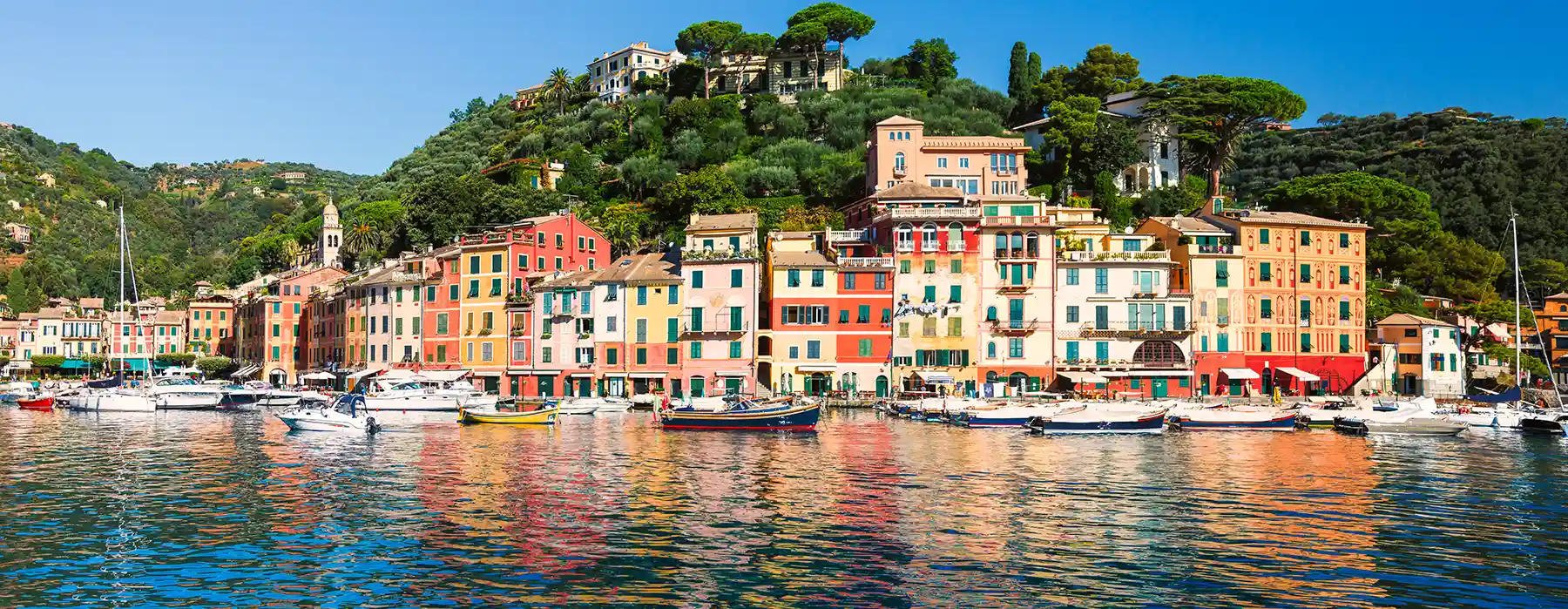
Portofino — the Riviera fishing village an easy boat or train hop from Genoa.
© Bruce Aspley / Adobe Stock
Travel
Genoa (Genova), the capital of Liguria, was for centuries one of the great maritime republics of the Mediterranean, and it wears that history vividly — a proud, layered, sometimes gritty port city the Genoese still call 'la Superba', the Superb One. It climbs steeply from its harbour up the surrounding hills, and at its heart lies one of the largest and best-preserved medieval old towns in Europe: a dense, shadowy maze of caruggi, the narrow alleys where laundry hangs overhead, artisan workshops and old shops (botteghe storiche) trade as they have for generations, and sudden squares open onto Romanesque churches and the striped marble Cathedral of San Lorenzo. The wealth of the banking republic survives in the Palazzi dei Rolli — the grand Renaissance and Baroque palaces, many along the Strada Nuova (Via Garibaldi), once registered to host visiting dignitaries and today a UNESCO World Heritage Site, several open as the Musei di Strada Nuova with their painting collections. Genoa's relationship with the sea is its other great theme: the Porto Antico (Old Port), redesigned by the Genoa-born architect Renzo Piano, has been transformed into a buzzing waterfront with the Aquarium of Genoa — the largest in Italy — the Galata Maritime Museum, the panoramic Bigo lift and the Biosfera, while the old Lanterna lighthouse still marks the harbour. East along the shore, the pastel former fishing village of Boccadasse, with its little beach and bobbing boats, feels a world away from the city behind it. Genoa is the birthplace of Christopher Columbus, of the violinist Paganini and of Renzo Piano, and the home of some of Italy's most beloved food — pesto alla genovese, focaccia, farinata and trofie. It is also the natural gateway to the Italian Riviera, with Portofino, Camogli and the Cinque Terre a short train ride along the coast. The climate is mild and Mediterranean; spring and autumn are ideal, summer warm and busy on the nearby Riviera.
The Caruggi and the Medieval Old Town
Genoa's old town is one of the largest medieval centres in Europe, and getting lost in it is the essential Genoese experience. The caruggi — tall, narrow alleys so close-set that daylight barely reaches the ground — form a dense, atmospheric labyrinth running back from the port, lined with workshops, tiny bars (where you might try the local farinata), historic shops and shrines, and opening without warning onto handsome squares. At its centre rises the Cathedral of San Lorenzo, with its banded black-and-white marble façade and striped interior, and nearby the grand Piazza De Ferrari with its fountain, ringed by the opera house (Teatro Carlo Felice), the stock exchange and the Palazzo Ducale, the former doges' palace that now hosts major exhibitions. Tucked in the lanes are gems like the medieval Porta Soprana gate and, beside it, the house traditionally said to be the boyhood home of Christopher Columbus. The old town can feel raw and labyrinthine, but that authenticity — a working port city rather than a polished museum — is exactly its appeal.
The Rolli Palaces and the Republic's Wealth
At the height of its power as a banking and maritime republic, Genoa built a remarkable concentration of aristocratic palaces, and the finest of them make up the Palazzi dei Rolli — a UNESCO World Heritage Site since 2006. The 'rolli' were official lists of grand private residences required to lodge visiting popes, princes and ambassadors of state, and the families competed in splendour. The showcase is the Strada Nuova (today's Via Garibaldi), a short street of breathtaking Renaissance and Baroque palaces built almost shoulder to shoulder. Three of them — Palazzo Rosso, Palazzo Bianco and Palazzo Doria-Tursi — open as the Musei di Strada Nuova, displaying works by Van Dyck, Rubens, Caravaggio and the Genoese masters amid frescoed halls, gilded salons and roof terraces with views over the city. Nearby, the Palazzo Reale (Royal Palace) preserves its hall of mirrors and waterfront gardens. On the autumn Rolli Days, many palaces normally closed to the public open their doors. Together they tell the story of a city that was once one of the richest in the Mediterranean.
The Old Port, the Aquarium and the Sea
Genoa has always faced the sea, and the Porto Antico (Old Port) is where the city reconnects with its harbour. Once cut off behind working docks, the waterfront was reimagined for the 1992 Columbus celebrations by the Genoa-born architect Renzo Piano and is now a lively public space. Its star is the Aquarium of Genoa, the largest in Italy and one of the biggest in Europe, with sharks, dolphins, penguins and a vast range of marine life across its tanks. Alongside it stand the Galata Maritime Museum, which tells the story of Genoese seafaring (with a full-size galley and an emigration section), the Biosfera glass bubble of tropical plants, and the Bigo, a crane-like panoramic lift that rotates for a view over the port and old town. Out at the harbour mouth, the Lanterna — Genoa's medieval lighthouse and emblem — still stands. For a complete change of mood, take the bus or walk east to Boccadasse, a pastel-painted former fishing village folded into the city, where small boats are drawn up on a pebble cove and people gather for ice cream at sunset.
Pesto, Focaccia and the Gateway to the Riviera
Genoa and Liguria gave the world some of Italy's best-loved foods, and eating here is a highlight. This is the home of pesto alla genovese — the raw sauce of Ligurian basil, pine nuts, garlic, Parmesan and pecorino and local olive oil, classically tossed with trofie or trenette pasta and a few potatoes and green beans. It is also focaccia country: the soft, oil-dimpled fugassa eaten at any hour, and the thin, cheese-filled focaccia di Recco from just along the coast. Add farinata (a chickpea-flour pancake baked in copper pans), stuffed vegetables, the Genoese minestrone and the sweet pandolce at Christmas, and the city is a destination for the table alone. Genoa is also the hub of the Ligurian Riviera: from its stations, trains run east along the Riviera di Levante to Camogli, Santa Margherita and Portofino, and on to the famous villages of the Cinque Terre, and west along the Riviera di Ponente toward San Remo — making the city an ideal base from which to combine its own dense history with the glamour and beauty of the coast.
Frequently asked questions
What is Genoa known for?
How long should I spend in Genoa, and is it a good base?
What food is Genoa famous for?
How do I get to Genoa?
Tourism & destination guides
Diplomatic missions in Genoa
1 embassy based in this city, grouped by region.
Visaja keeps this page's contact details and visa guidance under continuous review — still, requirements can change at short notice, so confirm the essentials with the mission or the official government portal before you travel.