
Travel deep dive
Indonesia's Volcanoes and the Ring of Fire
Indonesia's volcanoes aren't scattered hazards to route around — they're the same geological mechanism that built the archipelago's fertile farmland and shaped where its populations settled. The country sits directly on the Pacific Ring of Fire, where colliding tectonic plates force molten rock upward, producing more active volcanoes than almost any other country on earth. Bromo's smoking caldera and Ijen's midnight blue flames are direct visible evidence of the same process that makes Java's soil some of the richest in Southeast Asia.
Updated 2026-09-19
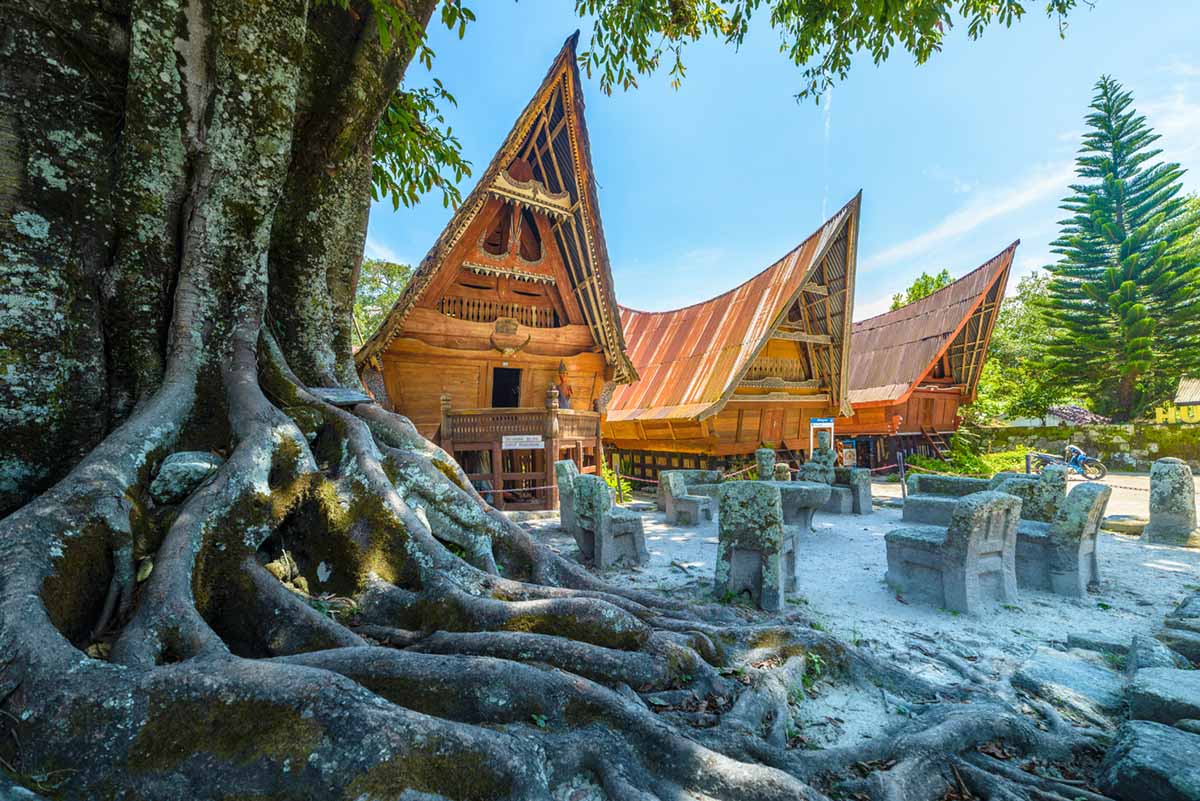
Sumatra's volcanic spine — the Ring of Fire geology that built the archipelago's farmland.
Bromo: sunrise over an active caldera
Mount Bromo sits inside the vast Tengger caldera in East Java, a otherworldly sea of volcanic sand ringed by the caldera's ancient walls, with Bromo itself — still actively smoking — rising from the sand sea's centre alongside several dormant neighbouring peaks. The standard visit starts in the pre-dawn dark, reaching a viewpoint on the caldera rim by jeep in time to watch the sunrise light up the whole sand sea and its ring of peaks simultaneously, a genuinely different scale of view from watching sunrise at a single summit.
From the viewpoint, the walk down onto the sand sea and up Bromo's own crater rim (a set of stairs cut into the ash slope) lets visitors look directly into the active, sulphur-smelling crater — a rare case of an accessible, walkable active volcano rather than one viewed only from a safe distance. The Tenggerese people who live in villages around the caldera practise their own distinct animist-Hindu tradition, holding an annual Kasada festival that involves offerings thrown directly into the crater.
Ijen: blue fire and the sulphur miners
Ijen's defining feature is only visible at night: sulphuric gases escaping the crater ignite on contact with air, producing electric-blue flames that flicker across the crater floor and are genuinely invisible in daylight, which is why the standard visit is a midnight hike timed to reach the crater rim while it's still dark. The blue fire shares the crater with a turquoise, highly acidic crater lake, one of the largest and most acidic bodies of water of its kind on earth.
Ijen is also a working sulphur mine, and the miners who descend into the crater to extract chunks of raw sulphur, carrying loads of seventy kilograms or more up the crater's steep path in woven baskets on their shoulders, do so without the respiratory protection the toxic gases would normally demand — a genuinely difficult, low-paid trade that visitors on the same trail witness directly rather than read about, and one worth approaching with the respect due to people doing dangerous work, not treating as a photo opportunity.
Rinjani and Agung: the sacred summits
Mount Rinjani, on Lombok, is Indonesia's second-highest volcano at 3,726 metres and the centrepiece of a two-to-three-day trek that climbs through forest, past the vivid turquoise crescent of Segara Anak crater lake, to a summit push that starts well before dawn to reach the top for sunrise — a serious multi-day trek rather than a day hike, and considered sacred by both the island's Sasak Muslim majority and its Balinese Hindu minority, each with their own ceremonial relationship to the mountain.
Mount Agung, Bali's highest point, holds a different kind of sacredness — as the mountain beneath Besakih, the island's “Mother Temple” (covered on the Bali temples page), Agung is considered the axis around which Balinese cosmology orients itself, and traditional building codes on the island have historically required structures to stay lower than the volcano's own silhouette as a mark of respect. Its periodic eruptions, including major activity in recent decades, are followed closely across the island given the mountain's spiritual as well as physical significance.
Kelimutu: three lakes, three colours
On Flores, Kelimutu holds a volcanic feature found almost nowhere else at this scale: three crater lakes sitting side by side atop the same volcano, each a different, shifting colour — commonly some combination of turquoise, dark green and near-black at any given time, the exact shades changing gradually over months or years as dissolved minerals and volcanic gas activity shift the water chemistry in each crater independently. Local Lio tradition holds that the lakes are the resting place of departed souls, sorted by age and character into the different craters, giving the site a genuine spiritual weight alongside its striking geology.
Reaching the summit viewpoint before sunrise is again the standard practice, both for the cooler hiking conditions and because the shifting light through dawn changes how the three colours read against each other — a volcano best understood as a slow-motion chemistry experiment made visible, not a single fixed sight.