- Population:558,745 (2023)
- Area:240 km²
- Elevation:20 m
- Timezone:CET/CEST (UTC+1/+2)
- IATA:GOA
Overview
Genoa (Genova), the capital of Liguria and once the home port of a seafaring republic, rises in steep tiers from its harbour, with a medieval old town and the palaces of the Rolli at its heart.
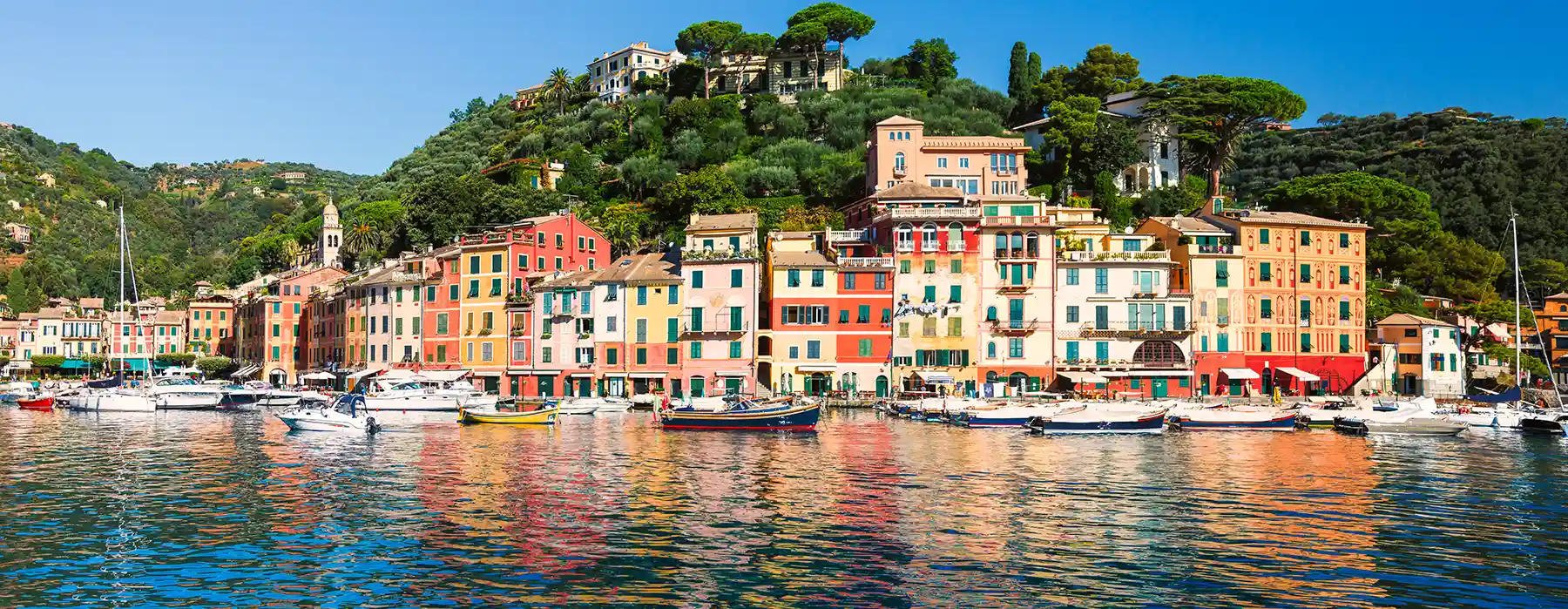
Portofino, on the Riviera east of Genoa, reached by train to Santa Margherita Ligure and then by bus or boat.
© Bruce Aspley / Adobe Stock
Travel
Genoa, the capital of Liguria, was for centuries the seat of a seafaring republic and is still one of Italy's largest ports, a city stacked on hills that rise almost straight from the harbour; the Genoese have long called it “la Superba”, the Superb. Between the water and the slopes lies one of the largest medieval old towns in Europe, a maze of caruggi so tall and narrow that daylight barely reaches the paving, and above it run the streets of palaces the republic's banking families built. It is a city of stairs and steep lanes, seen best on foot. The coastal railway runs through it in both directions, which puts the Italian Riviera a train ride away on either side.
Via Balbi and the Palazzo Reale
From Piazza Principe station, Via Balbi runs towards the centre between 17th-century palaces and the buildings of the university. Along it, the Palazzo Reale, built as a family palace in the 17th century and a residence of the House of Savoy in the 19th, is open as a museum of its state rooms: the gilded Hall of Mirrors, the throne room and a hanging garden that looks out over the port. At the far end of the street, behind a columned porch, the Basilica della Santissima Annunziata del Vastato is gilded and frescoed from floor to vault.
Via Garibaldi and the Palazzi dei Rolli
Via Cairoli leads on to Via Garibaldi, laid out in the 16th century as the Strada Nuova, a single straight street of Renaissance and Baroque palaces built almost shoulder to shoulder by the republic's banking families. These and other palaces across the old town were entered on the Rolli, official lists of private houses bound to lodge popes, princes and ambassadors on state visits, and today they form a UNESCO World Heritage Site, the Palazzi dei Rolli. Most are still offices, banks and homes; on the Rolli Days, palaces otherwise closed to the public open their doors.
Palazzo Rosso, Palazzo Bianco and Palazzo Tursi
Three palaces on Via Garibaldi form one museum, the Musei di Strada Nuova. Palazzo Rosso keeps its frescoed rooms and the portraits Van Dyck painted of the family that lived there, and Palazzo Bianco hangs works by Rubens and Caravaggio among its Flemish and Genoese paintings. Palazzo Tursi, the city hall, shows in a room of its own “il Cannone”, the violin of Niccolò Paganini, who was born in Genoa.
The Castelletto Lift and Viewpoint
A short walk from Via Garibaldi, in Piazza del Portello, a public lift rises through the hill to the Spianata di Castelletto, a terrace above the old town. Its balustrade looks down over the slate roofs and church domes to the cranes of the port and the Lanterna, and the view is at its best towards sunset.
The Caruggi and Palazzo Spinola
Below Via Garibaldi, the medieval old town runs down to the port in caruggi, tall, narrow lanes where laundry hangs between the windows, street shrines are set into the corners, and workshops and old shops, the botteghe storiche, trade at street level. Via San Luca, the old main street, leads to Piazza Banchi, the merchants' square with its open Loggia dei Mercanti. Close by, in Piazza Pellicceria, the Galleria Nazionale di Palazzo Spinola is a noble palace shown as its family lived in it, with furniture, frescoed ceilings and paintings still in their rooms. In lanes this dense the slope is the compass: the port is always downhill.
The Cathedral of San Lorenzo
On Via San Lorenzo, which climbs from the waterfront to the Palazzo Ducale, the cathedral of San Lorenzo stands behind a façade banded in black and white stone, with Gothic portals and a pair of stone lions on its steps. The stripes continue along the arcades of the nave, and a chapel in the left aisle holds the relics of St John the Baptist, one of the city's patron saints. It is a working cathedral, where covered shoulders and knees are part of the dress code of Italian churches.
Piazza De Ferrari, the Palazzo Ducale and Porta Soprana
Piazza De Ferrari, with its great bronze fountain, is the city's central square, ringed by the Teatro Carlo Felice, Genoa's opera house, the former stock exchange and the Palazzo Ducale. The palace of the doges is now the city's main venue for exhibitions and cultural events. A few minutes' walk away, the twin round towers of Porta Soprana, a gate of the 12th-century walls, stand above the small house shown as Christopher Columbus's childhood home, a later rebuilding on the site of the house where his family lived.
Piazza Caricamento and Sottoripa
Via San Lorenzo runs down to Piazza Caricamento, the square on the old waterfront, where the Palazzo San Giorgio, a medieval palace whose painted façade shows St George and the dragon, faces the harbour. Along the landward side of the square runs Sottoripa, a long medieval arcade whose shops fry fish and bake farinata to eat standing up. An elevated road passes between the square and the water, and the crossing beneath it leads straight into the old port.
The Porto Antico and the Aquarium
The old harbour lay closed off behind working docks until Renzo Piano, the Genoa-born architect, opened it to the city for the Columbus celebrations of 1992, and its quays are now a waterfront promenade of piers, old cotton warehouses and moored boats. Its main draw is the Aquarium of Genoa, the largest in Italy, where dolphins, sharks and penguins are among the animals in its tanks. A visit takes a good two hours, and in summer the calmest time to arrive is at opening.
The Darsena, the Galata Museum and the Lanterna
A short walk west along the quays, the Darsena, the old dock of the galleys, holds the Galata Museo del Mare, the maritime museum, in a glass-walled building on the water. Inside stands a full-size galley, and its emigration rooms follow the Italians who sailed from this port for the Americas. Further west, beyond the ferry terminal, rises the Lanterna, the city's emblem and still a working lighthouse; its present tower dates from 1543, on a headland lit since the Middle Ages, and it is seen from all along the harbour.
The Staglieno Cemetery
Up the Bisagno valley, a bus ride north-east of Brignole station, the monumental cemetery of Staglieno climbs a hillside in long arcades and terraces. It opened in the 19th century, and its galleries are lined with marble tombs carved in the realist style of the time, mourners and family members portrayed so closely that the lace and buttons of their clothes can be made out. It remains a working cemetery, visited in quiet.
Corso Italia and Boccadasse
East of the centre, Corso Italia follows the shore as a seafront promenade lined with bathing establishments, and at its far end lies Boccadasse. The former fishing village keeps its pastel houses stacked around a small pebble cove where boats are drawn up on the shingle, and in the evening people gather on the rocks to watch the light go. A city bus runs out to it too, but the walk along the sea is the way to arrive.
Nervi and Its Seafront Walk
At the eastern edge of the city, a short train ride from Brignole, Nervi was a resort town of its own before it became a quarter of Genoa. The Passeggiata Anita Garibaldi runs from its little harbour along the rocks above the sea, with the Portofino promontory ahead, and behind it the gardens of old villas form the public parks of Nervi, shaded by palms and old trees. The walk and the parks make an easy half-day out of the centre.
Pesto, Focaccia and the Genoese Table
Like every Italian regional cuisine, Genoa's is built on what its own hills and coast provide. This is the home of pesto alla genovese, the raw sauce of Ligurian basil, pine nuts, garlic, Parmesan and pecorino and the region's olive oil, served with trofie or trenette and often a few potatoes and green beans; pansoti, pasta parcels filled with wild herbs, come with a walnut sauce, and minestrone alla genovese is finished with a spoonful of pesto. Focaccia, fugassa in Genoese, is soft, oily and dimpled and eaten at any hour, while focaccia di Recco, from just along the coast, is thin and filled with cheese. Farinata, the chickpea pancake baked in copper pans, comes hot from the old town's ovens alongside stuffed vegetables, and at Christmas the dense sweet pandolce appears.
Frequently asked questions
How many days does Genoa need?
How do I get to Genoa?
How do I get around Genoa?
When is the best time to visit Genoa?
Is Genoa a good base for the Riviera?
Tourism & destination guides
Diplomatic missions in Genoa
1 embassy based in this city, grouped by region.
Visaja keeps this page's contact details and visa guidance under continuous review — still, requirements can change at short notice, so confirm the essentials with the mission or the official government portal before you travel.