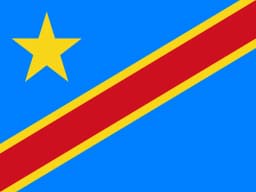
Democratic Republic of the Congo
Phone Code
+243
Capital
Kinshasa
Population
105.8M (2023)
Languages
Area
2,344,858 km²
Electricity
220 V
Plug types
Europlug · AC power plugs and sockets: British and related types · Type E
Driving side
right
Native Name
République démocratique du Congo
Region
Africa
Middle Africa
Timezones
West Africa Time
UTC+01:00
+1 more
On This Page
The Democratic Republic of the Congo is Africa's second-largest country, anchoring the continent's heart with the Congo Basin rainforest (the second-largest tropical forest on earth after the Amazon), the Congo River (the deepest river in the world at 220 metres and the second-largest by discharge) and a wildlife heritage that includes mountain gorillas in Virunga National Park, bonobos endemic to the country, okapis, forest elephants and Congo peacocks. Kinshasa, the capital and Africa's third-largest city, is the worldwide cradle of Congolese rumba (inscribed on UNESCO's Intangible Cultural Heritage list in 2021). French is the official language alongside Lingala, Kikongo, Swahili and Tshiluba. The country is distinct from its smaller neighbour, the Republic of the Congo (Brazzaville). Modernised entry processes — including the official e-visa system at evisa.gouv.cd — have made independent travel more practical for the wildlife, conservation, journalism, NGO and adventure-tourism communities that visit each year. Travellers should consult their government's current advisories before booking; recommendations vary by region.
Visa Requirements for the Democratic Republic of the Congo
The DRC requires advance authorisation for almost all foreign visitors — there is no visa-on-arrival service. Two routes are available. The official e-visa platform at evisa.gouv.cd (administered by the Direction Générale de Migration, DGM) allows online application for short stays up to 7 days through the VAP (Visa AéroPortuaire / Airport Visa) scheme, accepted at major international airports including Kinshasa N'djili and Goma. For longer stays, business, work, residence or student purposes, traditional embassy applications remain the route. Embassy applications require a passport valid at least six months beyond entry, completed forms, photos, a mandatory yellow fever vaccination certificate (vaccination at least 10 days before arrival), an officially certified invitation letter (stamped by host or by the Ministry of Foreign Affairs in Kinshasa, which can speed up applications routed there for decision), confirmed accommodation, return ticket and proof of funds. Embassy processing typically takes two to three weeks. International airport departures carry an exit fee of approximately USD 55 (USD 50 airport tax plus USD 5 boarding); domestic flights ~USD 10. Yellow fever vaccination, registration with the local DGM office for residents, and currency-export restrictions (Congolese francs cannot leave the country) are strictly enforced.
Common Visa Types
E-Visa / Airport Visa (VAP)
For short tourism, business or family visits via the DGM e-visa platform at evisa.gouv.cd, valid for arrivals at Kinshasa N'djili and other designated airports. Online application with passport scan, photo, yellow fever certificate, itinerary, accommodation proof and credit-card payment.
Tourist Visa (Embassy)
For longer leisure travel, national-park visits and family stays. Application through a DRC embassy with form, passport (6 months validity, blank pages), photos, yellow fever certificate, certified invitation or hotel booking, proof of funds and return ticket.
Business Visa
For meetings, conferences, mining-sector site visits, NGO programmes and other commercial activity that does not constitute local employment. Requires invitation letter from a registered DRC company, business documentation and the standard supporting paperwork.
Work Visa and Permit
Two-step process for employment in the DRC: business visa for entry, then a work permit through the Ministry of Labour with employer sponsorship. Permits are tied to a specific employer; changing job requires a new application.
Residence Permit
Mandatory for any foreigner staying beyond 90 days. Issued by DRC immigration authorities after arrival on the basis of employment, family reunification, retirement or business.
Student Visa
For studies at accredited DRC universities or research programmes. Acceptance letter, proof of tuition or scholarship, financial means and accommodation arrangements required.
Important Travel Information
•Apply for the e-visa at...
•Yellow fever vaccination is mandatory...
•Passport must be valid for...
•International airport exit fees: approximately...
•Cash-dominant economy: USD is widely...
•French is the language of...
•Travel advisories vary significantly by...
•The DRC is distinct from...
•Health: malaria prophylaxis is essential,...
•Photography of government buildings, military...
The Democratic Republic of the Congo offers some of the most distinctive travel experiences on the African continent — for a small but committed cohort of wildlife travellers, conservationists, photographers, journalists and NGO professionals who reach the country each year. Virunga National Park, on the Rwandan border in the east, is Africa's oldest protected area (UNESCO World Heritage) and shelters roughly half of the world's remaining mountain gorillas; trekking permits run USD 400–600 per person and are booked through the official park operation that funds ranger salaries and conservation. The same Virunga complex contains Mount Nyiragongo, an active volcano whose summit overlooks one of the world's largest permanent lava lakes — overnight ascents that include a night at the crater rim are among the most arresting volcanic experiences on earth. Salonga National Park (UNESCO), at the country's heart, is the largest tropical-rainforest national park on the continent and home to the bonobo, the great-ape species endemic to the DRC. The Okapi Wildlife Reserve (UNESCO) protects the only viable wild population of the okapi, a forest giraffe known to science only since 1901. The Congo River — the deepest river in the world — supports a riverboat culture that has run for over a century: the multi-day journey upriver from Kinshasa toward Mbandaka and Kisangani is one of the world's great river trips. Kinshasa itself, Africa's third-largest city, is the global cradle of Congolese rumba (UNESCO Intangible Cultural Heritage 2021), with live-music bars in the Cité, the Académie des Beaux-Arts and a frenetic urban culture that sets the rhythm for much of francophone Africa. Travellers should consult current government advisories before booking — guidance varies by region.
Discover Democratic Republic of the Congo
Virunga's gorillas and Nyiragongo's permanent lava lake
Virunga National Park, Africa's oldest protected area and a UNESCO World Heritage Site, shelters roughly half of the world's remaining mountain gorillas, with trekking permits priced at USD 400-600 funding the ranger salaries and conservation work that keep the park operational despite its location in a historically unstable border region. The same Virunga complex holds Mount Nyiragongo, an active volcano whose 3,470-metre summit overlooks one of the largest permanent lava lakes on Earth — the standard ascent is a one-day climb followed by a night camped at the crater rim, watching the lake glow red through the darkness, an experience with few real equivalents anywhere else on the planet.
Salonga's endemic bonobos and the Okapi Wildlife Reserve
Salonga National Park, the largest tropical-rainforest national park anywhere in Africa and a UNESCO site, is the only home of the bonobo — a great ape species endemic to the DRC and, alongside the chimpanzee, humanity's closest living relative — reached only by air or river and typically visited with primatologist-led guides. Far to the northeast, the Okapi Wildlife Reserve protects the only viable wild population of the okapi, a forest giraffe unknown to Western science until 1901, its dense Ituri rainforest also home to Congo peacocks and forest elephants, and bordered by traditional Mbuti communities reached via Beni or Bunia.
The Congo River's century-old riverboats and Kinshasa's rumba
The Congo River, the deepest river in the world at 220 metres, still sustains a riverboat culture running for over a century — the multi-day journey upriver from Kinshasa toward Mbandaka and Kisangani passes floating markets and pirogues approaching the boat to trade, dense rainforest lining both banks the entire way. Kinshasa itself, Africa's third-largest city, is the global cradle of Congolese rumba, inscribed on UNESCO's Intangible Cultural Heritage list in 2021, its live-music bars in the Cité and the frenetic energy of the Grand Marché setting a cultural rhythm that has shaped popular music across francophone Africa for generations.
Ways to Experience This Destination
Virunga National Park (UNESCO, Africa's oldest protected area) shelters roughly half of the world's remaining mountain gorillas. Trekking permits at USD 400–600 per person are booked through the official park operation that funds ranger and conservation work. Habituated family groups in volcanic forest above Goma.
An active volcano above Goma whose 3,470 m summit overlooks one of the world's largest permanent lava lakes. The classic ascent is a one-day climb followed by an overnight at the crater rim, with the lake glowing red through the night — among the most arresting volcanic experiences on earth.
Salonga National Park (UNESCO) is the largest tropical-rainforest national park on the African continent and the only home of the bonobo — the great-ape species endemic to the DRC and, alongside the chimpanzee, our closest living relative. Reached only by air or river, with primatologist-led visits.
The Congo River — the deepest river in the world (220 m) — sustains a riverboat culture that has run for over a century. The multi-day journey upriver from Kinshasa toward Mbandaka and Kisangani, with floating markets, pirogues approaching the boat to trade and dense rainforest on both banks, is among the world's great river trips.
Africa's third-largest city is the global cradle of Congolese rumba (UNESCO Intangible Cultural Heritage 2021). Live-music bars in the Cité, the Académie des Beaux-Arts, the bustling Grand Marché and a frenetic urban culture that sets the rhythm for much of francophone Africa.
The Okapi Wildlife Reserve (UNESCO) protects the only viable wild population of the okapi — a forest giraffe known to science only since 1901 — alongside Congo peacocks, forest elephants and dense Ituri rainforest. The reserve adjoins traditional Mbuti communities and is reached via Beni or Bunia.
Money & Currency
Congolese Franc (CDF)
Currency code: CDF
Practical Money Tips
Congolese Franc (CDF) and US Dollar — A Dual Cash Economy
The DRC officially uses the Congolese Franc (CDF), but the US Dollar (USD) functions as a parallel currency accepted almost universally in Kinshasa, Lubumbashi, and other cities for hotels, restaurants, flights, and larger purchases. Most international travelers operate primarily in USD. EUR and GBP are difficult to exchange outside Kinshasa. Bring crisp, undamaged USD bills (especially USD 100 notes post-2013 series) — worn or older bills are often refused. Currency exchange is available at licensed bureaux de change and some banks in Kinshasa; street changers are illegal and risky. CDF is essential for small purchases, transport, and local markets.
Very Limited ATM Network — Bring Sufficient Cash
ATM infrastructure is extremely limited in the DRC. Rawbank, Equity BCDC, and TMB (Trust Merchant Bank) operate ATMs in Kinshasa and Lubumbashi, but machines are frequently out of service, out of cash, or unavailable for foreign cards. Do not rely on ATMs as a primary cash source. Bring all the USD cash you need for your trip from your home country. Outside Kinshasa and a handful of major cities, ATMs essentially do not exist. Even within Kinshasa, ATM availability is unpredictable.
Card and Mobile Payments Very Limited — Cash Dominant
Credit and debit card acceptance is extremely limited and largely restricted to high-end hotels and airlines in Kinshasa. Apple Pay and Google Pay are not supported. Local mobile money services — M-Pesa (Vodacom DRC), Airtel Money, and Orange Money — are widely used among Congolese residents but require a local SIM with national identity registration, making them inaccessible to most visitors. Plan for a predominantly cash trip. Carry USD for major expenses and CDF for day-to-day purchases.
Budget Carefully — Kinshasa is Expensive for Africa
Contrary to expectations, Kinshasa is one of the most expensive capitals in sub-Saharan Africa for expatriates and international visitors. Mid-range hotel: USD 100–250/night. International restaurant meal: USD 20–60. Virunga National Park gorilla trekking permit: USD 400–600 per person (booked in advance). Local moto-taxi (boda-boda): CDF 500–2,000 for short trips. Street food: CDF 1,000–3,000 a meal. Security costs (required guide in many areas, vehicle hire): budget generously. Eastern DRC travel requires specialist operator; check travel advisories before planning.
Note: Always check current exchange rates before traveling. Currency exchange is available at airports, banks, and authorized money changers.
What currency should I bring to the DRC?
Do Apple Pay or Google Pay work in the DRC?
Are ATMs reliable in Kinshasa?
Can I use euros or British pounds in the DRC?
How do I exchange money safely in Kinshasa?
Is the DRC expensive for travelers?
What is the cost of a Virunga gorilla trekking permit?
Are there currency export restrictions?
Democratic Republic of the Congo — Embassies worldwide
Popular Destinations
Top destinations with verified missions
All Countries by Continent
Embassies in Democratic Republic of the Congo
These foreign embassies and consulates are based here. Choose a mission to open its in-depth guide and contact details.
Key origin countries


All countries by continent
Europe(1)

Do I need a visa to visit the Democratic Republic of the Congo?
Yes — advance authorisation is required for almost all foreign visitors, and there is no visa-on-arrival. Short stays up to 7 days can use the e-visa (VAP) at evisa.gouv.cd, while longer or purpose-specific stays require an embassy application.
How does the e-visa (VAP) work?
Apply online at evisa.gouv.cd with a passport scan, photo, yellow fever certificate, travel itinerary, accommodation proof and card payment. It's valid for arrivals at Kinshasa N'djili and other designated airports, grants an initial 7-day stay extendable through DGM offices once in the country, and must be used within 3 months of issue.
Is yellow fever vaccination really required?
Yes — it's mandatory for all travellers. Bring the WHO International Certificate of Vaccination, with the vaccination administered at least 10 days before arrival.
What are the exit fees at the airport?
International departures carry a fee of approximately USD 55 (USD 50 airport tax plus USD 5 boarding), often already included in international tickets, while domestic flights cost around USD 10.
Can I use credit cards, or is it a cash-only economy?
It's largely cash-dominant. USD is widely accepted in Kinshasa, Lubumbashi and Goma, but bills must be crisp, undamaged and printed after 2013 — worn or older notes are routinely refused. Congolese francs (CDF) cover everyday spending, ATMs are limited and unreliable, and cards work only at upscale Kinshasa hotels and airlines.
How much do gorilla trekking permits cost in Virunga?
Permits run USD 400-600 per person, booked through the official park operation, which funds ranger salaries and conservation work in Virunga National Park.
Is the DRC the same as the Republic of the Congo?
No — they're distinct countries, and crossing the Congo River between Kinshasa (DRC) and Brazzaville (Republic of the Congo) requires the appropriate visa for each country separately.
What language is used for visa procedures?
French is the language of all government and visa procedures. English is limited outside international organisations and major hotels, while Lingala is the everyday language of Kinshasa.
Visaja keeps this page's contact details and visa guidance under continuous review — still, requirements can change at short notice, so confirm the essentials with the mission or the official government portal before you travel.