Guinea
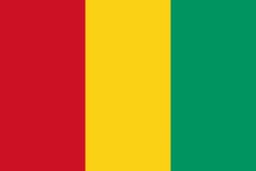
Phone Code
+224
Capital
Conakry
Population
17.5M (2025)
Languages
French · languages of Guinea
Area
245,857 km²
Electricity
220 V
Plug types
Europlug · Schuko · Type K
Driving side
right
Native Name
Guinée
Region
Africa
Western Africa
Timezone
Greenwich Mean Time
UTC±00
On This Page
Guinea — formally the Republic of Guinea and often called Guinea-Conakry to distinguish it from neighbouring Guinea-Bissau and the Spanish-speaking Equatorial Guinea further south — is a francophone West African republic on the Atlantic coast, bordered by Senegal, Mali, Côte d'Ivoire, Liberia, Sierra Leone, and Guinea-Bissau. The country is geographically remarkable: the Fouta Djallon highlands at its centre give rise to three of West Africa's great rivers — the Niger, the Senegal, and the Gambia — earning Guinea the nickname "the water tower of West Africa." Conakry, the capital, sprawls along an Atlantic peninsula and houses roughly two million residents in a port city defined by markets, music, and the sea. Guinea is one of the world's most resource-endowed nations: it holds approximately a quarter of the planet's proven bauxite reserves, is the world's largest exporter of the ore, sits on the Simandou iron-ore belt often described as the largest untapped high-grade iron ore deposit on Earth, and has substantial gold and diamond production. Tourism infrastructure is modest compared with regional neighbours such as Senegal or Ghana, but the natural attractions — the cool, plateau landscapes of the Fouta Djallon, the UNESCO-listed Mount Nimba reserve shared with Côte d'Ivoire and Liberia, the Loos archipelago off Conakry, dense Mandinka and Susu cultural traditions, and a music heritage that reshaped post-colonial African pop — reward travellers willing to plan carefully. French is the official and administrative language; Pular (Fula), Malinké (Mandinka), and Susu are the most widely spoken African languages.
Visa Requirements for Guinea
Guinea requires visas for most foreign nationals. Citizens of ECOWAS (Economic Community of West African States) member countries can enter visa-free for up to 90 days. All other visitors must obtain visas in advance through Guinean embassies or consulates: Guinea does not currently offer visa-on-arrival or a fully reliable e-visa for most nationalities, although electronic application platforms exist and are gradually being expanded. Visa applications require a valid passport (minimum six months validity), completed application forms, passport photos, a yellow fever vaccination certificate (mandatory and strictly enforced at Conakry airport), proof of accommodation, return or onward ticket, and visa fees. Processing times vary by mission. Business visas require an invitation letter from a Guinean partner. Because of the limited number of Guinean missions worldwide and the documentation burden, applicants should plan well in advance.
Common Visa Types
ECOWAS Visa-Free Entry
For citizens of ECOWAS states (Benin, Burkina Faso, Cape Verde, Côte d'Ivoire, Gambia, Ghana, Guinea-Bissau, Liberia, Mali, Niger, Nigeria, Senegal, Sierra Leone, Togo) for any purpose.
Tourist Visa
For tourism, sightseeing, visiting friends/family for nationalities requiring advance visa application.
Business Visa
For business meetings, conferences, trade negotiations, or establishing business relationships in Guinea.
Transit Visa
For travellers transiting through Guinea to another destination.
Important Travel Information
•Yellow fever vaccination: Certificate is...
•Visa in advance required: No...
•Passport validity: Must be valid...
•Language: French is the official...
•Currency: Guinean Franc (GNF). US...
•Health: Malaria is endemic year-round...
•Safety: Exercise caution. Political instability...
•Limited infrastructure: Tourism facilities are...
•Best season: November to April...
•Travel insurance with medical evacuation...
Guinea is a destination for travellers who value landscape, culture, and authenticity over comfort and curated routes. The Fouta Djallon — a sandstone plateau between 900 and 1,500 metres in the country's interior — is the centrepiece, a cool, mist-prone highland of waterfalls (Ditinn, Kinkon, Saala), table mountains, and Pular villages of round huts with conical roofs. The Mount Nimba reserve in the south-east, a UNESCO World Heritage site shared with Côte d'Ivoire and Liberia, protects more than 200 endemic species across a single mountain massif. Conakry is the chaotic, salt-air, music-saturated counterweight: a port city of markets, mosques, palm-lined avenues, and live djembé and balafon performance that traces directly back to Bembeya Jazz National, Mory Kanté, and Sékouba Bambino — the artists who put Guinean rhythms onto the post-independence African stage. The Loos archipelago off Conakry offers low-key beaches reachable by motorised pirogue. Travel logistics are demanding: roads degrade quickly in the rainy season (May–October), distances are slow, and accommodation is basic outside the capital. Best travel window is November to April. Yellow-fever vaccination is mandatory; antimalarial prophylaxis essential.
Discover Guinea
The Fouta Djallon: West Africa's Water Tower on Foot
The Fouta Djallon is the reason Guinea appears on ambitious West Africa itineraries: a sandstone plateau at 900-1,500 metres where the air cools, mists hang in the valleys, and three of the region's great rivers — the Niger, Senegal and Gambia — begin as highland streams. The hiking hub is the village of Doucki, perched above a canyon system that guides have nicknamed Guinea's Grand Canyon, with day routes descending past palm groves and rock arches into green amphitheatres. Dalaba, the old colonial hill station, keeps its pine-scented air and faded villas; Labé is the plateau's Pular capital and market centre. The waterfalls anchor the circuit — Ditinn's single 80-metre plunge, the Kinkon cascades near Pita, the Saala falls — each reached by rough pistes and short walks through villages of round thatched cases where greetings in Pular open every door. Travel here runs on shared taxis, patience and local guides; the reward is highland West Africa with almost no other travellers in the frame.
Mount Nimba and the Forested Southeast
Mount Nimba rises to 1,752 metres where Guinea, Côte d'Ivoire and Liberia meet — a UNESCO World Heritage ridge whose grassland summit and forested flanks hold more than 200 endemic species, most famously the Nimba viviparous toad, the only toad known to give birth to live young, and chimpanzee populations observed using stone tools. This is a Strict Nature Reserve in the technical sense: access requires permits arranged in advance through the Guinean environment authorities and a local guide, and casual walk-ups are turned away — a constraint that has kept the massif one of West Africa's most intact ecosystems even as iron-ore concessions press on its flanks. The gateway towns of Lola and N'Zérékoré, deep in Guinée Forestière, are themselves a cultural shift from the Muslim north — forest-region traditions, mask societies and kola-nut hospitality — and the journey there, two hard days by road from Conakry, explains why the southeast rewards only the well-prepared.
Conakry: Markets, Mosques and Salt Air
Conakry occupies a narrow Atlantic peninsula, which concentrates its two million people and all their commerce into a long, loud, humid ribbon — a city to engage rather than admire. Madina Market, one of West Africa's largest, swallows whole city blocks in cloth, bushmeat, electronics and indigo; go with a local companion, keep valuables minimal, and treat the crowd itself as the spectacle. The Grand Mosque, among sub-Saharan Africa's largest, anchors the skyline; the National Museum holds Nimba masks and Sékou Touré-era iconography in a modest colonial building; and Boulbinet's harbourside shacks serve the day's fish with attiéké as pirogues land the next catch. Evenings are Conakry's redemption: terrace maquis, cold Skol, and live bands in Taouyah and Kipé that keep the city's formidable musical bloodline audible any weekend. Power cuts, traffic and hustle are part of the deal — the city asks for street smarts and returns character.
The Loos Islands: Conakry's Escape Hatch
Twenty to forty minutes off Conakry's tip by motorised pirogue, the Loos archipelago is where the capital exhales. Kassa, the nearest island, fills with day-trippers on Sundays for its palm-backed beaches and grilled-fish shacks; Roume, smaller and prettier, has the sheltered coves and a castaway calm that feels implausible given the city smoke visible on the horizon; Tamara, the largest, adds lighthouse walks and the mossy ruins of the French penal colony that once made the islands a place of exile rather than escape. Boats leave from the Boulbinet and Petit Bateau jetties — agree the fare and the return pickup before boarding, carry water and cash, and aim for a weekday if solitude is the point. Simple guesthouses on Kassa and Roume turn the day trip into an easy overnight; sea state is calmest in the dry season.
The Sound of Guinea: Djembé, Balafon and the Syliphone Legacy
Guinea's outsized place in African music history was state policy: after independence in 1958, Sékou Touré's 'authenticité' programme funded national and regional orchestras, and the state Syliphone label recorded them — giving the world Bembeya Jazz National and a horn-driven dance-band sound that still defines the era's African modernism, later carried global by Mory Kanté's kora-pop and singers like Sékouba Bambino. The living tradition is easy to touch in Conakry: the city is one of the world's great djembé schools, and multi-day drum and dance workshops with master percussionists — often the same families who staff the national ballets — are the most rewarding cultural booking in the country. Balafon traditions run deepest in the Mandinka east around Kankan, and any wedding weekend in the capital doubles as a free percussion festival for whoever is within earshot.
Ways to Experience This Destination
The defining reason most travellers come to Guinea. A sandstone plateau of waterfalls, deep valleys, table mountains and Pular villages, with Dalaba and Labé as the main bases. Trails cross savannah, gallery forest, and grazing land; local guides are recommended; road journeys are long and patience-rewarding. Cooler than the coast, especially November to February.
The Mount Nimba Strict Nature Reserve (UNESCO, 1,752 m) on the borders with Côte d'Ivoire and Liberia harbours over 200 endemic species — including the famous viviparous toad (Nimbaphrynoides occidentalis), the only toad in the world to give birth to live young. Access is restricted and requires permits; the reward is one of West Africa's biologically richest landscapes.
Conakry is dense, hot, and uncompromising — and full of life. Markets at Madina, mosques, the National Museum, fresh-fish lunches at Boulbinet, and the Loos archipelago a short pirogue ride offshore. The islands of Kassa, Tamara, and Roume offer simple beach escapes and colonial-era ruins.
Guinea is one of the cradles of modern West African music. The Mandinka djembé and balafon traditions, Bembeya Jazz National, the orchestras of the Sékou Touré era, and artists from Mory Kanté to Sékouba Bambino define a sonic heritage that travels well. Live performance and dance lessons are part of the Conakry travel experience for those who seek them out.
Guinea suits travellers who deliberately choose a less-visited West African country with cultural depth and limited tourist infrastructure. It rewards patience, French language skills, and good local contacts; it punishes loose planning. For experienced Africa travellers it slots between Senegal and Sierra Leone as one of the region's most compelling unknowns.
Money & Currency
Guinean Franc (GNF)
Currency code: GNF
Practical Money Tips
Bring hard currency — euros or US dollars
Guinea is overwhelmingly a cash economy and reliable cash sources for foreign visitors are scarce. Bring your travel budget in clean, undamaged euro or US dollar notes — both are widely accepted at hotels, money-changers and bureaux de change in Conakry, and large foreign-currency notes generally get the best Guinean Franc (GNF) exchange rate. Smaller denominations are useful for tipping and small purchases. Avoid Scottish pounds, plastic-polymer notes other than euros, and any heavily worn bills — they are routinely refused.
Change money only at banks or licensed bureaux
Exchanging foreign currency on the street is illegal in Guinea, even at the international airport, and the UK Foreign Office has documented arrests and military-custody detentions of travellers caught using unofficial money-changers. Use bank counters and licensed bureaux de change in Conakry instead — Ecobank, Orabank, Vista Bank, and Société Générale Guinée are the most widely used. Always count your money before leaving the counter and request a receipt for larger amounts.
ATMs are limited to Conakry and unreliable
There are only a small number of ATMs accepting foreign Visa or Mastercard, almost all of them in central Conakry, and they dispense only modest amounts before running out of notes. ATMs should be treated as a backup, not as a primary source of money. Outside the capital, ATM access for foreign cards effectively does not exist. Bank ATMs in well-lit, secure locations during business hours are the safest option; avoid standalone street machines.
Cards rarely accepted; mobile money is for locals
Visa and Mastercard are accepted only at a handful of upscale hotels in Conakry (Sheraton/Noom, Radisson Blu, Riviera Royal, Onomo) and at a few high-end restaurants and travel agencies. Everywhere else — markets, transport, smaller hotels, all of upcountry Guinea — payment is in Guinean Francs in cash. Mobile-money platforms like Orange Money and MTN Mobile Money are dominant for everyday domestic payments but require a local SIM and a Guinean ID/registration to use, so they are not a practical option for short-stay visitors.
Carry small notes and exchange in stages
GNF banknotes circulate in 500, 1,000, 2,000, 5,000, 10,000, and 20,000 denominations; coins are essentially absent. Inflation means small purchases routinely cost tens of thousands of francs and your wallet will be thick. Change foreign currency in stages rather than all at once — both for security and to avoid being left with large amounts of GNF on departure. Note the export limit: travellers leaving Guinea cannot take more than 100,000 GNF or the equivalent of 5,000 USD/EUR in foreign currency.
Note: Always check current exchange rates before traveling. Currency exchange is available at airports, banks, and authorized money changers.
What is the currency of Guinea?
Can I use euros or US dollars in Guinea?
Are ATMs reliable in Guinea?
Are credit cards widely accepted?
Is tipping customary in Guinea?
Are there limits on bringing in or taking out cash?
How safe is it to carry cash?
Guinea — Embassies worldwide
Popular Destinations
Top destinations with verified missions
All Countries by Continent
Embassies in Guinea
These foreign embassies and consulates are based here. Choose a mission to open its in-depth guide and contact details.
Key origin countries


All countries by continent
Europe(1)

Do I need a visa for Guinea?
Most visitors do. Only ECOWAS member-state citizens enter visa-free for up to 90 days. Everyone else must apply for a visa in advance through a Guinean embassy or consulate — Guinea has no reliable visa-on-arrival or e-visa for most nationalities.
Is yellow fever vaccination required?
Yes — a certificate is mandatory for all visitors regardless of origin and is strictly enforced at Conakry airport. Bring the physical certificate, as digital copies aren't accepted.
What's the main reason to visit Guinea?
The Fouta Djallon highlands — a cool, waterfall-dotted sandstone plateau of Pular villages — draw most travellers, alongside the UNESCO Mount Nimba reserve and Conakry's Mandinka music scene, one of the cradles of modern West African music.
How difficult is travel logistics in Guinea?
Demanding — roads degrade quickly in the rainy season (May-October), distances take longer than they look on a map, and accommodation outside Conakry is basic. Patience and flexibility matter more than a tight itinerary.
When is the best time to visit Guinea?
November to April, the dry season, is the realistic travel window — the rainy season makes overland travel and many secondary roads difficult or impassable.
Is French necessary for travel in Guinea?
Essentially yes — French is the official and administrative language, and English is very limited outside international business and diplomatic settings. Basic French phrases make independent travel far more workable.
Planning a trip to Guinea? Check what you need to enter and apply online in minutes.
Apply for your eVisaThis overview comes from Visaja's worldwide missions database (visaja.com), checked against official government sources; for binding answers, the mission itself always has the final word.