- Population:~440k city, ~1.5M metro
- Timezone:CET/CEST (UTC+1/+2)
- IATA:ZRH
- Currency:Swiss franc (CHF). Cards are accepted almost everywhere.
- Key Areas:Altstadt / Lindenhof (Kreis 1) · Niederdorf (Kreis 1 right bank) · Seefeld (Kreis 8, lakefront) · Zürich West / Im Viadukt (Kreis 5)
Overview
Zurich is Switzerland's largest city, its banking capital and its main rail and air hub, set at the northern end of Lake Zurich where the Limmat leaves the lake.
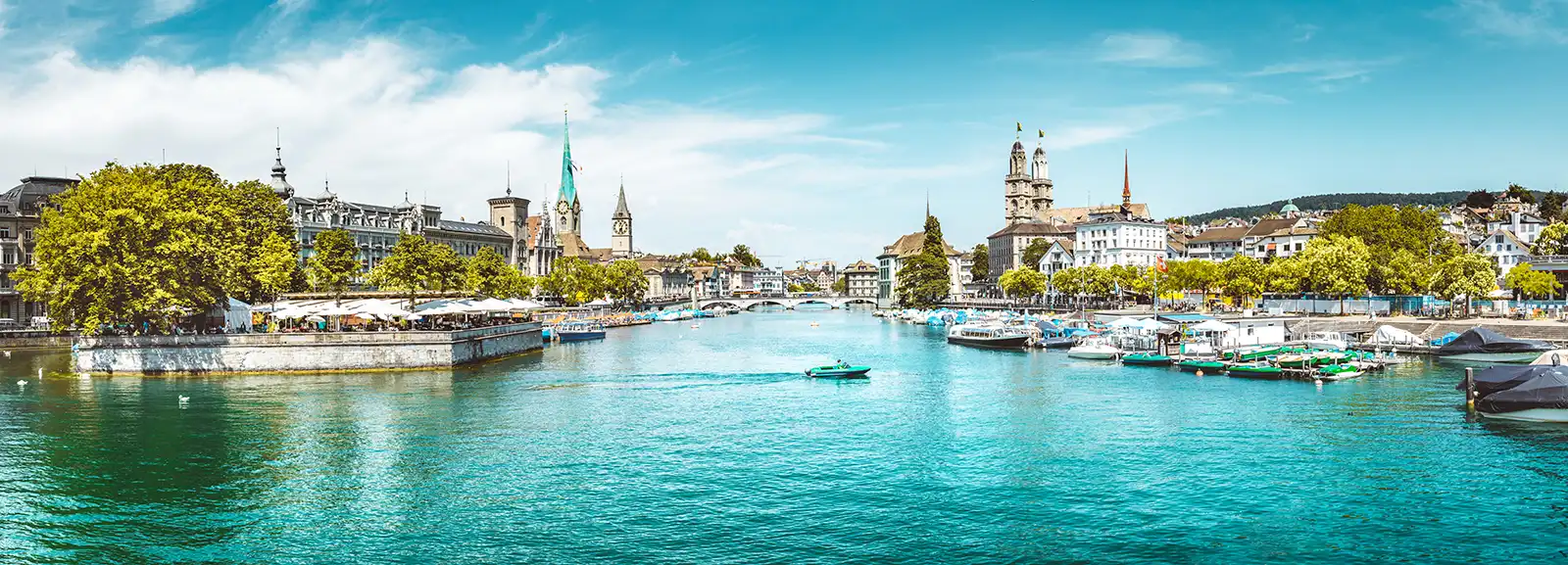
The Limmat through Zurich's Altstadt — Grossmünster and Fraumünster within a few hundred metres.
© JFL Photography / Adobe Stock
Practical Info
Language: Swiss German in its Zurich dialect is spoken, and standard German is the written language; English is widely understood in hotels, shops and museums. Currency: Swiss franc (CHF). Cards are accepted almost everywhere.
Travel
Zurich sits at the northern end of Lake Zurich, where the Limmat leaves the lake and flows north through the old town. The medieval centre covers both banks of the river — the Niederdorf lanes on the right, the Lindenhof hill and Bahnhofstrasse on the left — and is small enough to cross on foot in about twenty minutes. Trams reach everything beyond it, from the former industrial quarter of Zurich West to the lake baths, and boats sail from the quays up the lake. Zurich HB, the main station, is the busiest junction of the Swiss rail network, so much of the country lies within a day trip, and the canton beyond the city limits adds Winterthur, the lakeshore villages and the Uetliberg ridge.
Lindenhof and the Fraumünster
The Lindenhof, a tree-shaded terrace on a hill above the left bank of the Limmat, is where Zurich began: the Romans kept a customs post here, and later a fort. It holds the old town's classic view, across the river to the roofs of the Niederdorf, the twin towers of the Grossmünster and, on the slope above them, the main buildings of the university and ETH. Lanes lead down from the hill to the Fraumünster on the riverbank, whose choir holds five stained-glass windows by Marc Chagall, completed in 1970, each telling a biblical story in deep, saturated colour.
The Grossmünster and the Niederdorf
Across the river, the twin towers of the Grossmünster are Zurich's landmark. Huldrych Zwingli began preaching here in 1519, and the Reformation he led left the interior plain; its colour comes from the windows, Augusto Giacometti's in the choir and Sigmar Polke's of 2009, several of them made of thin slices of agate. One of the two towers, the Karlsturm, can be climbed for a view over the river and the lake. North of the church the Niederdorf follows the right bank, a car-free knot of lanes along Niederdorfstrasse, with the guild houses of the Limmatquai facing the river.
Cabaret Voltaire and James Joyce
In the Niederdorf, at Spiegelgasse 1, the Cabaret Voltaire is where Hugo Ball, Emmy Hennings, Hans Arp, Tristan Tzara and others launched Dada in February 1916, and the house is again an arts venue with exhibitions and evening events. James Joyce lived in Zurich from 1915 to 1919, writing much of Ulysses here, and came back to die in the city in 1941; his grave, with a seated statue of the writer, lies in the Fluntern cemetery on the Zürichberg, next to the zoo. The Zurich James Joyce Foundation, on Augustinergasse just off Bahnhofstrasse, keeps a library devoted to his work.
ETH and the Polyterrasse
From Central, the square at the northern end of the Niederdorf, the Polybahn, a small red funicular, climbs in a couple of minutes to the Polyterrasse in front of the main building of ETH Zurich, the federal institute of technology where Albert Einstein studied. The terrace looks over the old town's roofs and towers to the lake and, on clear days, the Alps, and the main building of the University of Zurich stands next door.
The Kunsthaus and Museum Rietberg
The Kunsthaus, on Heimplatz a few minutes uphill from Bellevue, the tram junction at the lake end of the right bank, has been Switzerland's largest art museum since David Chipperfield's extension opened across the square in 2021, joined to the original building of 1910 by a passage under the street. Its collection runs from Swiss painting, Füssli to Hodler, to a large group of works by Edvard Munch, Monet and the Impressionists, Picasso and post-war art, and it shows the Alberto Giacometti Foundation's collection of the sculptor's work. Museum Rietberg, in the park of a 19th-century villa in Enge, on the west side of the lake, holds art from Asia, Africa and Oceania.
The Swiss National Museum
The Swiss National Museum (Landesmuseum) stands beside the main station in a turreted, castle-like building opened in 1898, with a concrete extension added in 2016. Its collections follow the country's story from prehistoric finds and medieval altarpieces to furniture, costume and panelled period rooms rebuilt inside the building. Behind it, the Platzspitz park fills the point where the Sihl flows into the Limmat.
Bahnhofstrasse and Paradeplatz
Bahnhofstrasse runs 1.4 kilometres from the main station to the lake at Bürkliplatz, a street of department stores, watch and jewellery houses and fashion flagships, given over to trams and pedestrians. Halfway along, Paradeplatz is the heart of Swiss banking, with bank headquarters on its sides and tram lines crossing in the middle. Between Bahnhofstrasse and the Lindenhof, Rennweg and Augustinergasse keep the small scale of the old town, and the houses of Augustinergasse carry painted oriel windows.
The Lakefront and the Pavillon Le Corbusier
At Bürkliplatz, where Bahnhofstrasse ends, Lake Zurich opens to the south-east, about 40 kilometres long, and promenades follow both shores out of the centre: on the east side along Utoquai and through Seefeld to the Zürichhorn park, on the west along Mythenquai. In the Zürichhorn park, the Pavillon Le Corbusier, the architect's last building, completed in 1967 after his death, shows his work in a pavilion of glass and coloured enamelled steel. Lake boats leave Bürkliplatz for short round trips and the long run up the lake to Rapperswil, and smaller boats ply the Limmat between the National Museum and the Zürichhorn.
Swimming in the Lake and the Limmat
From late spring to early autumn, Zurich swims in its lake and its river, in public baths (the Badis) a short walk or tram ride from the centre. Seebad Enge on the west shore and the beaches at Mythenquai and Tiefenbrunnen are on the lake; the Frauenbad at Stadthausquai, a wooden bath for women by day, stands in the Limmat itself, and downstream at the Oberer Letten locals jump in and drift with the current. On summer evenings several of the baths turn into bars.
Zurich West
Zurich West, the former industrial quarter of the fifth district (Kreis 5) around Escher-Wyss-Platz, has turned its factories and rail yards into a district of culture and new building. Im Viadukt fills the stone arches of a railway viaduct with shops, studios and a covered food market, and the Schiffbau, the old shipbuilding hall of the Escher Wyss works, is a stage of the Schauspielhaus Zürich, the city's main theatre. The 126-metre Prime Tower rises beside the Hardbrücke station, and next to the station the Freitag bag company's tower of stacked shipping containers, with a lookout at the top, is the district's landmark.
Langstrasse after Dark
Langstrasse, the long street through Kreis 4, the district next door, is Zurich's nightlife quarter: bars, clubs and late kitchens of many cuisines line it and its side streets, and part of it is still the city's red-light district. Together with the bars and clubs of Zurich West, it is where the city goes out.
Eating in Zurich: Geschnetzeltes and Luxemburgerli
Zurich's own dish is Zürcher Geschnetzeltes, strips of veal in a cream and white-wine sauce with mushrooms, served with rösti, the crisp potato cake that gave its name to the Röstigraben, the line between German- and French-speaking Switzerland. Confiserie Sprüngli, on Paradeplatz since 1859, is known for its Luxemburgerli, bite-sized macarons, and Hiltl, opened on Sihlstrasse in 1898, is listed by Guinness World Records as the world's oldest vegetarian restaurant.
Frequently asked questions
How do I get from Zurich Airport to the city centre?
How do I get around Zurich?
How many days do I need in Zurich?
Which day trips are easiest from Zurich?
When is the best time to visit Zurich?
Transport & airports
Tourism & destination guides
Culture & festivals
Switzerland's largest art museum including the 2021 Chipperfield extension; home to the Giacometti Foundation and major European and twentieth-century collections.
National history and culture collection from pre-Roman artefacts to contemporary Swiss design in the Neo-Gothic building beside Zürich HB.
Diplomatic missions in Zürich
13 embassies based in this city, grouped by region.
Europe6
Americas4
Visaja keeps this page's contact details and visa guidance under continuous review — still, requirements can change at short notice, so confirm the essentials with the mission or the official government portal before you travel.