- Population:~440k city, ~1.5M metro
- Timezone:CET/CEST (UTC+1/+2)
- IATA:ZRH
- Currency:Swiss franc (CHF). Cards are accepted almost universally in Zürich. The Zürich Card (24hr CHF 29, 72hr CHF 54) covers all public transport and 40+ museum admissions. ATMs are plentiful and dispense CHF; euros are not standard tender in shops.
- Key Areas:Altstadt / Lindenhof (Kreis 1) · Niederdorf (Kreis 1 right bank) · Seefeld (Kreis 8, lakefront) · Zürich West / Im Viadukt (Kreis 5)
Overview
Zürich is Switzerland's largest city and financial capital, built around a medieval Altstadt divided by the Limmat, a lakefront that functions as a communal park, and one of Europe's most integrated urban transit systems.
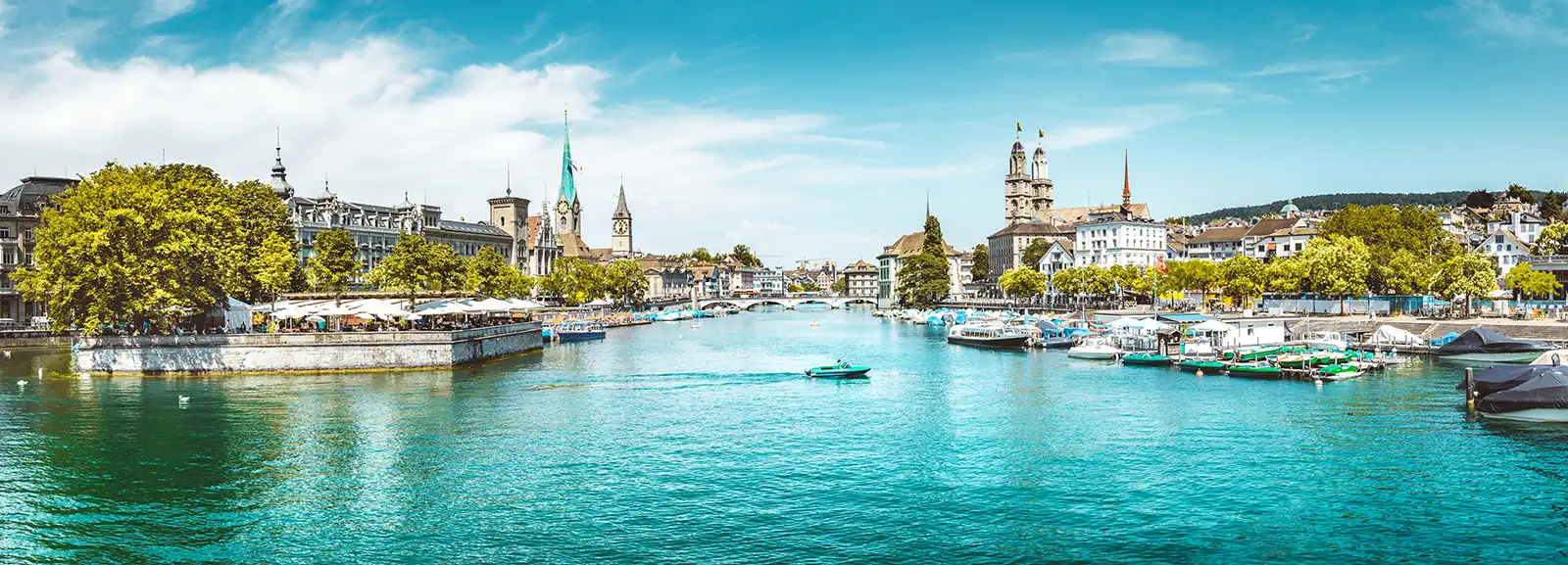
The Limmat through Zurich's Altstadt — Grossmünster and Fraumünster within a few hundred metres.
© JFL Photography / Adobe Stock
History
Roman troops established a customs post at Turicum on Lindenhof hill in the first century BCE, controlling the river crossing and the Alpine trade routes. The city received imperial charter status in 1218. In 1519, Huldrych Zwingli began preaching at the Grossmünster, launching the Swiss Reformation that would spread across Northern Europe and reshape the relationship between church and state. Zürich joined the Swiss Confederation fully in 1351. In the twentieth century the city became a refuge for intellectual and artistic exiles: the Dada movement was founded at the Cabaret Voltaire in 1916; James Joyce wrote large sections of Ulysses here during two stays; Lenin spent time in the city before the Russian Revolution. ETH Zürich, founded in 1855, became one of the world's leading scientific institutions, educating Einstein and producing more than 20 Nobel laureates.
Culture
Züri-Geschnetzeltes (sliced veal in cream and white-wine sauce over Rösti) is the city's defining dish — served at Zeughauskeller (vaulted armory restaurant near HB) and Kronenhalle (art-covered walls; Picasso settled his bill with a painting). Confiserie Sprüngli on Paradeplatz has produced Luxemburgerli macarons and chocolate truffles since 1859. Hiltl on Sihlstrasse, founded 1898, is the world's oldest vegetarian restaurant. Zürich's coffee culture centres around the Café Odéon (Art Nouveau, lake-view terrace) and a dense cluster of specialty roasters in Kreis 4 and 5. Festivals: Street Parade (August) — Europe's largest techno parade, 1M+ participants on lakefront, Zürich Film Festival (October) — major international competition, Zürifäscht (July, every 3 years) — lakefront city festival, Zürich Christmas market inside Zürich HB (December) — one of Switzerland's largest, Zürich Pride (June). Museums: Kunsthaus Zürich — Switzerland's largest art museum; Chipperfield extension 2021; world's largest Giacometti collection, Schweizerisches Nationalmuseum — Swiss National Museum in Neo-Gothic building beside HB, Museum Rietberg — Asian, African, and Oceanic art in Rieter Park, Museum für Gestaltung — design, graphic, and applied arts, Haus Konstruktiv — concrete and constructivist art, FIFA World Football Museum — permanent football history exhibition.
Practical Info
Safety: Zürich consistently ranks among the world's five safest large cities. The Langstrasse area has visible street life late at night but no particular danger for alert visitors. Standard awareness around Zürich HB at late hours is sufficient. Language: Swiss German (Züridütsch dialect) dominates daily speech; High German, French, and English are widely understood in transport, hospitality, and business contexts. Museum labels are typically in German and English. Currency: Swiss franc (CHF). Cards are accepted almost universally in Zürich. The Zürich Card (24hr CHF 29, 72hr CHF 54) covers all public transport and 40+ museum admissions. ATMs are plentiful and dispense CHF; euros are not standard tender in shops.
Travel
Zürich rewards visitors who resist the temptation to treat it as a transit hub and instead use its scale to their advantage. The city is compact enough to cover on foot and tram, yet large enough to absorb several days without repetition. Its old town spans both banks of the Limmat in a dense knot of guild-house facades, Reformation churches, and the narrow lanes where the Dada movement was born in 1916. Lake Zürich — a 40-kilometre glacier lake that begins at the city's southern edge — frames the skyline and provides a ring of waterfront promenades, park lawns, and public bathing establishments that remain genuinely central to daily life throughout the warmer months. Bahnhofstrasse runs 1.4 kilometres from the main train station to Bürkliplatz on the lake — one of the world's most architecturally coherent luxury shopping streets, anchored at its midpoint by Paradeplatz, the historic nerve centre of Swiss private banking where UBS occupies twin neoclassical buildings. From Bahnhofstrasse the visitor is ten minutes' walk from the Kunsthaus — Switzerland's largest art museum, expanded in 2021 by David Chipperfield to house the world's most important Giacometti collection alongside European old masters and twentieth-century modernism. Zürich West, the former industrial quarter of the fifth district, has become one of Europe's more convincing cases of adaptive urban reuse: railway arches turned market, a converted ironworks turned theatre, a tower of stacked shipping containers turned Freitag flagship. Langstrasse, once Zürich's red-light district, has evolved into the city's most energetic nightlife corridor. Meanwhile, the S-Bahn and InterCity network radiating from Zürich HB makes day trips to the Rheinfall, Lucerne, and the Bernese Oberland genuinely quick.
Altstadt: Reformation, Dada, and the Limmat
Zürich's old town occupies both banks of the Limmat and rewards slow exploration on foot. On the right bank, Grossmünster's twin Romanesque towers mark the site where Huldrych Zwingli launched the Swiss Reformation in 1519, reshaping the religious geography of Northern Europe. The minster's treasury holds early Reformation artefacts and a Giacometti-designed window. Across the river, the Fraumünster contains five nave windows by Marc Chagall commissioned in 1970 — five distinct biblical narratives in blue, green, red, yellow, and violet glass that remain the most visited single artwork in the city. Nearby, the Cabaret Voltaire in Niederdorf marks the narrow Spiegelgasse address where Hugo Ball, Emmy Hennings, Jean Arp, and others founded Dada in 1916. Lindenhof hill, a former Roman fortification above the left bank, offers the best view of both church towers and the river bend.
Lake Zürich: promenades, bathing, and the gold coast
Lake Zürich extends forty kilometres south of the city and shapes Zürich's quality of life as much as any built structure. The lakefront is a continuous park system from Enge through Zürichhorn, with public bathing establishments (Seebad Enge, Frauenbad Stadthausquai, Zürichhorn beach) operating from late spring through early autumn. Bürkliplatz — where Bahnhofstrasse ends at the water — hosts a Saturday flea market year-round and a flower market on Tuesday and Friday. On the eastern shore, Seefeld is Zürich's most affluent residential neighbourhood, with lakefront restaurant terraces and a walking path that continues to Küsnacht. The Zürichhorn park holds the Centre Le Corbusier, a late glass-and-steel pavilion completed in 1967 and reopened as a permanent Le Corbusier exhibition after conservation.
Bahnhofstrasse and Paradeplatz
Bahnhofstrasse was built in 1865 on the filled-in city moat and runs 1.4 kilometres from Zürich HB to the lake at Bürkliplatz. The street is shared by trams and pedestrians; its cross-streets reveal quiet arcade passages and the courtyard interiors of private banks. Paradeplatz, the mid-street junction, is flanked by the twin neoclassical buildings of what was formerly Credit Suisse and UBS — the two addresses that defined Swiss private banking for a century. The Confiserie Sprüngli at the corner has sold Luxemburgerli macarons and chocolate truffles here since 1859. In the other direction from HB, Löwenstrasse and Augustinergasse connect to the wholesale market and to the Augustinerkirche, a small fourteenth-century church with a bare interior typical of Zwinglian reform.
Kunsthaus Zürich and the museum quarter
The Kunsthaus Zürich is Switzerland's largest art museum and the city's principal cultural institution. The 2021 extension by David Chipperfield — a rectilinear limestone block connected to the 1910 original by an underground passage — doubled exhibition space and rehoused the Alberto Giacometti Foundation collection, the most comprehensive concentration of the sculptor's work in the world. The permanent collection spans Raphael to Gerhard Richter and includes a strong French impressionist holding and major works by Monet, Munch, Picasso, and Warhol. Around the corner, the Schweizerisches Nationalmuseum in a Neo-Gothic railway-adjacent building provides the national historical collection from pre-Roman artefacts to modern Swiss design. Museum Rietberg in the Rieter Park villa concentrates on Asian, African, and Oceanic art.
Zürich West: industrial reinvention
The fifth district — Zürich West — was an industrial zone of gasworks, ironworks, and rail yards through the twentieth century. Since the 1990s, it has been progressively converted into one of Europe's more convincing cases of adaptive reuse. Im Viadukt turned the 540-metre stone railway arches into a covered market and independent shops. Schiffbau, a former shipbuilding ironworks beside the Limmat, is now a theatre and restaurant complex for the Zürich Schauspielhaus. The Prime Tower by Gigon/Guyer was Switzerland's tallest building from 2011 to 2020. The Freitag flagship at the corner of Geroldstrasse and Hürlimannstrasse is a nine-storey tower of stacked shipping containers selling the recycled-tarpaulin bags made in Zürich since 1993. Langstrasse, the main artery of Kreis 4, is Zürich's liveliest street for restaurants, bars, and night venues from Tuesday onwards.
Day trips from Zürich HB
Zürich HB is one of Europe's busiest rail hubs and a superb day-trip base. The Rhine Falls at Schaffhausen — Europe's largest waterfall by volume — are reached in 45 minutes by direct train. Lucerne is 50 minutes by InterRegio and connects via lake ferry or rack railway to the summit of Mt. Pilatus (2,132m) or Rigi for panoramic Alpine views. Stein am Rhein, a medieval river town with painted façades, is under an hour by regional train. The Bernese Oberland — Interlaken, Grindelwald, Jungfrau — is around two hours. Lake Constance and the monastery island of Reichenau are reachable in 90 minutes. All these routes run directly from Zürich HB without transfers, using standard SBB tickets or the Swiss Travel Pass.
James Joyce, Lenin, and intellectual Zürich
Zürich's compactness and neutrality made it a refuge for twentieth-century intellectual life. James Joyce lived on Universitätstrasse and in Fluntern between 1915 and 1919, writing large sections of Ulysses in city cafés and libraries; he died here in 1941 and is buried in Fluntern Cemetery. A plaque at Spiegelgasse 14 marks where Vladimir Lenin lodged in 1917 before travelling to Russia in a sealed train. The Dada movement was formally launched at Spiegelgasse 1 (Cabaret Voltaire) in February 1916. ETH Zürich, the federal polytechnic on Rämistrasse hill, educated Albert Einstein and has produced more than 20 Nobel laureates; the Polybahn funicular from Central takes two minutes to the campus and its panoramic terrace. The James Joyce Foundation on Augustinergasse runs guided city walks and maintains the Joyce archive.
Getting around Zürich
Zürich Airport (ZRH) is directly connected to Zürich HB by S-Bahn in ten minutes; trains run every few minutes. Within the city, the ZVV integrated network covers trams, trolleybuses, and S-Bahn lines under a unified fare structure. The Zürich Card (24hr CHF 29, 72hr CHF 54) covers unlimited travel on all ZVV services and free or reduced admission to over forty museums including the Kunsthaus and National Museum. Trams 4, 13, and 14 serve the main visitor corridors. The S10 links the airport directly to HB without any intermediate stops. CHF is the currency; cards are accepted almost everywhere in Zürich, but small kiosks and the Saturday Bürkliplatz flea market typically prefer cash.
Frequently asked questions
Is Zürich just a transit hub, or worth several days?
What is the best day trip from Zürich?
How do I get from Zürich Airport to the city centre?
Is Zürich an expensive city to visit?
Transport & airports
Official transport authority covering tram, S-Bahn, and bus fare zones, timetables, and the Zürich Card integration.
National timetable and booking for day trips from Zürich HB to Rhine Falls, Lucerne, Stein am Rhein, and Alpine destinations.
Tourism & destination guides
Culture & festivals
Switzerland's largest art museum including the 2021 Chipperfield extension; home to the Giacometti Foundation and major European and twentieth-century collections.
National history and culture collection from pre-Roman artefacts to contemporary Swiss design in the Neo-Gothic building beside Zürich HB.
Diplomatic missions in Zürich
13 embassies based in this city, grouped by region.
Europe6
Americas4
Visaja keeps this page's contact details and visa guidance under continuous review — still, requirements can change at short notice, so confirm the essentials with the mission or the official government portal before you travel.