
Itinerary
Planning an Australia Trip
The most common mistake in planning an Australian trip is treating the country as a destination rather than as a continent with several. Sydney, the reef, Uluru and Melbourne appear on the same itinerary constantly, and that itinerary involves four flights and spends more of its time in transit than in any of the four places. The alternative is to choose one shape and do it properly. There are four that genuinely work, and the useful thing is to know what each gives you and what choosing it costs.
Updated 2026-08-15
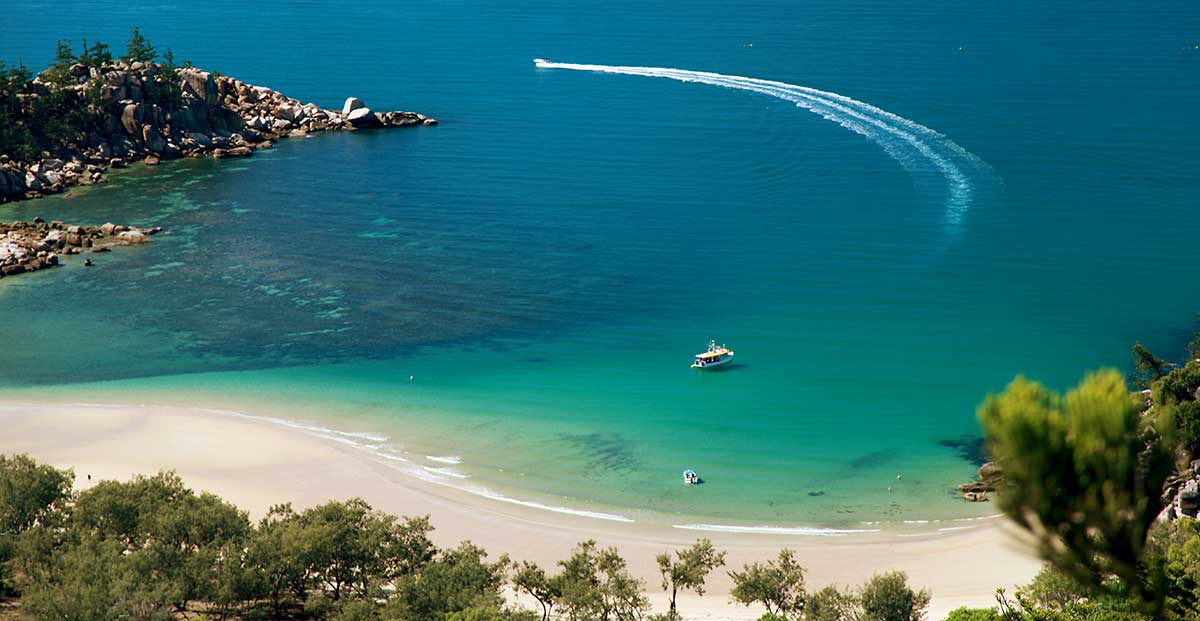
The reef corner of an Australia trip runs on day boats out of Cairns and Port Douglas.
The east coast run
This is the default and it is popular for good reason: Sydney up to Cairns, or the reverse, taking in the beaches, the surf towns, the subtropical hinterland, the islands and, at the northern end, the reef and the rainforest. It is the most infrastructure-dense corridor in the country, which means it works by campervan, by hire car, by coach or by a series of short flights, and it is the easiest Australian trip to improvise as you go.
Give it three weeks to enjoy, two to cover, one to regret. What it gives you is variety without difficulty and a warm-water coastline for most of its length. What it costs you is the interior — this trip contains no desert, no Uluru and no outback at all, and visitors who want the Australia of the red centre will not find it here. It also has the highest density of other travellers of any route in the country, which is either the point or the drawback depending on who you are.
The Centre and the Top End
The second shape is the interior and the tropical north: Uluru and Kata Tjuta, the desert ranges around Alice Springs, and then north to Kakadu, the gorges and Darwin, all of it in the Northern Territory. This is the trip that delivers the Australia of the imagination — red country, enormous skies, rock that changes colour, and a cultural depth the coast does not offer in the same way.
Two weeks does it comfortably and one week does half of it. The critical constraint is season, and it is unforgiving: the Top End is effectively closed by water through the tropical wet, while the Centre is at its best in the cooler months and dangerous in high summer. Get the months wrong and this trip does not work at all, which is not true of any of the others. What it costs you is the coast and the cities — there is no surf here, no reef, and the two settlements are small.
The west
The third shape is Western Australia, and it is the one most first-time visitors never consider. It comes in two depths. The lighter version runs from Perth through the south-west — the island of small marsupials, the wine and forest country, the southern beaches — and then north up the coral coast to Ningaloo, where the reef is close enough inshore to swim to from the sand and the whale sharks gather in the first half of the year. The heavier version is the Kimberley in the far north: unsealed gorge country, only accessible in the dry season, and one of the most spectacular parts of Australia.
Two weeks for the coast, and the Kimberley wants its own two on top. What this trip gives you is emptiness — genuinely fewer people than anywhere else on this list, at sites that elsewhere would be crowded. What it costs you is time in the air, because the west is a long way from everything else in the country, and the internal distances are the largest you will drive anywhere in Australia.
The south
The fourth shape is the temperate south-east: Melbourne, the Great Ocean Road running west of it, the ranges, and across the strait to Tasmania for the wilderness, the walking and the food. It is the most compact of the four, it has the best eating in the country by a clear margin, and it is the only one where distances are European rather than Australian.
Ten days to two weeks, and it is the easiest to extend or shorten. It suits people who want to walk, eat and drive rather than lie on a beach, and it is the best cool-weather option — this is the trip to take in the southern summer, when the north is either underwater or too hot. What it costs you is the tropical Australia entirely: no reef, no rainforest, no desert, and a climate most visitors did not fly this far to find.
Combining them, and the honest arithmetic
People do combine two of these, and it can work, but the arithmetic should be explicit. Each pairing costs a minimum of two internal flights and most of two days in airports and transfers, and the internal legs are long — several hours in the air, not the forty-minute hops that make multi-region trips easy in Europe or Japan. So a fortnight covering two shapes is realistically ten days of content, and a fortnight covering three is a tour of Australian airports. Those internal legs are flown more often than driven: the inter-city distances run into days behind the wheel, and most hire agreements forbid unsealed tracks outright.
If you have three weeks or more, the pairings that work best are the ones that share a season and an axis: the east coast with the Centre, since Cairns and the Top End are both dry-season destinations and the flight is short; or the south with the Centre, which contrasts well and puts a cool-weather half against a desert half. The pairing to avoid is the west with anything, because the distances are punitive and the west deserves better than four days.
And if you have one week, take one shape and only part of it. A week in the south, or Sydney and the reef, or the Centre alone, is a good holiday. A week attempting the country is a series of airports with views between them, and it is the single most common way people come home saying Australia was tiring.