
Travel deep dive
Australian Wildlife
Australia's animals are the reason a great many people come, and a surprising number of those people go home having seen almost nothing. The usual explanation offered is bad luck. It is almost never bad luck: it is that most Australian mammals are nocturnal or crepuscular, and a visitor looking for them between ten in the morning and four in the afternoon is looking during the hours when they are asleep. Fix the timing and the country becomes extraordinarily generous.
Updated 2026-08-15
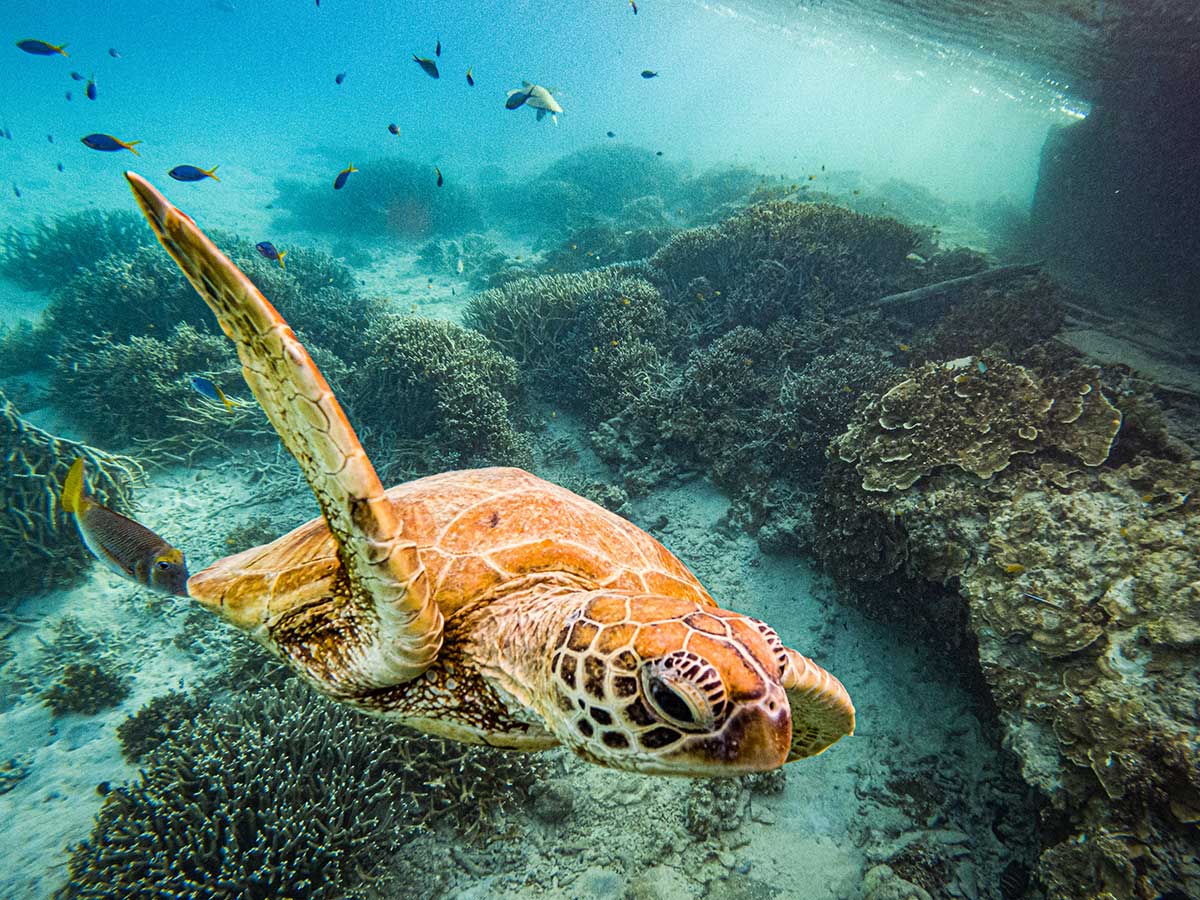
The reef's shallows — where most of Australia's marine wildlife encounters actually happen.
Why the animals are so strange
Australia separated from the other southern landmasses a very long time ago and drifted north in isolation, and its mammals evolved down a different road from almost everywhere else. Marsupials — which carry their young in a pouch through a long external infancy — became the dominant land mammals here rather than a curiosity, filling the roles that deer, cats and rodents fill on other continents. Kangaroos and wallabies are grazers, quolls are predators, wombats are burrowers, gliders occupy the trees.
Stranger still are the monotremes, the egg-laying mammals, of which the world has only a handful of species and all of them live here or in New Guinea: the platypus, which is a venomous, electro-sensing, duck-billed, egg-laying mammal and was widely assumed to be a hoax when the first specimen reached Europe, and the echidna, a spined ant-eater that also lays eggs. Seeing either in the wild is a genuine event.
The birds are the under-sold half of the story. Australia has an exceptional number of parrots and cockatoos, many of them loud, common and startlingly coloured in ordinary suburbs, and the songbird lineage that produced most of the world's singing birds appears to have originated here. A lyrebird imitating the other species around it — and, notoriously, whatever machinery it has heard — is among the best things in any forest on earth.
The timing problem, and how to solve it
The practical rule is simple: dawn and dusk. Kangaroos and wallabies come out of cover to graze in the last hour of light and the first of the morning, wombats emerge in the evening, possums and gliders after full dark, and platypus are active in the low light at either end of the day. The middle of the day is when almost none of it is visible, which is exactly when most visitors go looking.
The second solution is the guided spotlight walk — an hour or two after dark with someone who knows the ground and carries a proper torch. These run in many national parks and forest areas, they routinely turn up half a dozen species you would never find alone, and they are the single best-value wildlife activity in the country. The third is simply to stay somewhere rural. Wildlife tends to arrive at the edges of paddocks and lodges at dusk without any effort at all, and a night in the bush usually beats a day of driving to look.
The exception worth managing expectations about is the koala. They sleep for the large majority of the day, they sit high and still in eucalypts, and they are extremely well camouflaged — visitors regularly walk beneath them without seeing one. They are genuinely common in specific areas rather than distributed everywhere, so go where they are known to be, look up slowly, and take the sleeping grey lump as a success rather than a disappointment.
What to see, and roughly where
Kangaroos and wallabies are effectively everywhere outside the cities and often on their edges — golf courses, coastal reserves and rural roadsides at dusk. Wombats are most reliable in Tasmania and the alpine country of the south-east. Echidnas turn up unpredictably across the whole country and are usually found by someone walking slowly. Platypus want quiet freshwater on the eastern side of the continent, watched from a bank in the half-light without talking.
Some species are effectively confined to one place, which makes those places worth the detour. The small photogenic marsupial that has become a symbol of Western Australia lives on one island off the west coast and is unbothered by people. The Tasmanian devil is limited to Tasmania and is best seen at conservation facilities where breeding programmes work against the disease that has affected wild populations. The cassowary — a very large, flightless, genuinely powerful bird — lives in the far north Queensland rainforest and is watched from a distance, not approached. Dingoes are widespread, most visibly on one Queensland sand island, and are wild predators regardless of how much they resemble a dog. It is almost never the animals with the reputation that hurt people: deaths from snakes and spiders are vanishingly rare, and the risks that actually injure visitors are sunburn, rip currents, heat and long drives.
Penguins come ashore at dusk at several places along the southern coasts, arriving in numbers out of the surf and crossing the beach to their burrows. It is a well-organised and genuinely charming thing to watch, and every site that runs it enforces a no-flash-photography rule for the birds' sake.
The water, and doing it well
Marine wildlife is where Australia is at its most spectacular and its most seasonal. Humpback whales migrate along both coasts, broadly heading north through the cooler months and back south with calves later, and are watched from headlands and boats along most of that route; southern right whales winter on the southern coast. Whale sharks gather off the west coast in the first half of the year, on Ningaloo's fringing reef in Western Australia, and manta rays are present for much of the year. Sea turtles nest on tropical beaches in summer and hatch weeks later. Sea lions and fur seals occupy specific colonies on the southern coast, and in one southern gulf an enormous aggregation of cuttlefish gathers each winter in a display that divers travel a long way for.
Two rules make all of this better and are worth taking seriously. Do not feed wild animals — it makes them sick, makes them dependent, and makes them dangerous to the next person; the places where this has gone badly wrong are the places with the strictest rules. And choose operators and facilities that put the animal first: licensed swim programmes with limits on numbers and distance, sanctuaries that rehabilitate and release, and rules about handling that they enforce rather than waive.
On handling in particular: whether a visitor may hold a koala is a matter of state regulation, permitted in some states and prohibited in others, and it changes — check locally rather than assuming, and treat a facility that offers something the state next door has banned as a question rather than an opportunity. Wildlife hospitals and rescue groups operate across the country and many welcome visitors; they are usually a better hour than a photo.