Visit Cairo, Egypt: visa, Pyramids & 22 million stories
Apply for your eVisa- Population:22M metro
- Timezone:EET (UTC+2)
- IATA:CAI
Overview
Cairo is the city that never sleeps because it never had the option — 22 million people, 5,000 years of history, and the Pyramids of Giza literally visible from the Ring Road traffic jams.
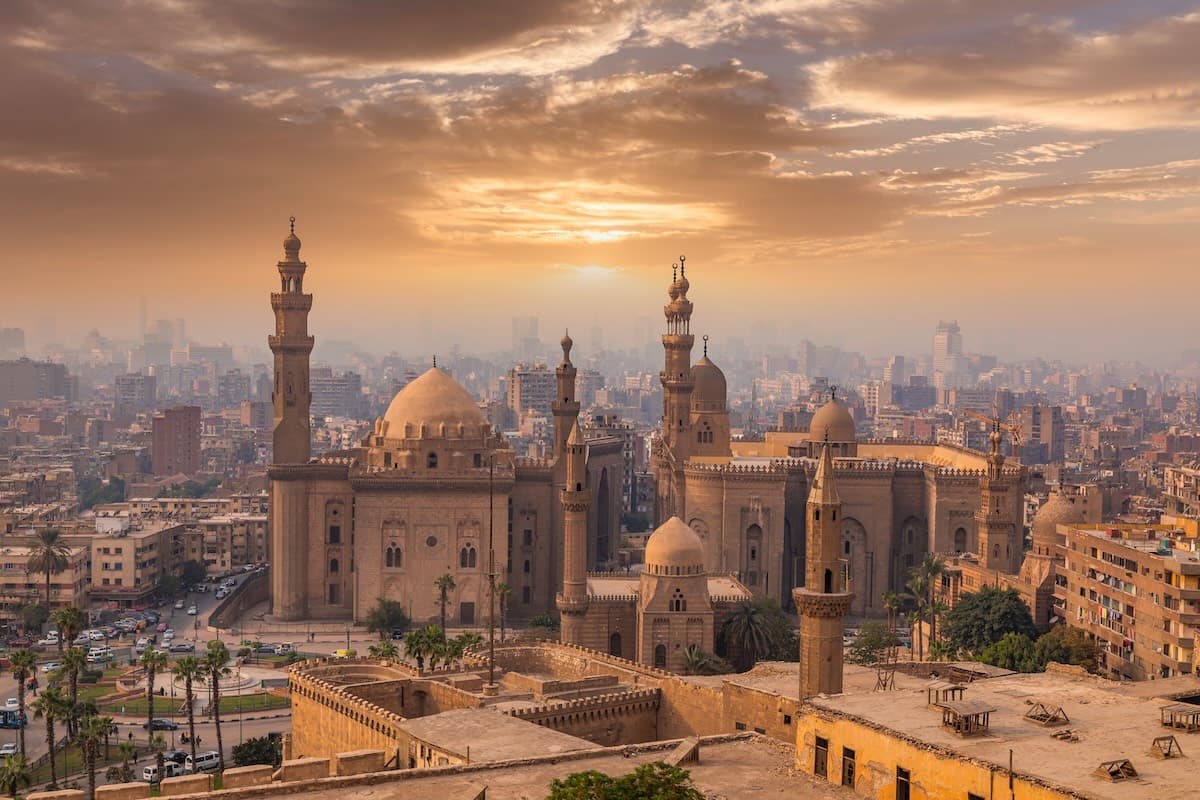
The Mosque-Madrasa of Sultan Hassan (1356) and the adjacent Al-Rifa'i Mosque, seen from the Citadel viewpoint at sunset.
© Anton Petrus / Adobe Stock
Travel
Cairo is not a city that reveals itself gently. It hits you with noise, exhaust, heat, crowds, and a traffic system that appears to operate on collective telepathy rather than road rules — and then, around a corner or from a rooftop, you see the Pyramids rising above the apartment blocks, and everything recalibrates. This is Africa's largest city and the Arab world's cultural capital, a place where the last surviving Ancient Wonder of the World sits at the edge of a KFC parking lot, where medieval mosques and Mamluk architecture line streets that haven't changed in 600 years, and where the new Grand Egyptian Museum houses the largest collection of pharaonic artifacts ever assembled under one roof. Cairo's layers are what make it extraordinary: Pharaonic Giza and Saqqara. Coptic Old Cairo with churches dating to the 4th century. Islamic Cairo's 800+ listed mosques, Al-Azhar University (founded 970 CE, one of the world's oldest continuously operating universities), and the Khan El-Khalili bazaar trading since 1382. The Art Deco and Belle Époque downtown built during Egypt's cosmopolitan era. And modern Cairo — Zamalek's island cafes, the October 6th Bridge's Nile views, and a food scene that runs from 3 AM ful carts to rooftop restaurants overlooking the city lights. The city is exhausting and addictive in equal measure.
The Pyramids of Giza don't need a sales pitch — they're the only surviving Ancient Wonder and they've been drawing visitors for 4,500 years. What most people don't expect: they're not in the desert. The urban edge of Cairo reaches right up to the Giza Plateau, which means you can see apartment blocks from the Sphinx and the Pyramids from Cairo's Ring Road. The Great Pyramid of Khufu (Cheops) contains 2.3 million limestone blocks averaging 2.5 tonnes each, rises 146 meters, and you can enter the interior via a narrow ascending passage (separate ticket, ~400 EGP — claustrophobic, hot, and absolutely worth it). The Pyramid of Khafre retains its limestone casing at the apex, and Menkaure's Pyramid is the smallest and most accessible. The Sphinx (73 meters long, 20 meters high) crouches between the pyramids and the valley — photographed a billion times but still surreal in person. Entry: 240 EGP for foreigners. Arrive at 8 AM opening to beat tour groups. The Sound and Light Show (evenings, ~400 EGP) is cheesy but atmospheric. Camel rides are aggressively offered — agree on a price before mounting and confirm it includes the return trip. The view from the 'panoramic viewpoint' behind the third pyramid, with all three aligned and Cairo's skyline behind, is the defining photograph.
Diplomatic missions in Cairo
15 embassies based in this city, grouped by region.
Treat this Visaja page as your starting point: verify the current rules directly with the official source before you submit an application.