Explore Giza Governorate: the Pyramids, the Grand Egyptian Museum & Saqqara
Apply for your eVisa- Code:GZ
- Type:governorate
- Native name:Giza Governorate
- Population:8.6M (2017)
- Area:13,184 km²
- Elevation:141 m
- Capital:Giza
Introduction
Giza Governorate lies on the west bank of the Nile opposite Cairo, and Giza city, Egypt's third-largest, runs into the capital as one continuous metropolis. Where its western streets end, the desert begins at the Giza Plateau, and the limestone escarpment south of it carries the royal cemeteries of Saqqara and Dahshur above a strip of fields and palm groves, where the village of Mit Rahina stands on the site of ancient Memphis. Beyond the valley the governorate reaches far west into the Western Desert, past the new desert cities of 6th of October and Sheikh Zayed and on, roughly five hours from Cairo, to the Bahariya Oasis, the gateway to the Black and White Deserts.
Overview
The Pyramids of Giza do not stand in open desert: they rise where the streets of Giza city run out, a ride-hailing trip from central Cairo, with the Grand Egyptian Museum on the desert edge beside them. South of the plateau, the same escarpment carries the older pyramid fields of Saqqara and Dahshur, which draw a fraction of Giza's crowds. Two full days cover the governorate's monuments — one for the plateau and the museum, one for the sites to the south.
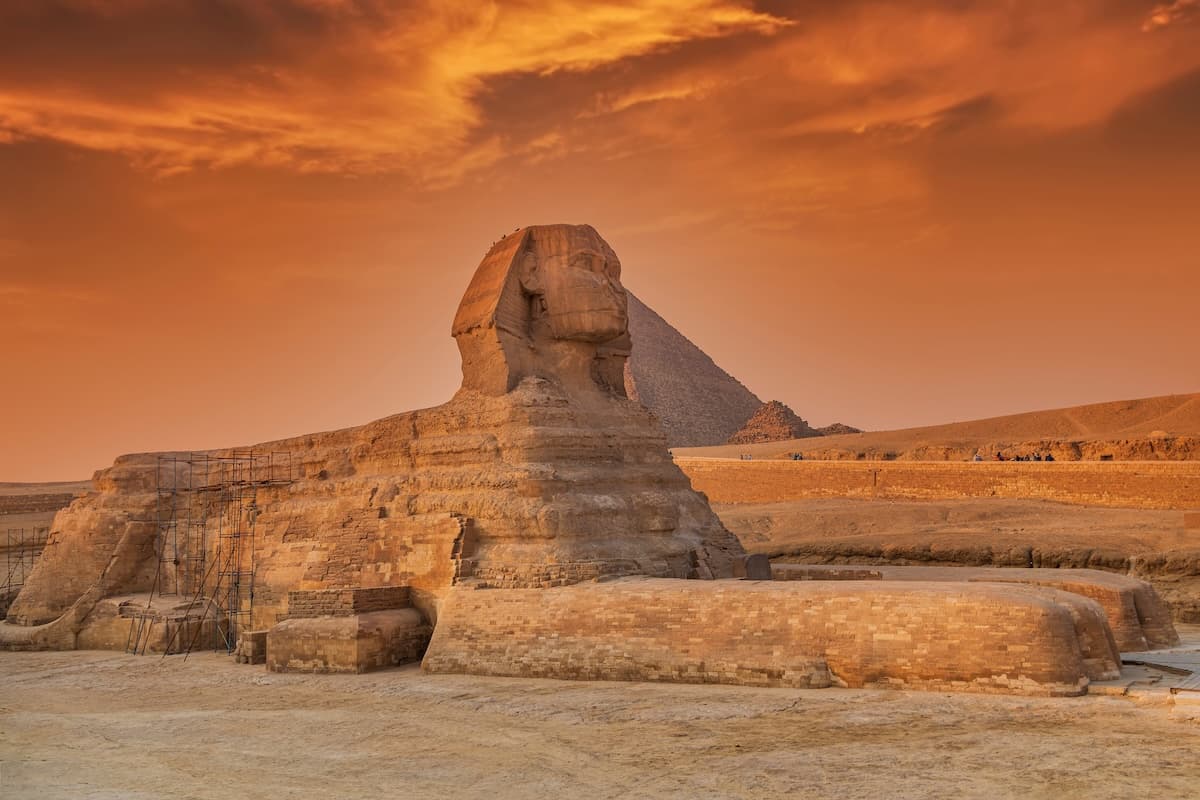
The Great Sphinx and the Pyramid of Khafre at sunset on the Giza Plateau.
© Tom / Adobe Stock
Discover Giza
The Giza Plateau: Khufu, Khafre, Menkaure & the Sphinx
The Giza Plateau holds the three Old Kingdom royal pyramids and the Great Sphinx in a single archaeological zone at the western edge of the city. The Great Pyramid of Khufu, the only one of the seven Ancient Wonders still standing, originally rose 146 metres and stands about 139 today, on a base some 230 metres a side, built of some 2.3 million limestone blocks averaging 2.5 tonnes each. Inside, a low ascending passage and the tall Grand Gallery climb to the King's Chamber and its granite sarcophagus. The Pyramid of Khafre, the second largest, looks the tallest of the three because it stands on higher ground, and it keeps its original casing of Tura limestone near the apex — the only one of the three that still shows how smooth the pyramids looked when they were finished. The Pyramid of Menkaure, the smallest, was clad in red granite for its lower courses, some of which survives. The Great Sphinx, 73 metres long and 20 metres high, was carved from a single outcrop of the plateau's limestone and crouches beside the Valley Temple of Khafre at the eastern foot of the site.
The Grand Egyptian Museum
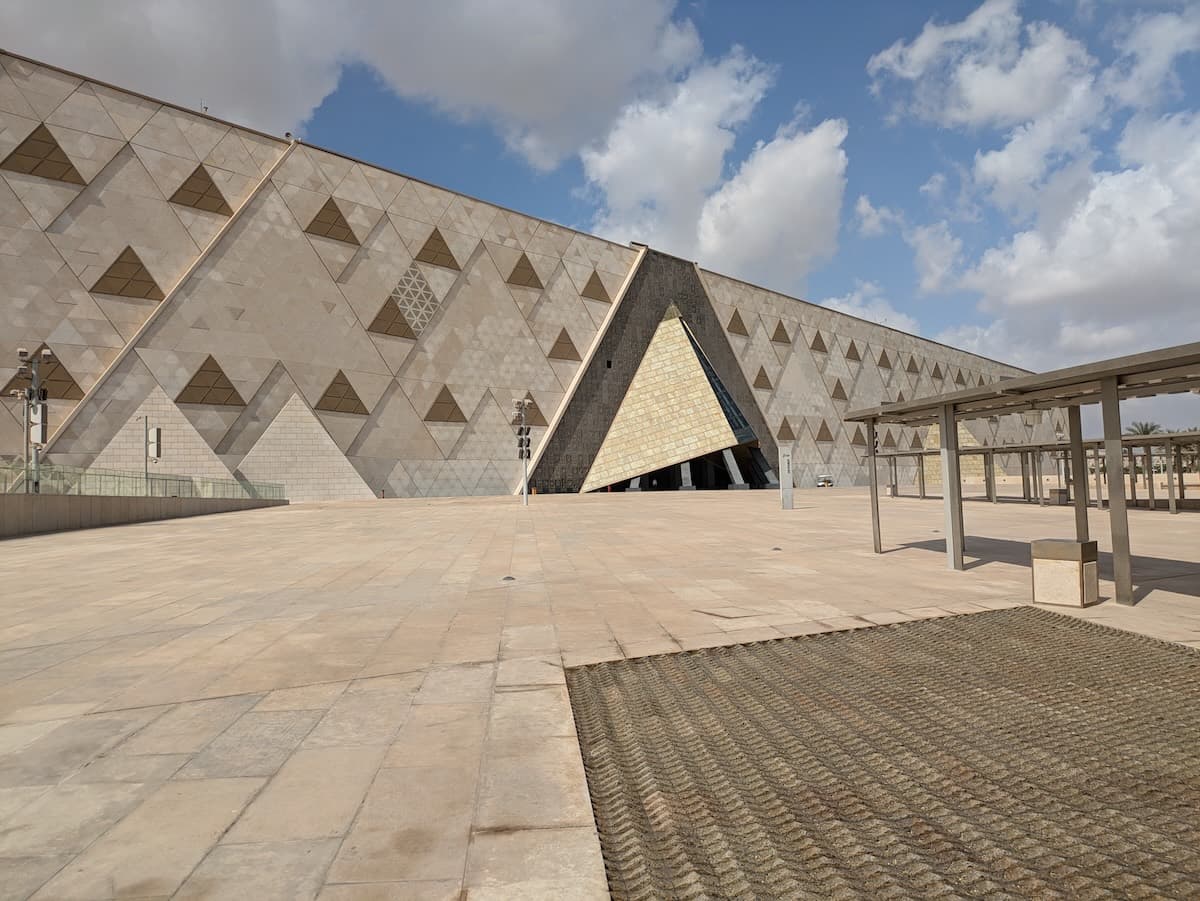
The Grand Egyptian Museum's alabaster facade at the edge of the Giza Plateau.
© LOOP / Adobe Stock
The Grand Egyptian Museum stands on the desert edge beside the Giza Plateau: the world's largest archaeological museum devoted to a single civilisation, with more than 100,000 artefacts. A colossal standing statue of Ramesses II, some 3,200 years old, fills the atrium at the entrance, and the Grand Staircase beyond it, lined with royal statues and sarcophagi, rises to the main galleries, which trace 5,000 years of Egyptian art and craft. The centrepiece is the complete Tutankhamun collection: more than 5,000 objects from his tomb (KV62), many of them displayed together for the first time since Howard Carter found the burial in 1922. The golden death mask, some 10 kg of gold, the nested coffins and the chariots share the galleries with the intimate personal objects — sandals, board games, childhood furniture — that humanise the boy king.
A Day at Giza: the Plateau, Then the Museum
A day at Giza starts at the plateau's opening time, when the light is low on the stone and the tour coaches have not yet arrived; by mid-morning the site is crowded. There is almost no shade, and from May to September afternoons regularly reach 35 °C and above, so the open plateau is a morning's work. The entry ticket covers the open site, and the Great Pyramid's interior takes a separate one; its passages are hot and cramped. The panoramic viewpoint behind the Pyramid of Menkaure lines up all three pyramids with Cairo's skyline behind them. Camel and horse rides are offered persistently: agree the full price, including the ride back, before mounting, because a price left open is one of the monument scams known across Egypt. The afternoon then belongs to the Grand Egyptian Museum next door, out of the heat and without a drive back across the city.
The Sound and Light Show
After dark, the Sound and Light Show lights the Sphinx and the three pyramids while a recorded narration tells their story to an audience seated facing the Sphinx. The narration is theatrical; the monuments lit against the night sky are the reason to go. The show is narrated in several languages and lasts about an hour. From November to March, evenings in the desert turn cool, and a light jacket is worth bringing.
Saqqara: the Step Pyramid, Unas & the Serapeum
Saqqara, some 15 km south of the Giza pyramids on the desert escarpment above the Nile floodplain, is one of Egypt's oldest royal burial grounds and was the cemetery of ancient Memphis. Its centrepiece is the Step Pyramid of Djoser (27th century BCE), designed by Imhotep, the architect later deified as a god of medicine: Egypt's first pyramid and its earliest large building in cut stone, the step from mud-brick mastaba tombs to the true pyramids of Dahshur and Giza. The surrounding complex has been extensively restored, from the entrance colonnade to the great south court and the heb-sed court. At the southern edge of the complex, the Pyramid of Unas (24th century BCE) carries the Pyramid Texts, the oldest known Egyptian religious texts, carved on the walls of its burial chamber. North-west of the Step Pyramid, the Serapeum is an underground catacomb where the sacred Apis bulls were buried in massive granite sarcophagi of some 70 tonnes each — one of Egypt's eeriest sites. Among the nobles' tombs, the mastaba of the vizier Mereruka is a warren of rooms carved with scenes of daily life, and the Imhotep Museum at the site entrance puts the architecture in context.
Dahshur: the Bent & Red Pyramids
Dahshur, about 10 km south of Saqqara, holds two pyramids built for Sneferu, Khufu's father, around 2600 BCE. The sides of the Bent Pyramid change angle partway up, from 54° to 43°, almost certainly because the steeper angle was causing structural problems, and it keeps more of its original smooth limestone casing than any other Egyptian pyramid — the clearest sense of how Khufu's and Khafre's pyramids looked when new. The Red Pyramid, named for the reddish limestone of its core, is Egypt's first successful true smooth-sided pyramid, the model for the Great Pyramid a generation later. Visitors go inside: stairs climb the north face to the entrance, and a long, steep corridor descends to chambers roofed with corbelled vaults. On the horizon, the Black Pyramid of Amenemhat III, from the Middle Kingdom, survives as a ruined mud-brick core.
Memphis at Mit Rahina
Memphis, about 24 km south of central Cairo on the valley floor a few kilometres east of Saqqara, was the capital of the Old Kingdom pharaohs whose pyramids line the desert edge above it. The ancient city was largely dismantled for building stone in the Islamic period, so what survives is shown as an open-air museum at the village of Mit Rahina. Its centrepiece is a colossal limestone statue of Ramesses II, over 10 metres long, displayed lying down in a purpose-built hall because its legs are too damaged for it to stand. In the garden outside stands an alabaster sphinx of some 80 tonnes, carved from a single block in the New Kingdom. The site has its own ticket, and the visit takes 30 to 60 minutes.
Ways to Experience This Destination
Khufu's Great Pyramid, Khafre's pyramid with its casing still at the apex, Menkaure's pyramid and the Great Sphinx beside the Valley Temple of Khafre.
More than 100,000 artefacts beside the Giza Plateau, with the complete Tutankhamun collection of more than 5,000 objects at its centre.
The plateau in the first hour after opening, before the tour coaches arrive, and the Sphinx and the pyramids lit after dark.
The Great Pyramid's passages to the King's Chamber and the Step Pyramid's interior at Saqqara, each on a separate ticket, and the Red Pyramid at Dahshur.
Rooftop guesthouses in Nazlet el-Samman at the foot of the Sphinx and the historic Mena House hotel below the Great Pyramid.
A day by car with a driver through the older pyramid fields south of Giza: the Step Pyramid and the Serapeum, the Bent and Red Pyramids and the colossus of Ramesses II.
Frequently asked questions
Should I stay in Giza or in central Cairo?
How long should I spend at the Grand Egyptian Museum?
How do I visit Saqqara, Dahshur and Memphis?
Visaja keeps this page's contact details and visa guidance under continuous review — still, requirements can change at short notice, so confirm the essentials with the mission or the official government portal before you travel.