
Travel deep dive
Varanasi and Bodh Gaya: Reading the Threshold City
Varanasi organizes itself around one piece of sacred geometry most visitors sense before anyone explains it: the entire city stands on the west bank of the Ganges, its eighty-odd ghats facing east into the sunrise, while the far bank is left almost empty — a threshold, not a town. Kashi, the city's old name, has been continuously inhabited longer than almost anywhere on earth — Mark Twain thought it looked older than history itself — and it is Hinduism's crossing point: to die here, tradition holds, is to step off the wheel of rebirth entirely, which is why pilgrims come to live out their last years by the river and why the cremation fires never go out. Ten kilometres away, the Buddha chose this city's doorstep to preach his alternative. Read together — the river liturgy and its great dissent — Varanasi and the Buddhist sites form the subcontinent's most concentrated lesson in what India believes.
Updated 2026-08-16
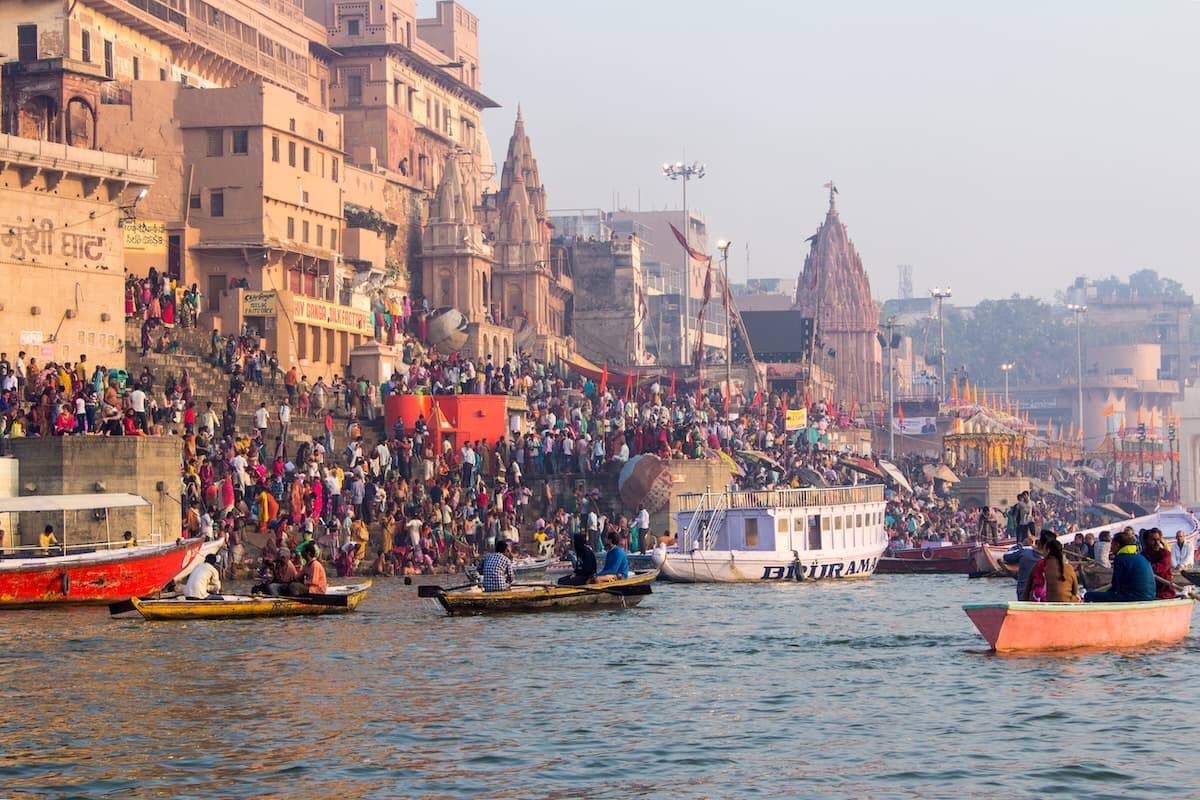
Dev Deepawali on the Varanasi ghats — the river front lit by thousands of oil lamps.
The threshold: why the city faces the river the way it does
The orientation is the theology made visible. Varanasi's ghats — the stone stairways descending to the water — all line the western bank, so the city greets the sun rising over the river each morning; the eastern shore opposite is floodplain, kept traditionally unbuilt, so that the view from the steps is water, light and sky. Bathers descending at dawn face the sunrise across a boundary with nothing behind it — as clear a piece of sacred staging as any temple axis in the world, and the reason the city's mornings feel liturgical even to visitors who know none of the liturgy.
Kashi's promise — that death here brings moksha, liberation from rebirth — makes Varanasi a destination for the end of life in the most literal sense: hospices near the river shelter the elderly who have come to die well, and the two burning ghats work day and night because the demand never pauses. Manikarnika, the principal cremation ground, is not a hidden or shameful place but the city's most sacred machinery, operated by hereditary specialist communities, its fires reputed by tradition to have burned continuously for centuries.
This is also the frame that keeps a visit from tipping into voyeurism: nothing at the burning ghats is staged for tourists, and nothing is hidden from them either, because in Kashi's own understanding death is not a private failure but a public completion. The visitor's part is conduct — but the first adjustment is interior: you are not watching a spectacle; you are a guest at the edge of a ceremony the city has performed forever.
The river liturgy: dawn by boat, dusk by fire
The pre-dawn rowboat is technique, not cliché. From the water, the whole five-kilometre ghat frontage becomes a single stage seen from the audience's side: bathers taking their first immersion as the sky lightens, laundry lines and wrestling akharas beginning their day, priests setting out umbrellas, the burning ghats' smoke rising into the sunrise. Boats go out from Assi and the central ghats in the dark to catch first light; an hour or two on the water, drifting north past the sequence, is the single experience most travellers name afterwards as the reason Varanasi mattered to them.
The evening bookend is the Ganga Aarti at Dashashwamedh Ghat — a choreographed fire-offering performed nightly by rows of priests with tiered brass lamps, conch shells and bells, drawing crowds on the steps and flotillas of spectator boats on the water. It is both genuine worship and grand theatre, and the two are not in tension here. Between the two bookends, the day belongs to ghat-walking: the frontage is continuous, and simply following it end to end — through bathing ghats, laundry ghats, music schools and tea stalls — is the city's best self-guided tour.
Conduct at the burning ghats is simple and absolute: no photography of the cremations or the bereaved, ever; keep respectful distance from the pyres and processions; decline the self-appointed “guides” who solicit donations for hospice charities with practiced scripts (real charity here is not collected from tourists at the fires); and dress and speak as you would at any funeral. Observed from the right distance with the right bearing, presence is entirely acceptable — the city has hosted respectful witnesses for as long as it has burned its dead.
The great counterpoint: Sarnath and Bodh Gaya
The Buddhist geography around Varanasi is not coincidence but commentary. When the Buddha attained enlightenment and chose where to teach first, he came to the deer park at Sarnath — ten kilometres from Kashi, the ancient world's capital of ritual religion — and preached a path that needed no priests, no sacrifices and no sacred river. Visiting Sarnath from Varanasi replays that argument physically: half a day among the excavated monastery foundations, the great Dhamek Stupa marking the first sermon's site, the Ashokan pillar whose lion capital became the republic's national emblem, and a quiet that the riverfront never offers.
Bodh Gaya, a few hours away in Bihar, is the tradition's absolute centre: the Mahabodhi Temple rises beside the descendant of the very Bodhi Tree beneath which the enlightenment happened, and the surrounding town has become a devotional United Nations — monasteries and temples built by Tibet, Thailand, Myanmar, Sri Lanka, Japan, Vietnam, Bhutan and more, each in its national style, functioning as embassies of faith around the shared source. Pilgrims from across the Buddhist world circumambulate the temple from before dawn; in the winter teaching season the town fills with maroon robes and the atmosphere doubles in intensity.
The two sites reward different durations: Sarnath is Varanasi's natural half-day, while Bodh Gaya justifies an overnight — the temple compound at dawn and after dark, when the pilgrims own it, is a different place from the midday version. Together with the river city they form a single itinerary about India's two great religious imaginations, staged on Kashi's own doorstep and a few hours east of it.
Practicalities: intensity, the labyrinth, seasons and the circuit
Varanasi is India at maximum concentration — dense, loud, sensorially relentless — and pacing is the survival skill. The rhythm that works mirrors the liturgy itself: out early for the river's calm hours, retreat through the heat of the day (the old city's rooftop cafés overlooking the ghats are the classic refuge), return for the evening aarti. Two nights is the honest minimum — one dawn boat, one aarti, one unhurried ghat walk — and a third buys Sarnath and the space to let the city stop being overwhelming and start being legible.
The old city behind the ghats is a medieval labyrinth of galis — lanes sometimes shoulder-wide, shared with cows, porters and processions — and getting mildly lost in it is not a failure but the format; the river is always downhill, which is all the navigation the quarter requires. Vehicles cannot enter, so accommodation inside the labyrinth trades convenience of access for the incomparable advantage of stepping onto the ghats at dawn without a commute.
Seasonally, the cool months are prime: comfortable walking, stable river levels, the boat trade in full swing. The monsoon swells the Ganges dramatically — high water can submerge the lower steps and suspend boat trips — and the summer heat on the treeless stone frontage is formidable, so both argue for the classic winter window. For the circuit, Varanasi is well connected by rail and air; Bodh Gaya pairs with it via the railhead at Gaya, and the two together anchor any route through India's spiritual east.