Visit Cairo, Egypt: visa, Pyramids & 22 million stories
Apply for your eVisa- Population:22M metro
- Timezone:EET (UTC+2)
- IATA:CAI
Overview
Cairo is the city that never sleeps because it never had the option — 22 million people, 5,000 years of history, and the Pyramids of Giza literally visible from the Ring Road traffic jams.
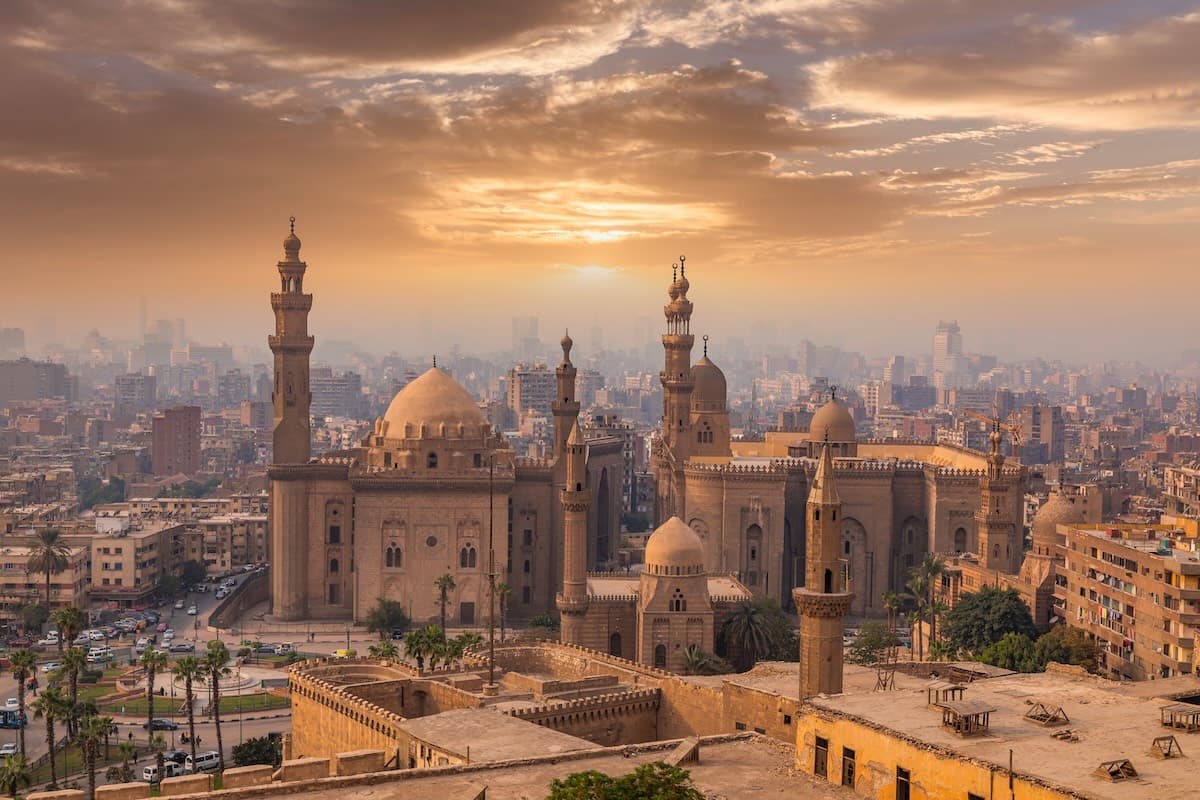
The Mosque-Madrasa of Sultan Hassan (1356) and the adjacent Al-Rifa'i Mosque, seen from the Citadel viewpoint at sunset.
© Anton Petrus / Adobe Stock
Travel
Cairo is not a city that reveals itself gently. It hits you with noise, exhaust, heat, crowds, and a traffic system that appears to operate on collective telepathy rather than road rules — and then, around a corner or from a rooftop, you see the Pyramids rising above the apartment blocks, and everything recalibrates. This is Africa's largest city and the Arab world's cultural capital, a place where the last surviving Ancient Wonder of the World sits at the edge of a KFC parking lot, where medieval mosques and Mamluk architecture line streets that haven't changed in 600 years, and where the new Grand Egyptian Museum houses the largest collection of pharaonic artifacts ever assembled under one roof. Cairo's layers are what make it extraordinary: Pharaonic Giza and Saqqara. Coptic Old Cairo with churches dating to the 4th century. Islamic Cairo's 800+ listed mosques, Al-Azhar University (founded 970 CE, one of the world's oldest continuously operating universities), and the Khan El-Khalili bazaar trading since 1382. The Art Deco and Belle Époque downtown built during Egypt's cosmopolitan era. And modern Cairo — Zamalek's island cafes, the October 6th Bridge's Nile views, and a food scene that runs from 3 AM ful carts to rooftop restaurants overlooking the city lights. The city is exhausting and addictive in equal measure.
Pyramids of Giza & the Great Sphinx
The Pyramids of Giza don't need a sales pitch — they're the only surviving Ancient Wonder and they've been drawing visitors for 4,500 years. What most people don't expect: they're not in the desert. The urban edge of Cairo reaches right up to the Giza Plateau, which means you can see apartment blocks from the Sphinx and the Pyramids from Cairo's Ring Road. The Great Pyramid of Khufu (Cheops) contains 2.3 million limestone blocks averaging 2.5 tonnes each, rises 146 meters, and you can enter the interior via a narrow ascending passage (separate ticket, ~400 EGP — claustrophobic, hot, and absolutely worth it). The Pyramid of Khafre retains its limestone casing at the apex, and Menkaure's Pyramid is the smallest and most accessible. The Sphinx (73 meters long, 20 meters high) crouches between the pyramids and the valley — photographed a billion times but still surreal in person. Entry: 240 EGP for foreigners. Arrive at 8 AM opening to beat tour groups. The Sound and Light Show (evenings, ~400 EGP) is cheesy but atmospheric. Camel rides are aggressively offered — agree on a price before mounting and confirm it includes the return trip. The view from the 'panoramic viewpoint' behind the third pyramid, with all three aligned and Cairo's skyline behind, is the defining photograph.
Grand Egyptian Museum & Egyptian Museum
The Grand Egyptian Museum (GEM), adjacent to the Giza Pyramids, is the world's largest archaeological museum — a $1 billion project over 20 years in the making, housing 100,000+ artifacts including the complete Tutankhamun collection (5,000+ objects, many displayed for the first time). The GEM has transformed the Giza visit: you can now spend a morning at the Pyramids and an afternoon at the museum without crossing Cairo's traffic. The centerpiece: the Tutankhamun galleries, including the golden death mask (11 kg of solid gold), the nested coffins, the chariots, and the intimate personal objects — sandals, board games, childhood furniture — that humanize the boy king. The older Egyptian Museum at Tahrir Square in downtown Cairo (1902 building, 200 EGP foreigners) still operates with a reduced collection and retains a chaotic, dusty charm that the GEM's climate-controlled halls can't replicate — it's worth visiting both if time allows. The Mummy Room at the old museum (separate ticket) holds the actual mummies of Ramesses II, Seti I, and other pharaohs — faces preserved after 3,000 years.
Islamic Cairo: Mosques, Madrasas & Khan El-Khalili
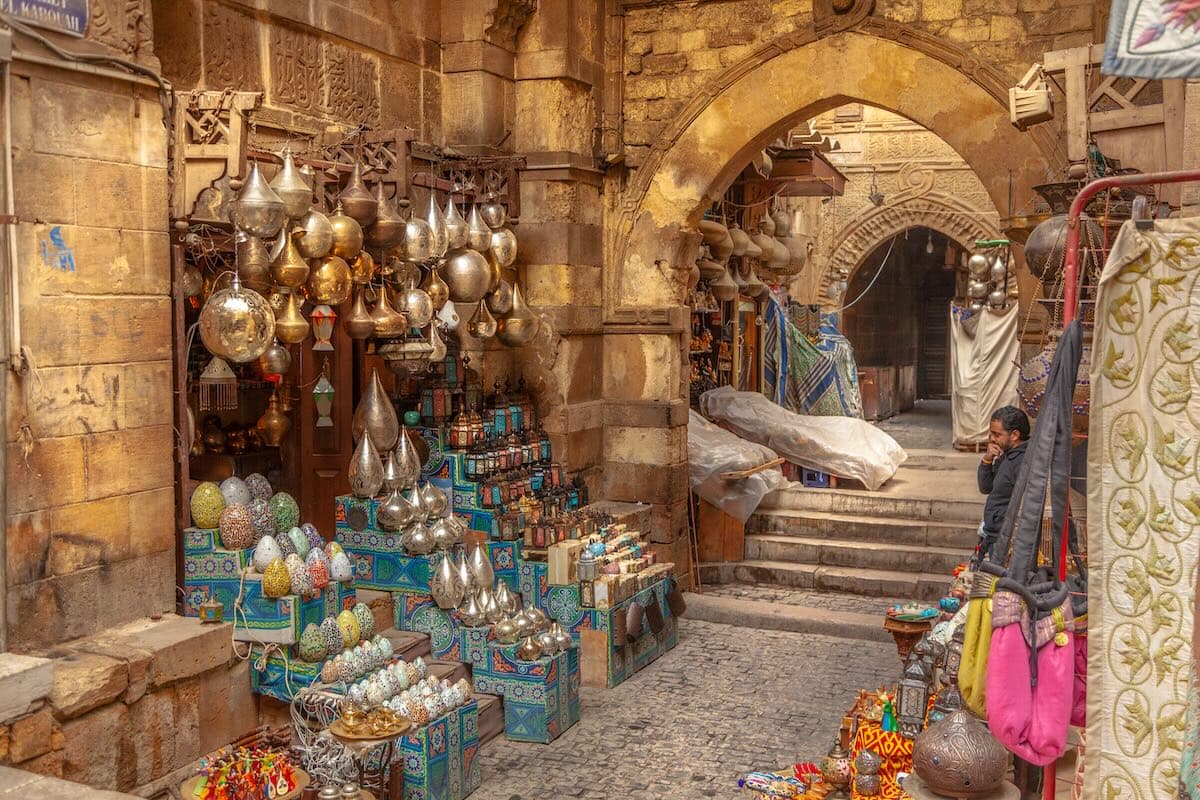
A lantern and copperware stall in Khan El-Khalili — the bazaar has traded continuously since 1382.
© merydolla / Adobe Stock
Islamic Cairo (Al-Qahira al-Fatimiyya) is a UNESCO World Heritage district containing the densest concentration of medieval Islamic architecture on Earth — over 800 listed monuments in a few square kilometers. The citadel of Saladin (1176) dominates from its hilltop, with the Muhammad Ali Mosque's Ottoman dome and minarets the skyline's defining feature (entry 200 EGP, panoramic Cairo views from the terrace). Below the citadel, Al-Muizz Street (Sharia al-Muizz li-Din Allah) is Islamic Cairo's spine — a pedestrianized kilometer of mosques, madrasas, caravanserais, and Mamluk architecture that's among the most visually dense historic streets anywhere. Key stops: Al-Azhar Mosque (970 CE, free entry, one of the world's oldest universities), Sultan Hassan Mosque (1356, architectural masterpiece with a 36-meter-high entrance portal), and Al-Hakim Mosque with its distinctive minarets. Khan El-Khalili, the bazaar adjacent to Al-Azhar, has operated since 1382 — a labyrinth of alleys selling metalwork, perfume, spices, jewelry, papyrus, and tourist souvenirs. Fishawi's Cafe (supposedly open continuously since 1773) serves Turkish coffee and shisha in a mirror-walled room. Bargain hard — start at a third of the asking price.
Coptic Cairo & Old Cairo
Coptic Cairo (Masr al-Qadima) occupies the site of the Roman fortress of Babylon, predating Islamic Cairo by centuries. The Hanging Church (Al-Mu'allaqa, 7th century, built on the gatehouse of the Roman fortress) is the most famous — its nave suspended over the passage between two towers, with a wooden ceiling resembling the interior of Noah's Ark. The Church of Saints Sergius and Bacchus (Abu Serga) claims to mark the spot where the Holy Family rested during their flight into Egypt — a cave below the church is accessible to visitors. The Coptic Museum (75 EGP foreigners) holds the finest collection of Coptic art in the world — textiles, icons, manuscripts, and the Nag Hammadi codices (Gnostic gospels discovered in 1945). The Ben Ezra Synagogue, in the same compound, is one of the oldest in Egypt (9th century, heavily restored) and where the famous Cairo Geniza — a trove of 300,000 medieval Jewish documents — was discovered in the 19th century. The entire area is compact and walkable in 2-3 hours. Entry to churches is free; the Coptic Museum has a separate ticket.
Saqqara & Memphis: Older Than Giza
Saqqara, 30 km south of Cairo, is Egypt's oldest royal burial ground and home to the Step Pyramid of Djoser (2670 BCE) — the world's first monumental stone structure, designed by Imhotep (the architect later deified as a god of medicine). The Step Pyramid predates the Great Pyramid by a century and represents the evolutionary leap from mud-brick mastabas to stone pyramids. The surrounding complex has been extensively restored, and the adjacent Pyramid of Unas (2375 BCE) contains the oldest religious texts in human history — the Pyramid Texts inscribed on the burial chamber walls (entry included). The Serapeum, an underground catacomb housing massive granite sarcophagi where sacred Apis bulls were buried, is one of Egypt's eeriest sites. Dahshur, 10 km further south, holds the Bent Pyramid (unique for its changed angle mid-construction) and the Red Pyramid — the first true smooth-sided pyramid, and one you can enter for free. Memphis open-air museum (15 km south of Giza) preserves a colossal fallen statue of Ramesses II and an alabaster sphinx. A full Saqqara-Dahshur-Memphis day trip from Cairo costs ~$30-50 by arranged driver and is far less crowded than Giza.
Egyptian Food: Ful, Koshari & the 3 AM Cart
Cairo's food scene operates on a different clock — peak eating hours extend well past midnight, and the 3 AM ful (fava bean) cart is a Cairo institution. Ful medames (stewed fava beans with oil, lemon, cumin — served for breakfast, lunch, or whenever) is the national dish in its simplest form, scooped with aish baladi (flatbread) for under 20 EGP. Koshari is Egypt's beloved carb bomb — lentils, rice, macaroni, chickpeas, fried onions, and tomato-vinegar sauce layered in a bowl, available at dedicated koshari restaurants (Abou Tarek on Champollion Street is the most famous, 40-60 EGP). Taameya (Egyptian falafel made with fava beans instead of chickpeas — greener, lighter) is the street breakfast staple. For grilled meats: Zooba for modern Egyptian street food reimagined, Felfela for classic Egyptian restaurant fare since 1963, and the ahwa (coffeehouse) culture where strong Turkish coffee, karkade (hibiscus tea), and shisha are consumed at sidewalk tables well into the night. Fiteer meshaltet (Egyptian layered pastry, sweet or savory) from El-Abd bakery is another essential. The weekend Friday brunch at upscale hotels (Four Seasons, Kempinski) is Cairo's social event — book ahead.
Downtown Cairo: Art Deco, Tahrir Square & Zamalek
Downtown Cairo (Wust El-Balad) was built during Egypt's cosmopolitan era (1860s-1940s) as a European-style city center with Haussmann-inspired boulevards, Art Deco apartment blocks, and Belle Époque cinemas. Tahrir Square (Liberation Square) gained global fame during the 2011 revolution and remains the geographic center of modern Cairo. The surrounding streets — Talaat Harb, Champollion, Qasr El-Nil — hold faded grandeur in their building facades, bookshops, old-school patisseries (Groppi, founded 1924 by a Swiss-Italian confectioner), and a street life that mixes students, office workers, and vendors. Zamalek, the island neighborhood in the Nile, is Cairo's most walkable area: tree-lined streets, embassies, cafes (Left Bank's terrace overlooks the Nile), art galleries, and restaurants. The Cairo Tower (187 meters, ~200 EGP, views of the entire city and on clear days the Pyramids) anchors Zamalek's southern tip. The Cairo Opera House complex on Gezira Island hosts performances and the Modern Art Museum. For nightlife, Zamalek and Maadi concentrate the bars and restaurants that Cairo's upper middle class frequents.
Nile Experiences: Feluccas, Dinner Cruises & the Corniche
The Nile defines Cairo — the city exists because the river does, and experiencing the water is essential. The most affordable option: a felucca (traditional wooden sailboat) ride from the docks near the Four Seasons Hotel Nile Plaza or opposite the Egyptian Museum. A one-hour sail costs 200-400 EGP for the entire boat (fits 6-8 people) — sunset is the obvious time, with the skyline silhouetted against the western sky. Dinner cruises on large boats (Nile Maxim, Le Pacha 1901) offer buffet dinners with belly dancing and live music for $30-60 per person — touristy but entertaining. The Corniche (Nile-side road) runs the length of central Cairo and is a nightly promenade for families, couples, and food vendors. Walking the Corniche from the Qasr El-Nil Bridge (with its famous lion statues) south to the Old Cairo waterfront takes about an hour and gives the best street-level view of Cairo's relationship with the Nile. For a full Nile experience, the 3-7 day Luxor-Aswan cruise (starting from $150/3 nights) is Egypt's most iconic travel experience.
Practical Tips: Traffic, Safety & Surviving Cairo
Cairo International Airport (CAI) is the main entry point. From the airport to central Cairo: Uber/Careem (the recommended option, ~150-300 EGP to downtown, 45 min-2 hours depending on traffic), prepaid taxi (booths at arrivals), or the dedicated bus from the nearest metro station — no rail line reaches the terminals. Cairo traffic is legendary — do not drive yourself. Uber and Careem have transformed local transport (cheap, air-conditioned, no fare disputes). The Cairo Metro (3 lines, expanding) is fast and air-conditioned but covers limited areas; women-only carriages exist. Walking in Cairo requires a specific skill: cross streets by walking steadily (not running, not stopping) — traffic flows around you. The city is generally safe for tourists; petty crime is less of a problem than persistent hassle from touts, unofficial guides, and souvenir sellers (a firm 'la shukran' — no thanks — works). Women travelers will experience street harassment (verbal mostly) — modest clothing reduces but doesn't eliminate it; staying in groups and using Uber at night helps. Heat: April-October is brutal (35-45°C); November-March is pleasant (15-25°C) and the ideal travel window. Cairo's air quality is poor — carry a reusable mask for particularly dusty/traffic-heavy days.
Diplomatic missions in Cairo
15 embassies based in this city, grouped by region.
Europe8
Americas5
Africa1
Treat this Visaja page as your starting point: verify the current rules directly with the official source before you submit an application.