Rajasthan
Apply for your eVisa- Code:RJ
- Type:state
- Population:68.5M (2011)
- Area:342,269 km²
- Capital:Jaipur
Introduction
Rajasthan is India's largest state by area and the one most shaped by its own aridity — a desert and semi-desert region whose Rajput kingdoms built hill forts, walled cities and palaces on a scale that outlasted them. Four of those cities, each with a distinct colour and character, carry most of what visitors come for; between and beyond them lie the Thar Desert, a tiger reserve inside a ruined fort, and craft traditions that still operate as working trades.
Overview
Rajasthan is a circuit, and understanding that is most of the planning. Its four headline cities — Jaipur, Udaipur, Jodhpur and Jaisalmer — sit far apart across genuinely large distances, and the trip you get depends almost entirely on how many of them you try to fit into the days you have. Attempt all four in a week and you will spend it in vehicles; take two or three at a proper pace and the state opens up. Each has a different character and, famously, a different colour: Jaipur's rose-washed planned grid, Udaipur's white marble around artificial lakes, Jodhpur's blue-painted old town beneath a fort on a cliff, and Jaisalmer's honey sandstone rising straight out of the desert. Around them, the state offers things none of the cities can: camel and jeep journeys into the Thar, tiger safaris at Ranthambore where the animals move through ruined fortifications, the sacred lake and autumn camel fair at Pushkar, and a network of former palaces and merchant houses now working as hotels. Rajasthan's crafts are not a souvenir economy but a living one — block printing, gem cutting, blue pottery and miniature painting are all worked here commercially. The season decides everything else: winter is the reason to come, and high summer is genuinely punishing.
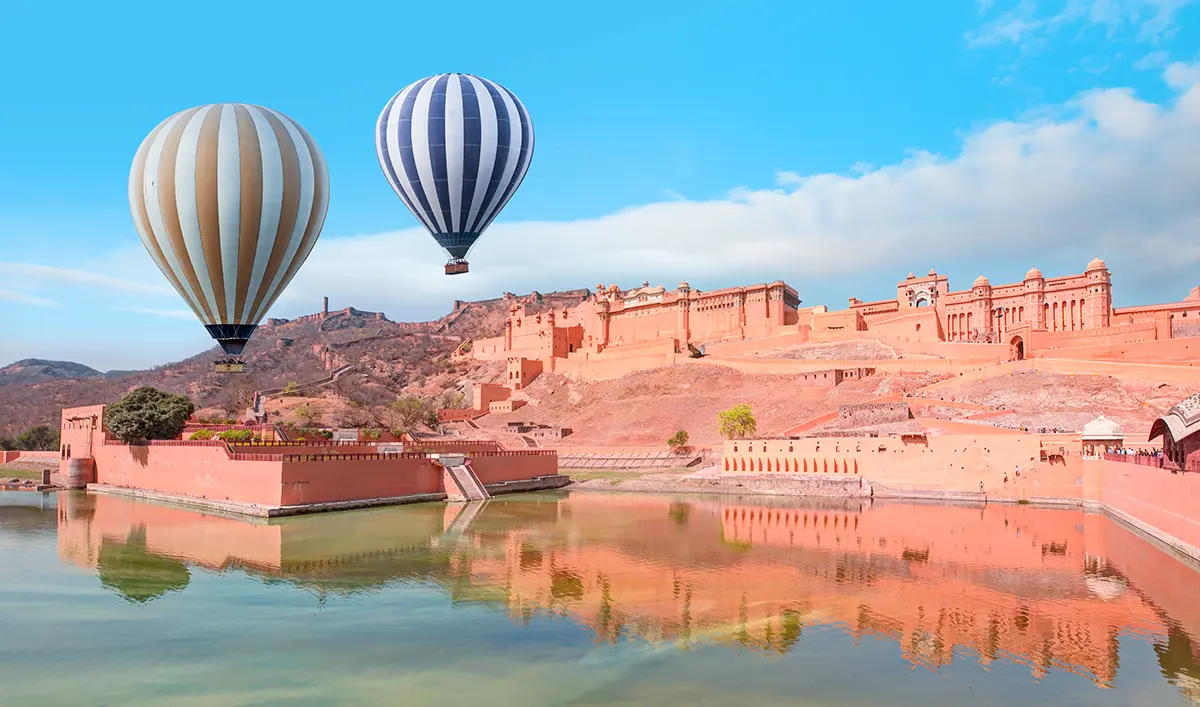
The majestic Amber Fort in Rajasthan, an UNESCO World Heritage Site showcasing Rajput architecture with colorful hot air balloons drifting overhead
© muratart / Adobe Stock
Discover Rajasthan
The four cities, and how far apart they really are
The classic route runs Jaipur to Udaipur to Jodhpur to Jaisalmer, and the distances are the part itineraries underestimate: Jaipur to Jaisalmer alone is over five hundred kilometres and most of a day on the road, with the others separated by long half-days. Ten days to a fortnight covers the four without misery; a week comfortably covers two, or three at a push if you use the overnight trains. Jaipur, the capital and the usual entry point, is its own destination — the planned pink grid, the palaces and the observatory live in the Jaipur city guide rather than restated here. What follows adds the shape of the state around it: which cities suit which trip, what lies between them, and where the desert, the wildlife and the crafts sit. If your time is short, the honest advice is to pick the two cities whose character appeals most and travel slowly between them, rather than collecting all four as a checklist.
Udaipur: lakes, marble and the softest landing in the state
Udaipur was built around artificial lakes created by damming seasonal rivers, and that engineering is why a desert state's most romantic city is a water city. The City Palace runs along the eastern shore of Lake Pichola — a long white façade of balconies and towers that doubles in the water — while the island palace that appears to float in the middle of the lake now operates as a hotel reached by boat. A sunset boat trip is the standard and genuinely worthwhile way to see the ghats, temples and lakeside houses from the water, with the Aravalli hills behind them. What makes Udaipur the easiest place in Rajasthan to spend several days is scale: the old city is walkable and pedestrian-friendly in a way the others are not, the rooftop restaurants look at something worth looking at, and the pace is markedly gentler than Jaipur's. It is also the base for the extraordinary Jain temple complex at Ranakpur, an hour or two north, whose carved marble interior is among the finest in India.
Jodhpur: the blue city under Mehrangarh
Jodhpur sits beneath one of India's most imposing forts. Mehrangarh rises directly from a rock outcrop more than a hundred metres above the plain, its walls continuous with the cliff, and inside it the palaces, courtyards and collections — palanquins, miniature paintings, arms — are unusually well curated, with an audio guide that is genuinely worth taking. From the ramparts you look down on the blue-painted old town, the colour traditionally marking particular households and now spread across much of the quarter, which is what gives the city its name and its photographs. Below, the clock tower market is the working centre: spices, textiles, sweets and handicrafts in lanes that require constant negotiation with motorcycles and cows. On the edge of town, Umaid Bhawan Palace, completed in the 1940s and among the largest private residences in the world, is part museum, part luxury hotel and part royal home. Jodhpur is also the gateway west toward the desert and the practical staging point before Jaisalmer.
Jaisalmer and the Thar Desert
Jaisalmer rises out of the Thar like a sandcastle, and its fort is the reason it is unlike anywhere else in the state: it is a living fort, one of very few remaining, with several thousand people still resident inside twelfth-century sandstone walls — shops, homes, temples and guesthouses in continuous use rather than a preserved monument. That habitation is also a conservation problem, since the drainage was never built for modern water use, and staying inside the walls is increasingly discouraged for that reason; the merchant havelis in the town below, with their lace-like carved façades, are the compensation. The desert itself is the other half of the visit. Camel and jeep trips run to the dunes near Sam and to the quieter sand further out, with overnight camps ranging from basic to distinctly luxurious. Take sunset over midday, take the quieter dunes over the crowded ones if offered, and treat the winter months as the season — summer temperatures here regularly exceed 45°C.
Pushkar, Ajmer and the sacred sites
Pushkar is built around a small sacred lake ringed by bathing ghats and several hundred temples, including one of the very few anywhere dedicated to Brahma. The town is vegetarian and alcohol-free by custom and law, which gives it a quiet that surprises people arriving from Jaipur, and it is a genuine pilgrimage centre rather than a tourist reconstruction of one. Each autumn it hosts one of the largest livestock fairs in the world: tens of thousands of camels, horses and cattle traded over several days, with races, competitions and a religious festival around the full moon. The trading happens in the days before the crowds arrive, which is worth knowing if it is the fair itself rather than the festival that interests you. Nearby Ajmer holds the Dargah Sharif, the shrine of the Sufi saint Moinuddin Chishti and one of the most significant Muslim pilgrimage sites in South Asia, drawing very large numbers particularly during its annual urs. Both towns work as a stop between Jaipur and Udaipur.
Ranthambore: tigers among ruins
Ranthambore is the most reliable tiger viewing in northern India and the most photogenic anywhere, because the park is built around a tenth-century fort and its tigers move through cenotaphs, stepwells and collapsed pavilions that the forest has taken back. Safaris run in shared or private vehicles on fixed zones and timings set by the park, morning and afternoon; zones are allocated rather than chosen, so multiple drives improve the odds considerably more than any single premium booking does. Sightings are genuinely common by Indian standards, and the guides track individual animals by name and territory. The hot months from March to May concentrate wildlife around water and produce the best odds, at the cost of considerable heat; the cool season is more comfortable and less certain. Book well ahead in peak season — permits are limited by design — and treat leopards, sloth bears and the bird life as the reason the drive is worthwhile even when the tiger does not appear.
Crafts as a working economy
Rajasthan's crafts are not a souvenir industry with a heritage veneer; they are functioning trades that happen to be old. Block printing operates in villages outside Jaipur, where you can watch carved wooden blocks stamped by hand across metres of cotton. The blue pottery of Jaipur is made from ground quartz rather than clay, which is why it fires that colour. Gem cutting and setting supply the international jewellery trade from workshops in the same city. Miniature painting on silk and paper continues in family studios in Udaipur and Bundi, and leather juttis, lacquer bangles and hand embroidery are made across the state. Puppetry, once a travelling storytelling trade, survives partly on tourism and partly on its own terms. What follows practically: buy where you can see the making, ask what is hand-blocked versus screen-printed, and expect the price to be higher for the former, because it should be.
Heritage hotels and the palace-stay economy
Rajasthan effectively invented the heritage hotel, and it remains the best place in India to sleep somewhere historic. When the princely states were absorbed after independence, families found themselves holding vast, expensive buildings with no income to maintain them; converting them into hotels became the mechanism that kept many standing. The result is a spectrum rather than a luxury category: modest havelis with a handful of rooms around a courtyard, mid-range forts converted room by room, and a small number of internationally famous palace hotels at the top. What the good ones share is architecture that cannot be reproduced — frescoed walls, carved jharokha balconies, courtyards built for a desert climate — and staff who are often the descendants of the households that ran them. Booking directly usually gets a better rate than an aggregator, and reviews matter more here than in a chain, since standards vary far more widely.
The desert kitchen
Rajasthani cooking is a logical response to an arid state, and reading it that way makes it far more interesting. Fresh vegetables were historically scarce, so the cuisine leans on lentils, gram flour, milk solids and dried or preserved ingredients: gatte ki sabzi turns chickpea flour into dumplings in a yoghurt gravy; ker sangri combines desert berries and beans that grow where little else does; dal baati churma bakes hard wheat balls that keep, then breaks them into ghee and lentils. The meat tradition runs alongside it, since Rajput hunting culture produced dishes like laal maas, a mutton curry built on dried red chillies rather than tomatoes. Sweets are heavy and often milk-based, with seasonal specialities like ghewar. Where all this sits within Indian cuisine as a whole is covered in the India food guide; here, the point is that the constraints are visible on the plate, which is what makes it worth eating attentively rather than just enthusiastically.
Season, distances and practical planning
Winter, from November to February, is the season and everything about it is better: days in the low twenties, cold desert nights, and the weather that fort-climbing and camel trips require. It is also peak pricing and peak crowding in all four cities. March and April warm quickly but remain workable if you start early. May and June are severe — regularly above 45°C in the west — and genuinely inadvisable for a first visit. The monsoon from July into September brings limited rain to a dry state, more humidity than relief, and the compensation of lower prices and green in the Aravallis. On movement: trains connect the major cities and overnight services save both time and a hotel night, but book well ahead in season; a hired car with a driver is the flexible option and standard practice here rather than a luxury. Safety and health specifics for India as a whole — water, heat, traffic and conduct — are covered in the India health and safety guide rather than repeated here.
Ways to Experience This Destination
Mehrangarh rising from its cliff above blue Jodhpur, Udaipur's marble palaces on their lakes, Jaisalmer's living desert fort, and Jaipur's planned grid — each city a different character and a real distance from the next.
Camel and jeep journeys to the dunes beyond Jaisalmer, overnight camps from basic to luxurious, and the quieter sand further out that rewards the extra drive.
Pushkar's sacred lake, ghats and rare Brahma temple with its autumn livestock fair, and the Sufi shrine at Ajmer that draws pilgrims from across South Asia.
Northern India's most reliable tiger viewing, in a park built around a tenth-century fort where the animals move through stepwells and collapsed pavilions.
Hand block printing in the villages outside Jaipur, quartz-based blue pottery, gem cutting for the international trade, and miniature painting in family studios.
The conversion economy that saved these buildings — courtyard havelis, room-by-room forts and a handful of famous palace hotels, at every level of budget.
Planning Notes for Rajasthan
- Distances are the thing itineraries get wrong: Jaipur to Jaisalmer is over 500 km and most of a day by road, with long half-days between the other cities. Allow ten days to a fortnight for all four, or pick two and travel slowly.
- November to February is the season — pleasant days, genuinely cold desert nights, and the weather forts and camel trips need. May and June regularly exceed 45°C in the west and are inadvisable for a first visit.
- Camel safari quality varies enormously. Book through an established operator, confirm exactly what is included, prefer sunset over midday, and ask how far out the camp is — the quieter dunes are worth the extra drive. Jeep alternatives exist for anyone whose back would not thank them for a camel.
- The Pushkar fair's dates move with the lunar calendar, and the livestock trading happens in the days BEFORE the full-moon festival most visitors come for. Accommodation fills months ahead and prices rise sharply.
- Photography rules vary by monument: still cameras are usually permitted for a fee, some interiors prohibit photography entirely, and drones need permission. Always ask before photographing people, and expect that a request for payment may follow.
Cities in Rajasthan
Treat this Visaja page as your starting point: verify the current rules directly with the official source before you submit an application.