- Population:2.1M
- Timezone:CET/CEST
- IATA:PAR
- Currency:Euro (EUR); cards and contactless payment are accepted almost everywhere.
- Key Areas:Le Marais · Saint-Germain-des-Prés · Montmartre · Latin Quarter
Overview
Paris, the capital of France, spreads across twenty arrondissements on both banks of the Seine, from the Louvre and the two islands at its centre to the hill of Montmartre in the north.
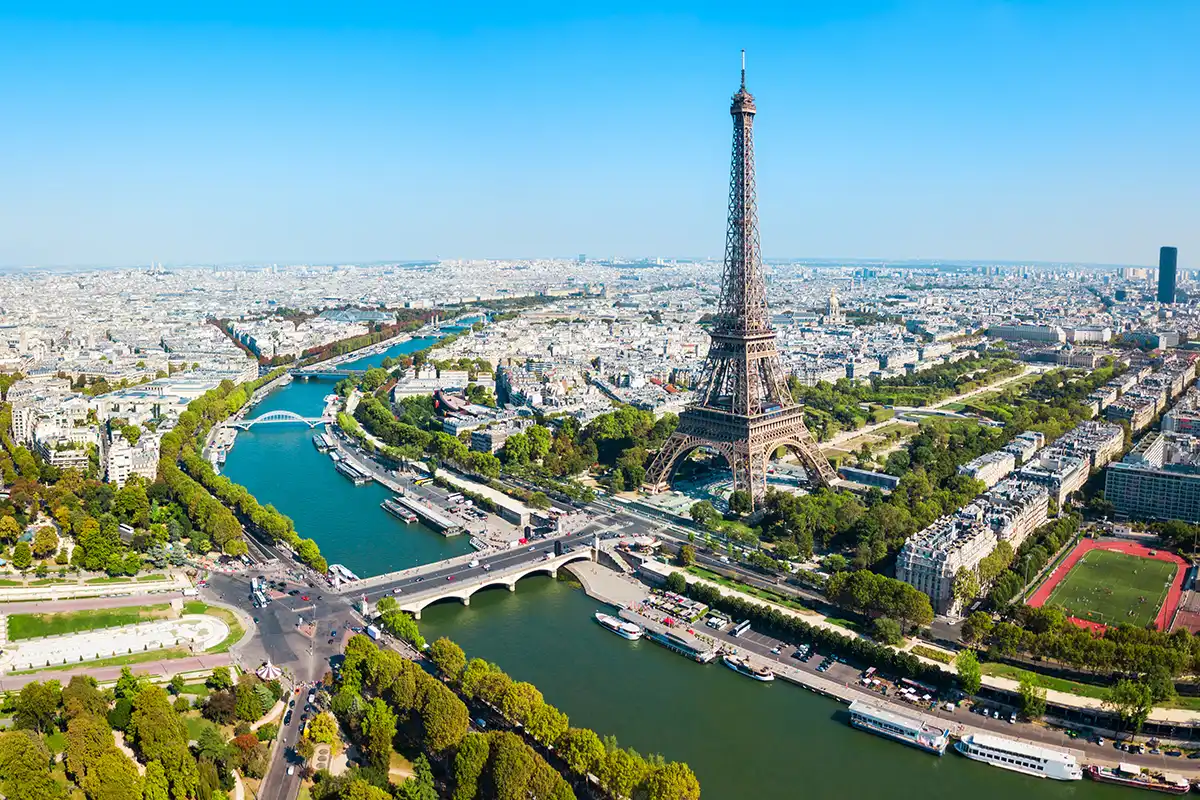
The Eiffel Tower over the city's zinc rooftops.
© saiko3p / Adobe Stock
Practical Info
Language: French. Currency: Euro (EUR); cards and contactless payment are accepted almost everywhere.
Travel
Paris is where most journeys through France begin or end, and it deserves days of its own rather than a night on the way through. The Seine divides the city into the Right Bank to the north and the Left Bank to the south, with the Île de la Cité and the Île Saint-Louis in midstream. Its twenty numbered arrondissements spiral clockwise out from the 1st, around the Louvre, and Parisians locate any address by its number — the 5th, the 11th. It is an expensive city, its central hotels above all, crowded at its famous sights and occasionally brusque.
The Louvre
The Louvre was a royal palace before it was a museum, and it grew over some seven centuries: from a fortress of around 1200, whose moat walls survive beneath the Sully wing, to the wings completed in the 19th century, with I. M. Pei's glass pyramid as its main entrance. Its galleries display some 35,000 works, from Mesopotamian antiquities to 19th-century French painting. The Mona Lisa draws the crowds, but the Winged Victory of Samothrace on her staircase, the Venus de Milo, Vermeer's The Lacemaker and Delacroix's Liberty Leading the People reward the walk, and whole departments of Egyptian, Greek and Islamic art fill wings of their own. A full visit could take days, so a morning given to two or three departments sees more than a march past the famous pieces.
The Tuileries & the Orangerie
West of the Louvre, the Tuileries Garden runs to the Place de la Concorde in a formal French axis of gravel walks, pools, fountains and sculpture, with chairs set out around the water. At its Concorde end, the Musée de l'Orangerie shows Monet's Water Lilies in two oval rooms designed for them, the painted water curving around the walls on every side.
The Musée d'Orsay
Across the Seine from the Tuileries, over the Passerelle Léopold-Sédar-Senghor footbridge, the Musée d'Orsay fills a railway station built for 1900 with France's national collection of art from 1848 to 1914. The station's glass-vaulted hall holds sculpture, and the Impressionists — Monet, Renoir, Degas, Cézanne — hang on the top floor, where the great clock faces of the old station look out across the river towards the Louvre; the collection runs on to Van Gogh and the Post-Impressionists.
The Champs-Élysées & the Arc de Triomphe
From the Place de la Concorde, the Champs-Élysées runs west for about two kilometres to the Arc de Triomphe, lined with flagship stores, cinemas and cafés; the couture houses stand a few streets south on the Avenue Montaigne. The arch rises in the middle of the Place Charles-de-Gaulle, where twelve avenues meet in one roundabout, and the way to it is the underground passage from the top of the Champs-Élysées, never across the traffic. A spiral stair climbs to the roof terrace, which looks back down the avenue towards the Louvre and out the other way to the towers of La Défense.
The Eiffel Tower
Gustave Eiffel's iron lattice tower went up for the World's Fair of 1889 as a temporary structure, and it stayed the tallest structure in the world for 41 years. Lifts run to the second floor and on to the summit, and the stairs climb 674 steps to the second floor, the view widening over the whole city on the way. After dark the tower sparkles for five minutes on the hour. The Champ de Mars below is the picnic lawn with tower views, and the Trocadéro across the Seine gives the classic photograph.
Les Invalides, the Musée Rodin & the Quai Branly
East of the tower along the Left Bank, Les Invalides holds Napoleon's tomb beneath its gilded dome, together with the Musée de l'Armée. Beside it, the Musée Rodin shows The Thinker and The Kiss in an 18th-century mansion and its sculpture garden. Closer to the tower, on the river, the Musée du Quai Branly fills Jean Nouvel's building, fronted by a living plant wall, with indigenous arts from Africa, Asia, Oceania and the Americas.
Notre-Dame & the Île de la Cité
The Île de la Cité, the island in the Seine where Paris began, carries Notre-Dame at its eastern end. Begun in 1163, the cathedral shows French Gothic at full scale: flying buttresses, rose windows and a west front of three carved portals. The restoration that followed the 2019 fire cleaned the interior back to pale stone and colour hidden for centuries under grime. In the square in front, a bronze plaque set in the paving marks Point Zéro, from which road distances from Paris are measured.
Sainte-Chapelle & the Conciergerie
West along the island, inside the walls of the Palais de Justice, Sainte-Chapelle was consecrated in 1248 as a royal chapel in two storeys: a low-ceilinged lower chapel and, above it, an upper chapel walled almost floor to ceiling in 13th-century stained glass, at its best on a sunny day. Next door, the Conciergerie keeps the vaulted Gothic halls of the medieval royal palace.
The Île Saint-Louis & the Seine
Behind Notre-Dame, a footbridge crosses to the Île Saint-Louis, a quieter island of 17th-century townhouses on narrow streets, ringed by tree-lined quays just above the water. The banks of the Seine through the centre are a UNESCO World Heritage Site, and long stretches of the lower quays on both banks are closed to cars, given over to walkers, runners and picnics, and to rosé by the water on summer evenings. Along the parapets of the upper quays, the bouquinistes sell old books, prints and postcards from green boxes. On the river itself, the big glass-roofed sightseeing boats suit a first visit, smaller boats run aperitif cruises, and some moored barges are bars and clubs.
The Latin Quarter & Saint-Germain-des-Prés
On the Left Bank opposite the islands, the Latin Quarter (5th) surrounds the Sorbonne with bookshops and small cinemas, and the domed Panthéon crowns the hill above it. To the west, Saint-Germain-des-Prés (6th) keeps the Left Bank's literary name in its galleries, bookshops and brasseries, and two cafés on its boulevard, Les Deux Magots and the Café de Flore, are known for the writers who worked at their tables, Sartre and de Beauvoir among them. Between the two quarters lies the Jardin du Luxembourg, the garden of the Senate's palace, with its central pond and the Medici Fountain.
The Marais & the Centre Pompidou
The Marais, across the 3rd and 4th arrondissements on the Right Bank, is a quarter of aristocratic mansions, the hôtels particuliers, many of them museums: the Musée Carnavalet tells the history of Paris, and the Musée Picasso shows the painter's work. At its heart lies the arcaded Place des Vosges, laid out in the early 17th century. Rue des Rosiers runs through the old Jewish quarter, the quarter's bars are a centre of LGBTQ+ nightlife, and some of the city's most fashionable boutiques fill the streets between. On the quarter's western edge, the Centre Pompidou, its pipes and escalators on the outside of the building, houses France's national museum of modern art and is closed for renovation until 2030.
Canal Saint-Martin, Oberkampf & Belleville
East of the centre, the 10th and 11th arrondissements — along the Canal Saint-Martin with its locks and iron footbridges, and up the Rue Oberkampf — are the young, multicultural Paris of natural wine bars, international street food and independent galleries, and the city's specialty coffee roasters gather here. Further east, Belleville, on its hill across the 19th and 20th, mixes Chinese and North African restaurants with artists' studios, and the top of the Parc de Belleville looks out over the whole city.
Montmartre & Sacré-Cœur
Montmartre, the hill (butte) above the 18th arrondissement, keeps the feel of a village: cobbled streets climb past ivy-covered houses, the Clos Montmartre vineyard and the portrait painters of the Place du Tertre to the white domes of the Basilica of Sacré-Cœur at the top. From the steps in front of the basilica most of Paris lies spread below, and inside, a great gold mosaic of Christ fills the apse. The funicular from the foot of the hill saves the steepest climb.
Montmartre's Painters & the Streets Below
Picasso and Modigliani worked in the Bateau-Lavoir studios, rebuilt on the Place Émile-Goudeau, and Toulouse-Lautrec painted the neighbourhood's cabarets, among them the Moulin Rouge, which still stands at the foot of the hill on the Boulevard de Clichy. The Musée de Montmartre keeps the house and gardens where Renoir worked, and Dalí Paris, a small museum near the Place du Tertre, shows the surrealist's sculptures. Down the hill, the eastern slope leads to the Goutte d'Or, with its African grocers and fabric shops, and the southern slope to South Pigalle (“SoPi”), in the 9th, with its cocktail bars and restaurants.
Bistros, Bakeries & Cafés
Paris is a city of Michelin-starred dining rooms, yet its everyday food — the boulangerie and the bistro — is the greater pleasure: a croissant from the bakery at seven in the morning, a croque-monsieur at a zinc café counter, steak-frites and crème caramel at a corner bistro, a tarte Tatin after dinner. The city's bakers compete each year for its prize for the best baguette, and the winner supplies the Élysée Palace for the following year. A café terrace is where the city sits down, over an espresso or a glass of Beaujolais with the chairs turned to the street. Service is included in the bill by law, so tipping in France comes down to rounding up or leaving the coins from the change.
Markets & Food Streets
The Marché des Enfants Rouges in the Marais, dating from the early 17th century and the city's oldest covered market, is as much a lunch counter as a market, its stalls serving cooked food from several countries at shared tables. The Marché d'Aligre (12th) pairs a covered hall with street stalls and a small flea market; Rue des Martyrs (9th) is lined with fromageries, pâtisseries and bakeries; and the organic market on the Boulevard Raspail (6th) supplies the Left Bank.
Getting Around Paris
The Métro has more than 300 stations, so close together in the centre that one is seldom more than a few minutes' walk away. The RER, the regional express network, crosses the centre with fewer stops and runs out to the suburbs: the RER B serves Charles de Gaulle (CDG), and Orly (ORY) is on Métro Line 14. Vélib', the bike share, has docking stations across the city and its neighbouring towns, with green mechanical bikes and blue electric ones.
Trains Out of Paris
Paris's main-line stations each face their own part of the country, because France's rail network radiates from the capital. Eurostar trains leave the Gare du Nord for London in about 2¼ hours, and TGVs leave the Gare de Lyon for Lyon in about 2 hours and Provence in about 3. The Gare de l'Est serves Reims and Strasbourg, Montparnasse serves Brittany and Bordeaux, Saint-Lazare serves Normandy, and the Gare d'Austerlitz the slower Intercités lines to the centre and south-west.
Day Trips from Paris
The Île-de-France region around the city holds the classic day trips: the Palace of Versailles, with its Hall of Mirrors and 800 hectares of gardens and park, is about 40 minutes away on the RER C; Disneyland Paris is about 40 minutes out on the RER A; and Fontainebleau's Renaissance palace and forest and the medieval town of Provins, a UNESCO site, each lie within 90 minutes. Just beyond the region's northern edge, Chantilly's château and horse museum are within the same range. Further out, Monet's garden at Giverny, in Normandy, blooms from April through October and is reached by train from Saint-Lazare to Vernon; Chartres Cathedral, an hour by train from Montparnasse, keeps most of its 12th- and 13th-century stained glass; and Reims, in Champagne, is under an hour by TGV from the Gare de l'Est.
Frequently asked questions
How many days do you need in Paris?
What should you book ahead in Paris?
Where do pickpockets work in Paris?
What are the main festivals and events in Paris?
Can you walk around Paris?
Do you need to speak French in Paris?
Diplomatic missions in Paris
36 embassies based in this city, grouped by region.
Asia11
Europe10
Africa9
This overview comes from Visaja's worldwide missions database (visaja.com), checked against official government sources; for binding answers, the mission itself always has the final word.