
Travel deep dive
Provence & the Côte d'Azur: Where the Light Comes From
Painters didn't imagine Provence's light — a specific wind put it there. The mistral, funnelling down the Rhône valley and scouring humidity from the air, is the physical reason this corner of France reads differently in paint and in photographs than anywhere else in the country, and it's the thread connecting Cézanne's studio in Aix-en-Provence to Van Gogh's asylum garden in Saint-Rémy to the resort towns further along the coast that a very different set of outsiders later invented from nothing.
Updated 2026-08-16
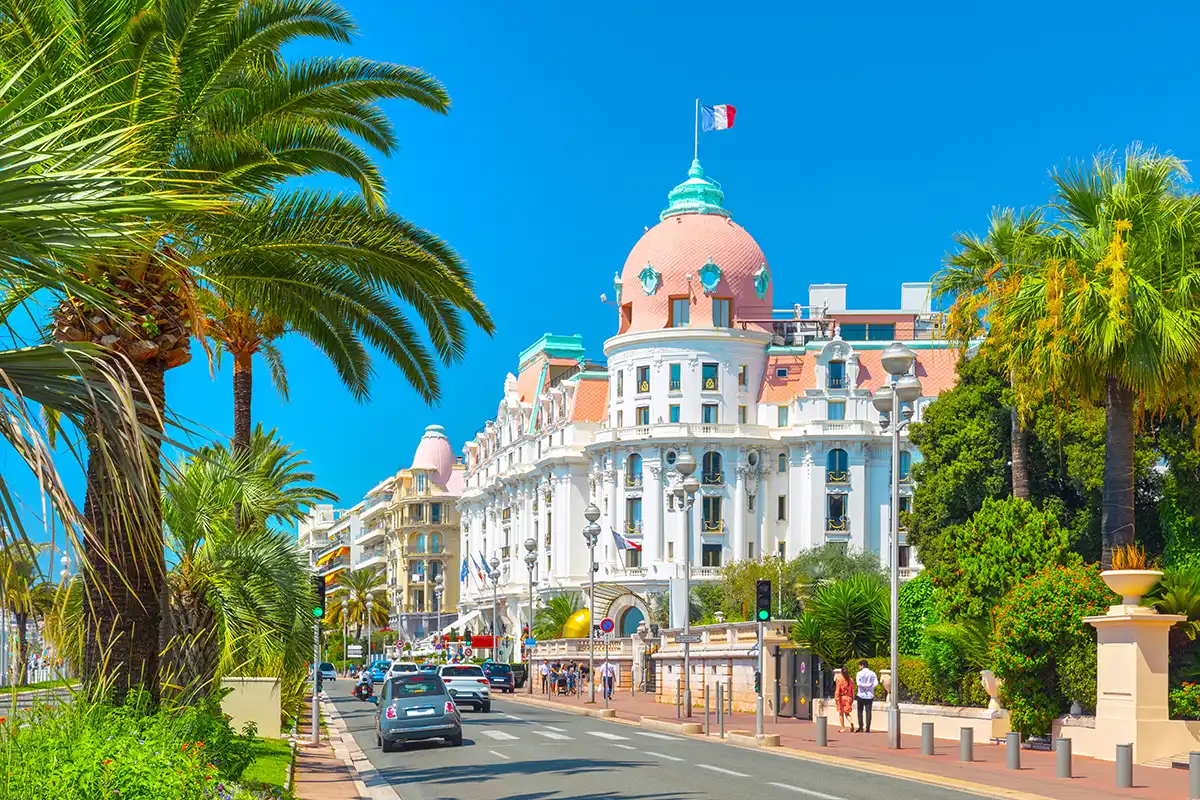
The Baie des Anges at Nice — the Riviera the Victorians and the Jazz Age invented.
© proslgn / Adobe Stock
The mistral and the light painters chased
The mistral is a powerful, often bitterly cold wind that funnels down the Rhône valley from the north, and its practical effect is to scour humidity and haze out of the air, leaving skies over Provence an intense, saturated blue found in few other places. That specific quality of light is why Paul Cézanne, working from his studio outside Aix-en-Provence, painted Mont Sainte-Victoire dozens of times chasing exactly how the light struck it; it's why Vincent van Gogh, during his stay at the Saint-Paul-de-Mausole asylum near Saint-Rémy-de-Provence, produced some of his most intense colour work, including studies of the region's cypress trees and olive groves. The wind itself is strong enough to be a genuine practical consideration for visitors — it can blow for days at a time, and locals plan outdoor activities around it rather than fighting it.
Lavender fields, on their own calendar
Provence's lavender fields, the region's single most photographed sight, bloom on a narrow and specific calendar — roughly mid-June through early August, peaking in July, with the Valensole plateau's vast commercial fields and the Abbaye de Sénanque's smaller, more intimate rows (a 12th-century Cistercian abbey still in active use, with lavender planted directly up to its walls) the two most visited locations. Outside that window the fields are simply cut stubble, a genuine disappointment for visitors who arrive expecting purple in April or September, so timing a visit around the bloom matters more here than almost any other seasonal sight in France. The lavender industry itself — distilleries, soap-making, the annual harvest — is a real regional economy rather than a backdrop, and several producers open for visits during the season.
Hilltop villages and market towns
Provence's interior is dotted with hilltop villages (villages perchés) built for defence in earlier centuries and preserved today as some of the region's most atmospheric stops: Gordes, tumbling down a rocky outcrop in tightly stacked stone, and Roussillon, built from and coloured by the ochre cliffs beneath it, are the two most visited, while Les Baux-de-Provence adds a ruined clifftop castle to the formula. Aix-en-Provence and Avignon anchor the region's town life — Aix for its fountain-lined boulevards and Cézanne connections, Avignon for the Palais des Papes, the enormous Gothic palace built when the papacy relocated here in the 14th century, and for the Avignon Festival each July, one of the world's most significant theatre festivals. Provençal markets, running most mornings in nearly every town, are as much the destination as any single monument — stalls of olives, cheese, lavender products and produce that make the region's food culture tangible in a way no restaurant meal quite matches.
How the Côte d'Azur was invented, twice
The Riviera's glamour is not ancient French tradition — it was built by two successive waves of foreign visitors. In the 19th century, British aristocrats wintering along the Mediterranean coast to escape northern cold built the first grand hotels and seafront promenades in Nice and Cannes, essentially inventing the idea of this coast as a resort. What turned it into the sun-worshipping, celebrity-studded image most visitors picture today came later and from a different direction entirely: American and European elites of the 1920s Jazz Age — writers, artists and a new class of leisure travellers — discovered Saint-Tropez and Cannes and remade them around summer sunbathing rather than winter escape, a genuine cultural inversion that stuck. Monaco's own glamour runs on a separate, older track as an independent principality built around its casino and later Grand Prix racing, distinct from the resort-town history of its French neighbours.
Along the coast: Nice, Cannes, Antibes and Marseille
Nice anchors the Riviera with the Promenade des Anglais — literally the Englishmen's promenade, named for the wave of British visitors who funded its construction — a seafront walk that remains the coast's most iconic stretch. Cannes carries the Croisette and its film-festival glamour each May; Saint-Tropez trades on its yacht harbour and beach-club culture rather than historic monuments. Antibes, quieter than either, holds the Picasso Museum in the Château Grimaldi, where the artist worked for several months in 1946 and left much of what he made there to the town. Marseille, France's second city and gateway to the Calanques — the fjord-like limestone inlets along the coast southeast of the city, and the MuCEM's contemporary architecture on the old port — is a grittier port city, very different in character from Nice's Riviera, and this coast is what connects the two.