
Travel deep dive
Etosha National Park: How the Waterhole Circuit Works
Most safari parks reward covering ground — more track driven, more habitat crossed, better odds of a sighting. Etosha inverts that logic. The park is built around an enormous salt pan so dry and mineral-poor that almost nothing can live on it directly, which pushes nearly all the water in a 22,750 km² landscape into a small number of permanent springs and boreholes at its edges. Animals don't disperse across that space; they commute to it. Once that's clear, the park stops being about how far you drive and becomes about which waterhole you're at, and when.
Updated 2026-08-15
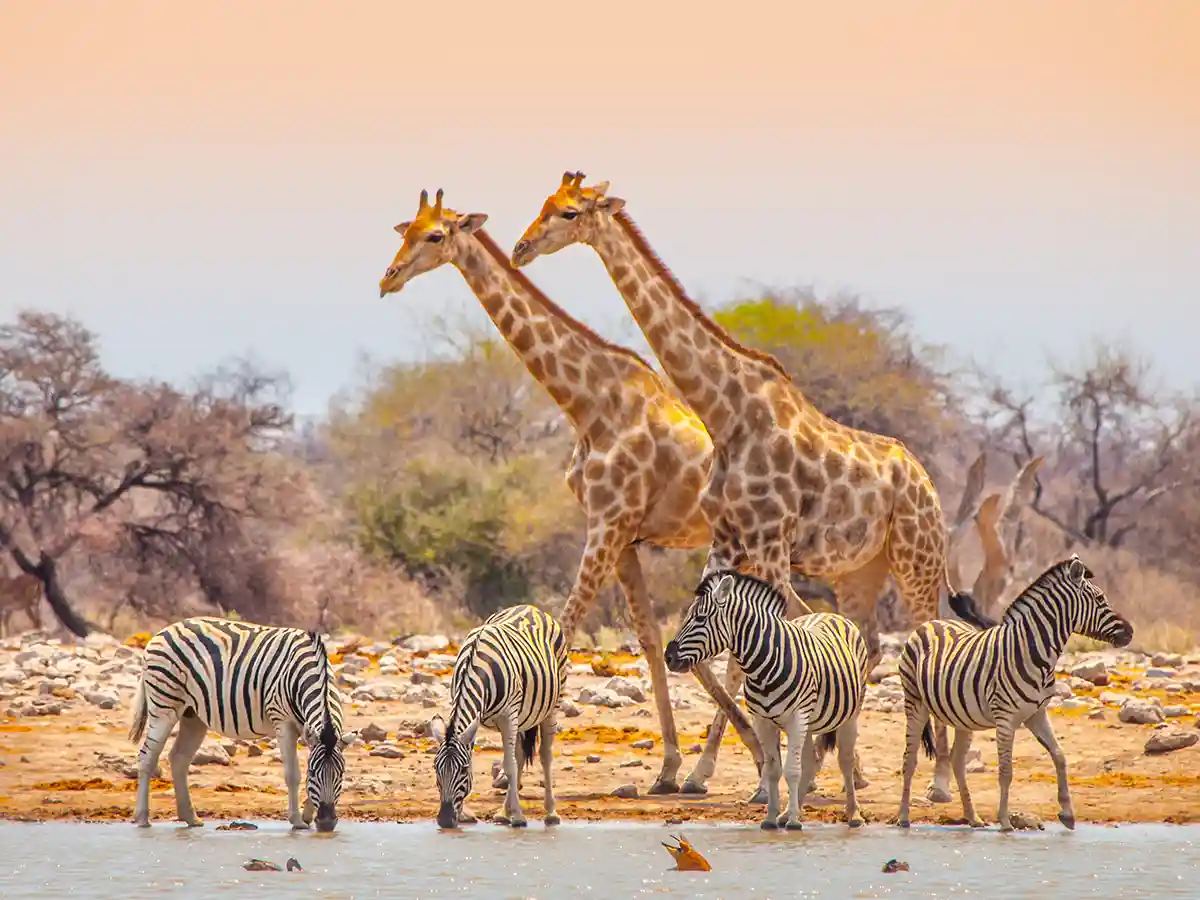
Giraffes and zebras at a waterhole — Etosha's game-viewing runs on the waterhole commute, not on distance driven.
© pyty / Adobe Stock
Why one pan reorganizes an entire ecosystem
The Etosha Pan is the dry bed of a vast ancient lake, its floor caked in mineral salts left behind as the water that once filled it evaporated over geological time. Rain fills a shallow skin of water across the pan for a few weeks most wet seasons, drawing flamingos and pelicans to a landscape that's otherwise inhospitable to almost everything — the salt crust supports no grazing and holds no permanent water of its own.
That inhospitality is exactly what makes the park work as a wildlife destination. With the pan itself unusable, water collects instead at a limited number of springs and man-made boreholes strung along its southern edge, and every large mammal in the park has to return to one of them regularly regardless of how far its territory ranges. A park this size would normally scatter sightings across an unmanageable area; Etosha concentrates them at a handful of predictable points instead.
The practical result is that Etosha rewards patience over distance. Parking at a good waterhole for an hour often outperforms an hour of driving, because the animals are already converging on the same handful of points you could simply wait beside.
Choosing a camp is choosing a waterhole
Namibia Wildlife Resorts operates three rest camps inside the park — Okaukuejo, Halali and Namutoni — and each is built around its own floodlit waterhole that keeps working after the gates close for the night, when the private lodges outside the park can't compete. Which camp to base at is less a question of location than of which waterhole's character suits the trip.
Okaukuejo's waterhole is the park's flagship: open, close to camp, and reliable enough that elephant, black rhino and predators arrive there in a rough, watchable sequence most evenings. It's also the busiest of the three for exactly that reason. Halali sits in the middle of the park among rocky kopjes that suit leopard more than the open-pan camps do, and its waterhole runs quieter. Namutoni, built around a converted German colonial fort, anchors the park's eastern side, where the Fischer's Pan floods after good rains and pulls in a different set of species — including large numbers of pelican and flamingo when the water is running.
A multi-night Etosha stay is stronger for splitting nights between at least two of these rather than committing to one, since the eastern and western halves of the park genuinely behave differently — denser predator activity west, quieter and more bird-rich east when the seasonal pans hold water.
Self-drive rhythm, and what the private lodges add
Etosha is one of the most straightforward parks in Africa to self-drive: roads are graded and well-signed, waterholes sit just off the main routes, and a rental sedan handles the core circuit without difficulty. The constraint is time, not terrain — gates open at first light and close at dusk on a schedule that shifts with the season, and every vehicle needs to be back inside a camp's fence by closing. Driving after dark inside the park isn't an option for self-drivers at all.
That closing-gate rule is precisely what the private lodges along Etosha's southern boundary — Mushara, Onguma, Ongava among them — are built to get around. Because they sit just outside the park fence on their own private concessions, they can run night drives and guided walking safaris after the gates close, activities no self-driver staying inside the park can access at any price. The trade-off is straightforward: NWR camps put you inside the park, cheaper, with the floodlit waterhole doing the guiding for free; private lodges cost more but extend the day into the hours when Etosha's predators are often most active.
Many itineraries split the difference — a few nights inside the park at an NWR camp for the waterhole circuit, then a night or two at a boundary lodge for what only night access can deliver.
Two seasons, two entirely different parks
The dry season, roughly May to October, is when the waterhole logic runs at its clearest: rain stops, natural pools dry up across the wider landscape, and the surviving permanent water points become the only option for anything that needs to drink. Game concentrates hard, vegetation thins enough to see well into the bush, and the camp waterholes turn into genuine theatre most evenings.
The wet season inverts the whole picture. Rain refills scattered natural pans across the park, so animals no longer need the permanent waterholes and disperse widely — sightings become less predictable and more work, but the trade-off is a park transformed: green rather than dust-brown, full of newborn antelope and zebra foals, and host to migratory birds that only show up when the eastern pans are holding water. Neither season is simply better; they reward different kinds of trips, and travellers chasing guaranteed big-game density should lean dry while those drawn to birdlife, scenery and lower prices should lean wet.