
Travel deep dive
Kaokoland, Kunene River and Epupa: The Far North-West
Kaokoland is the region most independent travellers in Namibia skip, and the reason is simple: it's remote, the roads are difficult, and there's little conventional infrastructure. It's also the region that rewards understanding a single fact before anything else — the Kunene River, tracing the border with Angola across the top of the country, is essentially the only permanent water for hundreds of kilometres. Almost everything distinctive about Kaokoland, from where its settlements sit to how the Himba built their way of life, follows from that one river being the exception in an otherwise waterless landscape.
Updated 2026-09-19
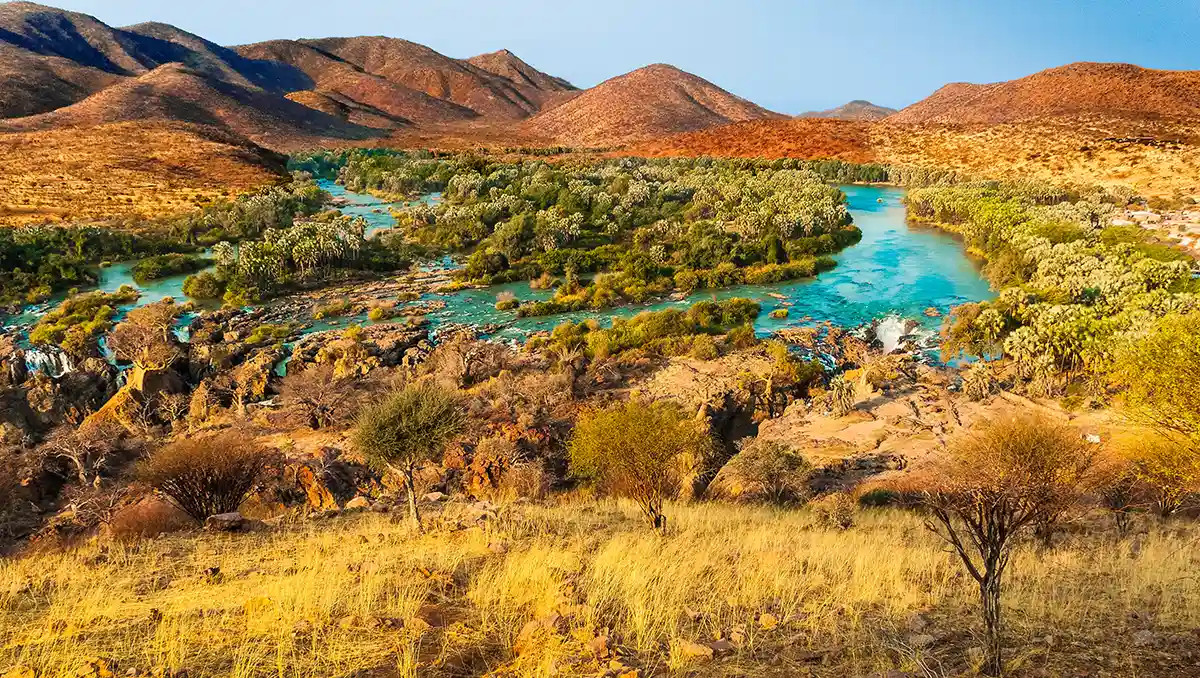
Epupa Falls, where the Kunene River splits into dozens of cascades along the border with Angola.
© maramade / Adobe Stock
A river that explains the whole map
Away from the Kunene, Kaokoland receives some of the lowest and most unreliable rainfall in Namibia, which makes the river's course effectively the only dependable water source across an enormous stretch of territory. Settlements, grazing routes and the region's few reliable tracks all orient toward it in one way or another, not because the river is scenic but because it's the only water that doesn't disappear for months at a time.
Epupa Falls, where the river drops around 35 metres over a 1.5-kilometre series of cascades through a corridor of palm trees, is the region's single most photographed spot precisely because it makes that scarcity visible: lush green vegetation clustered along a narrow ribbon of river, with dry mountain and gravel plain stretching away from it in every direction. The contrast isn't an accident of framing — it's the region's water geography made visible in a single view.
The Himba: a pastoral culture built around the same scarcity
The Himba people, whose homeland this is, built a semi-nomadic pastoral way of life specifically suited to land too dry and unpredictable for settled agriculture — herding cattle and goats across territory large enough to always have grazing and water somewhere within reach, moving in response to conditions rather than staying fixed to one plot of ground. Their most visible cultural marker to outsiders, the ochre-red pigment mixed with butterfat that women apply to skin and hair, serves practical purposes in this climate — sun and insect protection chief among them — as much as it does symbolic or aesthetic ones.
This is a living culture continuing on its own terms, not a historical reenactment, and the respectful way to encounter it is through a visit arranged by a local guide or operator with a genuine, ongoing relationship with a specific community, rather than as an unannounced stop. Operators who work this way typically share a portion of the visit's proceeds directly with the community, turning cultural tourism into something closer to the conservancy model that protects Damaraland's wildlife than to a roadside curiosity stop.
Getting there: the road as its own filter
Opuwo, the regional centre, is the last town with reliable fuel and supplies before the roads genuinely thin out. The route on to Epupa, roughly 180 kilometres along the D3700, is entirely gravel and slow going even in good conditions — after rain, sections can become impassable to anything without high clearance and real off-road capability, which is as much a natural filter on who reaches the falls as it is an inconvenience.
North of Kaokoland proper, the Marienfluss and Hartmann Valley push the same logic further: virtually no infrastructure, no fuel, no reliable phone signal, and travel that only makes sense as a multi-day 4x4 convoy, ideally with a guide who knows the terrain and can help if a vehicle breaks down somewhere the nearest help is a full day's drive away. This isn't a stretch of Namibia meant for a single self-drive vehicle travelling alone.