Geneva
- Population:209,061 (2024)
- Area:16 km²
- Timezone:CET/CEST
- Currency:Swiss franc (CHF). Some shops near the French border take euros, at a poor rate.
- Key Areas:Old Town (Vieille Ville) · Plainpalais · Pâquis · Eaux-Vives
Overview
Geneva is the French-speaking Swiss city at the south-western tip of Lake Geneva: the United Nations' second-largest duty station after New York and home to the Red Cross, the WHO and the WTO, with a medieval Old Town on its hill and CERN on the French border.
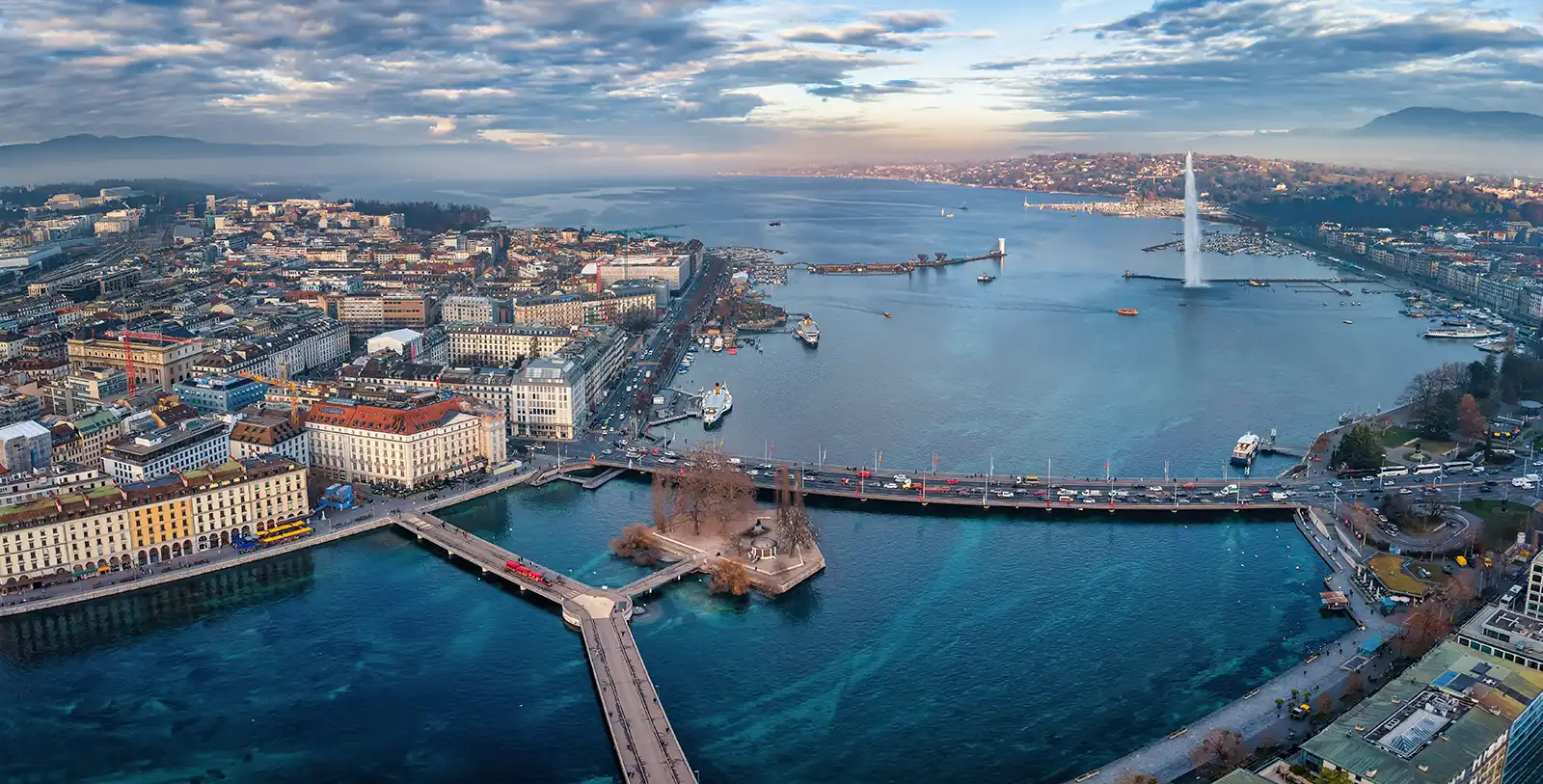
The Jet d'Eau — Geneva's 140-metre lake fountain.
© moofushi / Adobe Stock
Business & Economy
Key industries: Multilateral diplomacy and international NGOs, Private banking and wealth management, Watchmaking (Patek Philippe, Vacheron Constantin, Rolex, Piaget), Commodities trading (oil, grain, sugar), Pharmaceuticals and biotech, Particle physics research (CERN). Business hubs: Pregny-Chambésy / Place des Nations (international organisations), Centre-ville banking corridor (Rue du Rhône, Rue de la Confédération), Plan-les-Ouates (watch manufactures), Acacias (Rolex, La Praille), Meyrin / Satigny (CERN, biotech, light industry).
Practical Info
Language: French. English is widely spoken in International Geneva, hotels and shops. Currency: Swiss franc (CHF). Some shops near the French border take euros, at a poor rate.
Travel
Geneva sits at the south-western tip of Lake Geneva, where the Rhône leaves the lake through the middle of the city and splits it in two. The right bank holds the main station, Cornavin, the lakefront hotels and, a tram ride north, the international organisations; the left bank holds the Old Town on its hill, the museums and the shopping streets. The centre is small enough to cross on foot, and trams reach the sights farther out, from CERN to Carouge. France begins a few kilometres out on almost every side, so trams, trains and lake boats cross the border as a matter of routine, and the canton beyond the city keeps the vineyards, the lakeshore villages and the Salève cable car.
The Rade and the Jet d'eau
The Rade is Geneva's harbour basin, the last stretch of lake before the Mont-Blanc bridge, lined on the right bank by the grand hotels of the Quai du Mont-Blanc and on the left by the Jardin Anglais, with its flower clock, and the Quai Gustave-Ador. On a clear day the Mont Blanc range shows some 70 kilometres to the south-east, and the lake itself stretches 73 kilometres east to Montreux and Villeneuve. The Jet d'eau rises from the Eaux-Vives jetty on the left bank: it began in 1886 as a pressure-relief outlet of the city's water network, became a landmark in the Rade in 1891 and has stood at its present spot since 1951, throwing 500 litres of water a second 140 metres into the air, at 200 km/h from the nozzle. A path runs out along the jetty towards the foot of the jet, close enough to be soaked when the wind turns.
Mouettes and Paddle Steamers
The Mouettes Genevoises, small yellow boats, are the Rade's water shuttles: four short lines link the Pâquis, Molard, Eaux-Vives, Genève-Plage and De-Chateaubriand landings. Longer trips belong to the CGN, the lake's navigation company, whose fleet includes Belle Époque paddle steamers and sails from Geneva up the lake towards Yvoire and Lausanne. Yvoire, a medieval walled village on the French shore, makes a day out by boat from the city.
Swimming at the Bains des Pâquis
The Bains des Pâquis, a lakeside bath on a jetty off the right bank, built in its present form in 1932, is where Geneva swims: wooden decks over the water and the lake itself as the pool, open all year, with a sauna and hammam in winter. On the left bank, Genève-Plage, at the end of the Eaux-Vives quays, is the larger lido, with a beach on the lake.
Saint-Pierre Cathedral and the Old Town
The Old Town (Vieille Ville) covers the hill above the Rhône, small enough to walk in half a day, and Saint-Pierre Cathedral stands at its top. Built between the 12th and 15th centuries on a site with churches since the 4th, and given a neoclassical portico in the 18th, it became John Calvin's church in the Reformation, and his wooden chair stands in the north aisle. The 157 steps of the north tower lead to a view over the Old Town's roofs to the lake and the Jet d'eau, and the archaeological site beneath the cathedral exposes Roman, early Christian and medieval foundations. Beside the cathedral, the International Museum of the Reformation tells the story of the movement that made Geneva Calvin's city.
Bourg-de-Four, the Maison Tavel and the MAH
Just below the cathedral, the Place du Bourg-de-Four, Geneva's oldest square and a marketplace since Roman times, is the Old Town's meeting point, ringed with café terraces. The Maison Tavel, Geneva's oldest private house, rebuilt after the fire of 1334, holds the museum of the city's history; in its attic, the Magnin relief model shows Geneva in 1850, still inside its fortifications. Rue des Granges, above the Place Neuve, keeps the 18th-century townhouses of the city's patrician families, and on the hill's lower, northern slope the Place de la Madeleine opens around the Temple de la Madeleine. Down the eastern side of the hill, the Musée d'art et d'histoire (MAH) holds Konrad Witz's altarpiece of 1444, whose “Miraculous Draught of Fishes” sets the Gospel scene on Lake Geneva, with the shore and mountains around the city behind.
The Treille, the Bastions and the Reformation Wall
The Promenade de la Treille, on the old walls at the Old Town's southern edge, has one of the world's longest wooden benches (1767) and the official chestnut tree, whose first leaf is recorded each year as the start of spring in Geneva. Below it, the Parc des Bastions runs along the foot of the ramparts, with the main building of the University of Geneva and games of chess on giant boards under the trees. Against the rampart stands the Reformation Wall (Mur des Réformateurs), a monument about 100 metres long begun in 1909, whose central figures, some five metres tall, are Guillaume Farel, John Calvin, Theodore Beza and John Knox.
Plainpalais: the Flea Market, the MEG and MAMCO
Plainpalais, the district south-west of the Old Town, centres on the Plaine de Plainpalais, a wide open square that holds the city's flea market. Nearby, the Musée d'ethnographie de Genève (MEG) shows collections from around the world in a building opened in 2014, and on Rue des Vieux-Grenadiers MAMCO, the museum of modern and contemporary art, fills a former factory.
The Patek Philippe Museum and Geneva Watchmaking
Watchmaking took root in Geneva in the 16th century, when Calvin's ban on jewellery turned the city's goldsmiths to watches, and watches finished in the canton to its rules may carry the Geneva Seal (Poinçon de Genève), a hallmark since 1886. On the same street as MAMCO, the Patek Philippe Museum shows some 2,500 watches, automata and enamel miniatures from the 16th century to today, with the history of Patek Philippe, founded in Geneva in 1839. The great houses — Patek Philippe and Vacheron Constantin, founded in 1755, in Plan-les-Ouates, and Rolex in the Acacias district — make their watches behind closed doors, and the Watches and Wonders fair fills the Palexpo halls each spring. The other Swiss centre of the craft lies in the Jura, in the watchmaking towns of Le Locle and La Chaux-de-Fonds.
Carouge
Across the Arve from Plainpalais, Carouge is a separate town with an Italian face: laid out from 1772 by the Kings of Sardinia as a rival to Geneva and built up by 1786, it follows a regular grid of low, pastel-rendered houses around the Place du Marché, the Place du Temple and Rue Saint-Joseph, drawn by architects of the court at Turin. Its ground floors hold the workshops of leatherworkers, ceramicists, jewellers, dressmakers and antiquarian booksellers, between cafés and bars. A market fills the Place du Marché in the mornings, and the Théâtre de Carouge stages its own productions. Trams 12 and 18 reach Carouge from the centre in about 15 minutes, and the walk from Plainpalais over the Pont de Carouge takes about 25.
Place des Nations and International Geneva
International Geneva — the organisations, permanent missions and NGOs that make the city the United Nations' second-largest duty station after New York — lies about two kilometres north of Cornavin, and tram 15 runs there from the station. Its front door is the Place des Nations, an open square of ground fountains before the Palais des Nations, where Daniel Berset's Broken Chair, a wooden chair twelve metres high with one leg snapped off, was first set up in 1997 as a reminder of the victims of landmines. Some forty international organisations have their seats in Geneva, and the main ones lie around the square: the WHO on Avenue Appia, the ILO and the IOM on Route des Morillons, the UNHCR on Rue de Montbrillant and the WTO in the Centre William Rappard on the lakeshore.
Inside the Palais des Nations
The Palais des Nations was built between 1929 and 1938 for the League of Nations and has housed the United Nations Office at Geneva since 1946. It is 600 metres long, with 2,800 offices; the Human Rights Council, the Conference on Disarmament and the World Health Assembly meet here, and UNCTAD has its offices inside. Its great rooms are the Salle des Pas-Perdus, the Assembly Hall, the Council Chamber under José Maria Sert's gold-and-sepia murals and Room XX, where the Human Rights Council sits under Miquel Barceló's ceiling of coloured stalactites; guided tours visit them as far as meetings allow. The Musée Ariana, a museum of ceramics and glass, stands at the edge of the park around the Palais.
The Red Cross and Red Crescent Museum
Across the Avenue de la Paix from the Palais, the International Red Cross and Red Crescent Museum stands beside the headquarters of the International Committee of the Red Cross, the organisation Henry Dunant co-founded in Geneva in 1863. Its permanent exhibition follows humanitarian work from 1863 to the present. The International Federation of Red Cross and Red Crescent Societies has its seat a short walk away in Petit-Saconnex.
CERN: the Science Gateway and the Globe
CERN, the European Organization for Nuclear Research, lies about 8 kilometres from central Geneva at Meyrin and Saint-Genis-Pouilly, on the French-Swiss border. Founded in 1954, funded by 25 member states and staffed by scientists from more than 100 countries, it runs the Large Hadron Collider, the 27-kilometre accelerator ring under the border where the Higgs boson was found in 2012, and it is where the World Wide Web was first proposed, in 1989. Its visitor centre is the Science Gateway, a Renzo Piano building opened in 2023 and paid for by donations, with three permanent exhibitions, a 900-seat auditorium and hands-on lab spaces for school groups. Beside it, the Globe of Science and Innovation, the wooden sphere built as a Swiss pavilion for Expo.02 and moved to CERN in 2004, is the site's landmark.
Visiting CERN: Tram 18 and Guided Tours
Tram 18 runs from Cornavin to its terminus at CERN in about 25 minutes. Guided tours to working sites, such as the Synchrocyclotron, CERN's first accelerator, and the ATLAS visitor centre, are booked online in advance, and summer dates go quickly. The underground experiments themselves open to visitors only during the collider's long shutdowns and on rare open days.
Perch, Longeole and Cardoons
Geneva eats on the French-speaking side of the Röstigraben, and its lake dish is filets de perche, pan-fried perch fillets. Two local products carry protected status: the longeole, a pork sausage seasoned with fennel seed (a Swiss IGP), and the spiny Geneva cardoon (AOP), baked as a gratin for Christmas. In December the Escalade brings the marmite, a chocolate cauldron filled with marzipan vegetables, which the youngest and the oldest at the table break together. Behind the right-bank quays, the streets of the Pâquis hold Lebanese, Eritrean, Vietnamese and Korean restaurants side by side.
Trams and the Léman Express
Geneva's public transport company, the TPG, runs five tram lines (12, 14, 15, 17 and 18), trolleybuses and buses, some of them across the French border. The Léman Express, the cross-border rail network, runs from Cornavin across the left bank on the CEVA line to Annemasse and on to Évian, Annecy, La Roche-sur-Foron and Saint-Gervais-les-Bains-Le Fayet in France, and along the lake to Coppet in Vaud.
Frequently asked questions
Can I visit the UN's Palais des Nations as a tourist?
Is CERN worth visiting, and do I need a science background?
Where are the consulates and missions in Geneva?
How do I get from Geneva Airport to the city centre?
How long does the train take from Geneva to Lausanne, Bern, Zurich and Paris?
Where should I stay in Geneva?
How many days do I need in Geneva?
When is the best time to visit Geneva?
Is Geneva safe?
Transport & airports
Transports publics genevois — the canton's tram, trolleybus and bus operator. Live timetables, ticket purchase and fare zones, plus the cross-border French routes and the integration with the Léman Express commuter rail.
Geneva-Cointrin Airport's official site. Flight information, terminal maps including the unusual French Sector that gives direct exit to the French side, parking and the six-minute rail link to Cornavin.
Tourism & destination guides
Official government sites
The Ville de Genève municipal portal. Residency and registration, district services, the city council and administration, and the cultural and event calendar of the municipality.
The official site of the United Nations Office at Geneva. Visitor information for the Palais des Nations, guided tour schedules and booking, the calendar of conferences open to the public, and information on the wider International Geneva organisations.
Diplomatic missions in Geneva
38 embassies based in this city, grouped by region.
Africa12
- Botswana Embassy in Geneva
- Permanent Mission of Burundi in Geneva
- Cape Verde Embassy in Geneva
- Central African Republic Embassy in Geneva
- Djibouti Permanent Mission to UN Geneva
- Eritrea Embassy in Geneva
- Ethiopia Embassy in Geneva
- Guinea Embassy in Geneva
- Kenya Consulate General in Geneva
- Mozambique Embassy in Geneva
- Namibian Embassy in Geneva
- Republic of Congo Permanent Mission in Geneva
Asia11
- Afghan Embassy in Geneva
- Armenian Embassy in Geneva
- Permanent Mission of Bahrain in Geneva
- Bangladeshi Embassy in Geneva
- Bhutan Embassy in Geneva
- Consulate General of Brunei in Geneva
- Cambodian Permanent Mission in Geneva
- Consulate General of India in Geneva
- Mongolia Embassy in Geneva
- Saudi Arabian Consulate General in Geneva
- Turkish Consulate General in Geneva
Europe9
Americas5
Oceania1
This overview comes from Visaja's worldwide missions database (visaja.com), checked against official government sources; for binding answers, the mission itself always has the final word.