Geneva
- Population:209,061 (2024)
- Area:16 km²
- Timezone:CET/CEST
- Currency:Swiss franc (CHF). Geneva is in the Swiss customs area — travellers from euro countries need to exchange (informal EUR acceptance at retail near the French border is at unfavourable rates). Card payments and contactless are universal; Twint (the Swiss mobile payment app, Apple-Pay-compatible) is universal in retail, transport and restaurants. ATMs are everywhere — UBS, Credit Suisse-UBS branches, PostFinance and the canton's Banque Cantonale de Genève (BCGE) all serve foreign cards. Tipping is not customary (service is included by Swiss law); rounding up the bill is the standard gesture for good service.
- Key Areas:Old Town (Vieille Ville) · Plainpalais · Pâquis · Eaux-Vives
Overview
Geneva is the western Swiss city at the southern tip of Lake Léman where the United Nations Office, the Red Cross, the WTO, the WHO, the ILO, the UNHCR and CERN cluster around a 16th-century French-speaking Old Town — the second-largest UN duty station after New York, an enclave of multilateral diplomacy beside the French border.
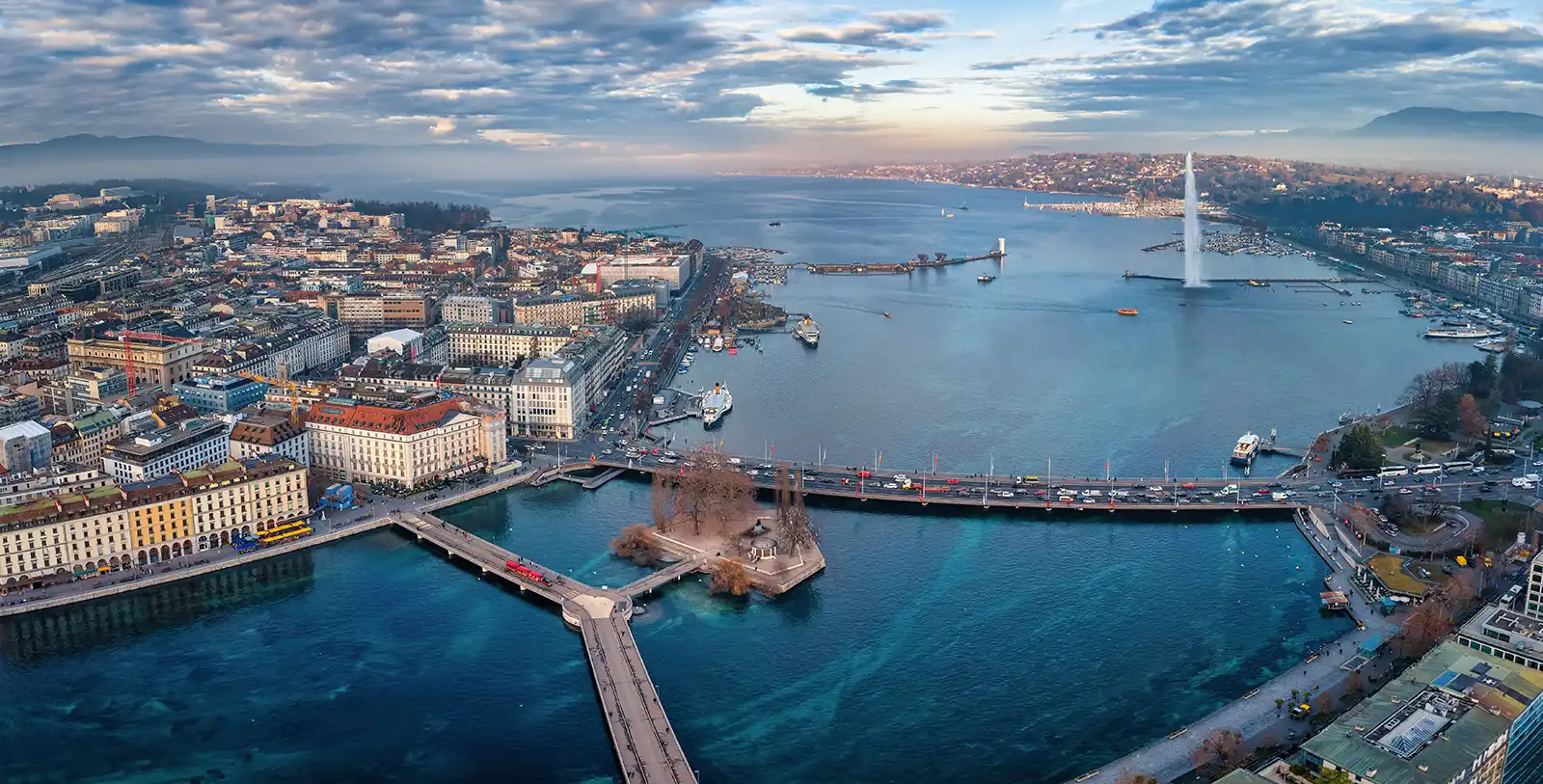
The Jet d'Eau — Geneva's 140-metre lake fountain.
© moofushi / Adobe Stock
History
Geneva began as the Roman Genava (1st century BCE) and the Burgundian and Carolingian episcopal seat from the 4th century. The Bishopric of Geneva became increasingly autonomous from the 11th century, and the city joined the Reformation under Guillaume Farel in 1536; John Calvin arrived later that year and made Geneva the institutional centre of Reformed Christianity from 1541 to his death in 1564 — Calvin's strict religious republic earned the city the title “Protestant Rome” and produced the Refuge huguenot wave when France revoked the Edict of Nantes in 1685. The Republic of Geneva (1535-1798, 1813-1815) operated as an independent Calvinist city-state allied with the Swiss Confederation but not part of it. After French annexation under Napoleon (1798-1813) and the Congress of Vienna, Geneva joined the Confederation as the 22nd canton in 1815. The 19th century brought the founding of the International Red Cross by Henry Dunant (1863), the city's emergence as a watchmaking and banking centre, and the foundation of the League of Nations in 1920 (Geneva chosen as headquarters); the UN succeeded to the Palais des Nations in 1946. The post-1990 Geneva is the second-largest UN duty station after New York, with International Geneva employing roughly 30,000 people across the UN system and NGOs.
Culture
Geneva's food scene reads francophone-Swiss with a strong cross-border French and international layer. Local specialities include filets de perche du Léman (perch fillets from the lake), longeole (a fennel-seeded pork sausage with EU IGP protection), papet vaudois (leek and potato stew with sausage), the Geneva fondue (slightly different from the Vaud or Fribourg variants), the L'Escalade marmite chocolate cauldron filled with marzipan vegetables in December, and the longeole-and-cardons Christmas tradition. Carouge's aperitivo culture and the international restaurants of Pâquis (Lebanese, Eritrean, Vietnamese, Korean) reflect the diaspora geography of UN Geneva. Plainpalais hosts a flea market on Wednesdays, Saturdays and the first Sunday of the month. Festivals: L'Escalade (December 11-12, the 1602 Savoy attack commemorated with vegetable soup and chocolate cauldrons), Fête de la Musique (June 21, free concerts across the city), Fêtes de Genève (summer waterfront festival), Geneva International Film Festival (autumn), Watches and Wonders Geneva (Palexpo, spring). Museums: International Red Cross and Red Crescent Museum, Musée d'art et d'histoire (MAH), Musée Patek Philippe, Musée d'ethnographie de Genève (MEG), MAMCO (Museum of Modern and Contemporary Art), Maison Tavel, Bodmer Lab (manuscripts at Cologny).
Business & Economy
Key industries: Multilateral diplomacy and international NGOs, Private banking and wealth management, Watchmaking (Patek Philippe, Vacheron Constantin, Rolex, Piaget), Commodities trading (oil, grain, sugar), Pharmaceuticals and biotech, Particle physics research (CERN). Business hubs: Pregny-Chambésy / Place des Nations (international organisations), Centre-ville banking corridor (Rue du Rhône, Rue de la Confédération), Plan-les-Ouates (watch manufactures), Acacias (Rolex, La Praille), Meyrin / Satigny (CERN, biotech, light industry).
Practical Info
Safety: Geneva is generally very safe by major-European-city standards. Pickpocketing risk concentrates around Cornavin railway station, the Pâquis district at night and the Rue du Mont-Blanc tourist strip; standard precautions cover most situations. The Pâquis red-light area immediately north-west of Cornavin is safer than its reputation but maintain situational awareness late at night. Emergency: 112 (Europe-wide), 117 (police), 144 (medical), 118 (fire). Language: French is the working language of canton and city. English is universal in International Geneva, the financial sector, the railway and tourist economy, and most retail. German is widely understood but seldom volunteered (Geneva is firmly Romandie). Italian and Spanish are common community languages reflecting the historical Italian-Iberian migration; Arabic, Russian, Mandarin and dozens of other languages reflect the UN-system diaspora. Most Genevans speak at least three languages. Currency: Swiss franc (CHF). Geneva is in the Swiss customs area — travellers from euro countries need to exchange (informal EUR acceptance at retail near the French border is at unfavourable rates). Card payments and contactless are universal; Twint (the Swiss mobile payment app, Apple-Pay-compatible) is universal in retail, transport and restaurants. ATMs are everywhere — UBS, Credit Suisse-UBS branches, PostFinance and the canton's Banque Cantonale de Genève (BCGE) all serve foreign cards. Tipping is not customary (service is included by Swiss law); rounding up the bill is the standard gesture for good service.
Travel
Geneva sits at the south-western tip of Lake Geneva (Lac Léman) where the Rhône exits the lake on its way to the Mediterranean — a small Swiss city by population (around 205,000 in the city itself, 510,000 in the canton, and roughly one million in the cross-border conurbation that spreads into the French Pays de Gex and Annemasse) but the second-largest UN duty station in the world after New York. The city's defining geography is dual: on the right bank, International Geneva gathers the Palais des Nations and roughly forty UN-system organisations within a fifteen-minute walking radius of Place des Nations; on the left bank, the cobbled Old Town climbs the Saint-Pierre hill around the cathedral that was the centre of Calvin's Reformation.
International Geneva — Palais des Nations & the Multilateral Quarter
International Geneva is the cluster of UN-system organisations, NGOs, missions and conference centres on the city's right bank around Place des Nations, the open square dominated by Daniel Berset's twelve-metre “Broken Chair” sculpture (1997, a Handicap International commission against landmines). The Palais des Nations, built 1929-1938 as the seat of the League of Nations and home of the United Nations Office at Geneva (UNOG) since 1946, is the largest UN building outside New York — 600 metres long, 2,800 offices, and the principal venue for the Human Rights Council, the Conference on Disarmament, and the WHO World Health Assembly. Public guided tours run twice daily on weekdays (book in advance via the UNOG Visitors Service); they pass through the Salle des Pas-Perdus, the Council Chamber with José Maria Sert's gold-and-sepia ceiling murals, and the Salle des Assemblées. The wider International Geneva quarter holds the WHO headquarters above Pregny, the WTO at the Centre William Rappard along the lakefront, the ILO and the UNHCR on Avenue Appia, the IOM (International Organization for Migration), the UN Conference on Trade and Development (UNCTAD), and roughly forty further UN-system organisations. The International Committee of the Red Cross (ICRC) and the International Federation of Red Cross and Red Crescent Societies (IFRC) sit on Avenue de la Paix; the International Red Cross and Red Crescent Museum next door is one of Geneva's most-substantial museums, narrating 160 years of humanitarian history. Tram line 15 from Nations to the city centre is the fastest connection to International Geneva; the cluster sits roughly two kilometres north of Cornavin railway station.
Lake Léman & the Jet d'eau
Lake Geneva (Lac Léman) ends at Geneva — the long crescent lake stretches eastward 73 kilometres to Montreux and Villeneuve, and the city sits at its narrow south-western tip where the Rhône exits and turns south towards the Mediterranean. The Rade — the harbour of central Geneva, formed where the Mont-Blanc bridge crosses the Rhône — is the city's defining urban-water space, framed by the four-star hotels of the Quai du Mont-Blanc on the right bank, the Jardin Anglais flower clock and Quai Gustave-Ador on the left bank, and (on a clear day) the Mont Blanc range visible 80 km to the south. The Jet d'eau, built in 1886 as a release valve for the city water-pressure system and turned into a 140-metre tourist landmark in 1891, runs from late morning to late evening between March and October (off-season schedule November to February); it consumes 500 litres of water a second and reaches 200 km/h at the nozzle. The Mouettes Genevoises — small yellow shuttle boats running on a fixed-route ferry service — cross the Rade between four landings (Pâquis, Molard, Eaux-Vives, Genève-Plage) and operate as part of the TPG public-transport tariff. Larger CGN paddle steamers (Compagnie Générale de Navigation) run scheduled services up the lake to Lausanne, Évian, Yvoire (the medieval French village across the lake) and Montreux. Bains des Pâquis on the right bank — the historic 1932 lakeside bath complex on a small jetty — is open to swimmers year-round, with a sauna and hammam in winter and the cheapest dawn coffee in Geneva.
Old Town — St. Pierre Cathedral, Calvin & the Reformation Wall
Geneva's Old Town (Vieille Ville) climbs the Saint-Pierre hill on the left bank — the medieval-and-Reformation core, walkable in a half-day, centred on the Cathédrale Saint-Pierre. The cathedral, founded in the 4th century and largely rebuilt in the 12th-15th centuries with an incongruous neoclassical west portico added in 1750, was Calvin's preaching church from 1536 to 1564 and remains the spiritual centre of Reformed Christianity worldwide; Calvin's wooden chair is preserved in the north aisle, and the climb to the north tower (157 steps) gives the panoramic city view. The Espace Saint-Pierre archaeological site beneath the cathedral exposes Roman, early Christian and medieval foundations. The Place du Bourg-de-Four immediately downhill — Geneva's oldest square, holding a market since Roman times — is now ringed with cafés and restaurants and is the social heart of the Old Town. The Maison Tavel, Geneva's oldest civic building (1334, restored as a museum of city history), the Rue des Granges with its 18th-century patrician townhouses, and the Place de la Madeleine cluster around the Old Town's western edge. Below the cathedral, the Reformation Wall (Mur des Réformateurs, 1909) at the foot of the Bastions Park is a 100-metre relief sculpture of John Calvin, John Knox, Theodore Beza, and Guillaume Farel; the Bastions Park itself, with its giant outdoor chess sets and the University of Geneva main building, is the city's principal Old Town green space. The Promenade de la Treille, Europe's longest wooden bench (126 metres, 1767), sits along the Old Town walls.
Carouge — Geneva's Sardinian Twin
Carouge across the Arve river from Plainpalais is technically a separate Genevan commune of 23,000 people, but it functions as Geneva's southern district — a Mediterranean-grid neighbourhood of low pastel-painted houses, ground-floor artisan workshops and tree-lined squares that gives Geneva its unmistakable Italian-Sardinian counterpart. Carouge was built between 1772 and 1786 by the Kingdom of Sardinia (which then ruled the Savoy duchy) as a deliberate Catholic counter-pole to Calvinist Geneva, designed to attract craftsmen, traders and Catholic refugees from across the Confederation; the regular grid plan with its Place du Marché, Place du Temple and Rue Saint-Joseph was laid out by the Sardinian architects Luigi Andrea Vannelli and Giuseppe Battista Piacenza in the Italian Neoclassical style. Carouge today holds Geneva's most-concentrated independent design and craft scene — leather workshops, ceramicists, dressmakers, jewellers, antiquarian booksellers — alongside dozens of cafés, bistros and aperitivo bars that operate later than in central Geneva. The Wednesday and Saturday morning Place du Marché farmers' market is the largest in the canton; the Théâtre Saint-Gervais and the smaller Théâtre de Carouge stage independent productions. Tram lines 12 and 18 reach Carouge from central Geneva in roughly 15 minutes; on foot the walk from Plainpalais via Pont de Carouge takes 25 minutes, and the contrast — Genevan limestone-and-glass on the right bank, Carouge pastel stucco on the left — is the canton's clearest architectural signature.
Watchmaking Heritage — Patek Philippe & the Plan-les-Ouates Manufactures
Geneva is one of the two great Swiss watchmaking capitals alongside the Jura cluster of La Chaux-de-Fonds and Le Locle — a tradition running back to 1541, when Calvin's sumptuary laws banned jewellery and pushed the city's goldsmiths into the more austere craft of timekeeping. The historic Geneva Seal (Poinçon de Genève), instituted in 1886, is the strictest mark of watchmaking quality recognised in the trade; it is reserved for movements made in the canton of Geneva that meet the historical Geneva finishing standards. The Patek Philippe Museum at Plainpalais (Rue des Vieux-Grenadiers 7), opened in 2001 in a former watch-finishing workshop, is the most-substantial public watch museum in the city — 2,500 watches, automata and miniature enamels from the 16th century to today, with the entire production history of Patek Philippe (founded Geneva, 1839) on the third and fourth floors. Vacheron Constantin (Plan-les-Ouates, founded 1755 — the oldest watch manufacture in continuous operation), Rolex (Acacias, on Rue François-Dussaud), Piaget (Plan-les-Ouates), Roger Dubuis, and Audemars Piguet (in nearby Vaud canton at Le Brassus) all maintain manufactures in or near the canton. The Watches and Wonders Geneva trade fair every spring at Palexpo is the industry's principal showcase. The Time Travel exhibition at the new Science Gateway at CERN takes the relationship between watchmaking precision and atomic physics as its theme. Most manufactures do not offer public tours, but the Patek Philippe Museum, the new La Maison Vacheron Constantin in the Old Town (Rue des Moulins 1, opened 2024) and the Beyer Watch Museum in Zurich are the substantive public-access points.
CERN & the Globe of Science and Innovation
CERN, the European Organization for Nuclear Research, sits about 8 kilometres from central Geneva on the French-Swiss border at Meyrin and Saint-Genis-Pouilly — the world's largest particle physics laboratory and the site of the Large Hadron Collider (LHC), the 27-kilometre underground accelerator ring straddling the border that produced the 2012 Higgs boson discovery. CERN was founded in 1954 as one of Europe's first joint scientific organisations and is funded today by 23 member states; its 23,000 scientific users from over 100 countries make it one of the world's most international research environments. The public visitor offering centres on two recent buildings: the Globe of Science and Innovation (the wooden globe originally built as a Swiss pavilion for Expo 02 and relocated to CERN in 2004) hosts the permanent exhibition “The Universe of Particles”, and the new Science Gateway by Renzo Piano (opened 2023, financed by a €100 million private donation) is the dedicated public-facing campus with three permanent exhibitions, two auditoriums, hands-on lab spaces for school groups, and a 100-seat planetarium. Both are free to visit, daily except Mondays, and reachable by tram line 18 from central Geneva (about 25 minutes from Cornavin to the CERN terminus). Guided tours of the actual experimental facilities (ATLAS, CMS, ALICE, LHCb, the synchrotron complex) require booking weeks ahead through CERN's online visit-booking system; tours fill quickly during summer and around Open Days. The CERN cafeteria is open to the public — a quick way to mix with the international physics community over a Swiss-priced lunch.
The Diplomatic Quarter & Visa Applicant Orientation
Geneva's foreign embassies and consulates split across three loose clusters. The largest is around the Place des Nations / Pregny-Chambésy area on the right bank, near the UN — the Permanent Missions to the UN cluster on Rue de Vermont, Avenue de Budé and Avenue de la Paix, with consular work mostly handled separately by the missions in Bern (Switzerland's federal capital) but with significant Geneva-based consular operations for major receiver countries (United States, United Kingdom, France, Germany, Italy, China, India, Russia, Brazil). The second cluster sits in the left-bank Eaux-Vives and Champel districts, in 19th-century townhouses on Rue Lamartine, Rue de Lausanne and Avenue Krieg. The third cluster is in the Florissant district along the Avenue de Champel. Major visa-application centres (VFS Global Geneva, TLScontact Geneva) sit on Rue de Vermont and Rue du Mont-Blanc — close to Cornavin railway station and easily reached by tram from anywhere in the city. Most consulates open mornings only Monday-Friday and close on Swiss federal holidays plus their own national days; appointments are universally required. Cornavin (Geneva-Cornavin railway station, the city's main station) and the airport (GVA Cointrin, six minutes by direct Léman Express train) frame the visa-applicant arrival route — most international visa-and-business travellers stay in the right-bank Pâquis or Mont-Blanc districts within walking distance of both the station and the diplomatic quarter.
Practical Geneva — TPG, Léman Express & GVA Airport
Geneva runs an unusually integrated transport system. Within the canton, the Transports publics genevois (TPG) operate trams (lines 12, 14, 15, 17, 18), trolleybuses, regular buses and the cross-border French routes — a single CHF ticket covers any combination on a 60-minute zone basis, and tourists staying in any Geneva-canton accommodation receive a free Geneva Transport Card valid for the entire stay (issued at hotel check-in). The Léman Express (opened 2019) is the binational commuter rail network connecting Geneva-Cornavin to the French side via the new CEVA tunnel — six lines reach Annemasse, Évian, La Roche-sur-Foron, Annecy and Saint-Gervais-Bettex on the French side and Coppet on the Swiss side, on roughly 15-minute frequencies into the rush hour. Geneva-Cointrin Airport (GVA), six kilometres north of the centre, is the second-busiest Swiss airport — direct Léman Express trains reach Cornavin in six minutes (among the shortest airport-to-city-centre rail connections anywhere); the airport has the unusual French sector that allows direct passage to the French side of the airport without crossing into Switzerland (separate immigration, separate baggage hall, French taxis and bus connections to Annecy and the Mont-Blanc valley). Long-distance trains: TGV Lyria to Paris in 3h 10min (six daily); ICE to Frankfurt and Stuttgart; CFF InterCity to Lausanne (35 min), Bern (1h 50min) and Zurich (2h 40min). The city-canton transport authority Mobilité Genève publishes a useful journey planner. CHF cash is universally accepted; contactless card and Twint (the Swiss mobile-payment app) are universal in retail, restaurants and transport. EUR is informally accepted at most retail near the French border but at unfavourable rates — change to CHF at the airport, station or any post office.
Frequently asked questions
Can I visit the UN's Palais des Nations as a tourist?
Is CERN worth visiting, and do I need a science background?
How do I get from Geneva Airport to the city centre?
Is Geneva only about international diplomacy, or is there more to see?
Transport & airports
Transports publics genevois — the canton's tram, trolleybus and bus operator. Live timetables, ticket purchase and fare zones, plus the cross-border French routes and the integration with the Léman Express commuter rail.
Geneva-Cointrin Airport's official site. Flight information, terminal maps including the unusual French Sector that gives direct exit to the French side, parking and the six-minute Léman Express rail link to Cornavin.
Tourism & destination guides
Official government sites
The Ville de Genève municipal portal. Residency and registration, district services, the city council and administration, and the cultural and event calendar of the municipality.
The official site of the United Nations Office at Geneva. Visitor information for the Palais des Nations, guided tour schedules and booking, the calendar of conferences open to the public, and information on the wider International Geneva organisations.
Diplomatic missions in Geneva
38 embassies based in this city, grouped by region.
Africa12
- Botswana Embassy in Geneva
- Permanent Mission of Burundi in Geneva
- Cape Verde Embassy in Geneva
- Central African Republic Embassy in Geneva
- Djibouti Permanent Mission to UN Geneva
- Eritrea Embassy in Geneva
- Ethiopia Embassy in Geneva
- Guinea Embassy in Geneva
- Kenya Consulate General in Geneva
- Mozambique Embassy in Geneva
- Namibian Embassy in Geneva
- Republic of Congo Permanent Mission in Geneva
Asia11
- Afghan Embassy in Geneva
- Armenian Embassy in Geneva
- Permanent Mission of Bahrain in Geneva
- Bangladeshi Embassy in Geneva
- Bhutan Embassy in Geneva
- Consulate General of Brunei in Geneva
- Cambodian Permanent Mission in Geneva
- Consulate General of India in Geneva
- Mongolia Embassy in Geneva
- Saudi Arabian Consulate General in Geneva
- Turkish Consulate General in Geneva
Europe9
Americas5
Oceania1
This overview comes from Visaja's worldwide missions database (visaja.com), checked against official government sources; for binding answers, the mission itself always has the final word.