- Population:314,869 (2025)
- Area:22 km²
- Elevation:3 m
- Timezone:PET (UTC-5)
- IATA:LIM
- Currency:Peruvian sol (PEN). Cards widely accepted in Miraflores and Barranco hotels, restaurants, and supermarkets. Cash is expected at Mercado de Surquillo, street-food stalls, and local taxis. ATMs are dense in Miraflores (Av. Larco, Av. Diagonal) and on Jirón de la Unión in the historic center. Dollars are accepted at some hotels and tour operators but at worse rates than soles.
- Key Areas:Miraflores — primary visitor base: hotels, Malecón cliffs, restaurants, Huaca Pucllana · Historic Center — UNESCO colonial core, Plaza Mayor, San Francisco catacombs, government · Barranco — arts quarter: MATE, galleries, music venues, Puente de los Suspiros · San Isidro — financial district, Bosque El Olivar, quieter boutique hotels
Overview
Lima is Peru's Pacific capital of ten million — a vice-regal UNESCO historic core surrounded by a vast coastal metropolis of clifftop neighborhoods, pre-Columbian huacas embedded in modern districts, and one of Latin America's most serious food scenes, from market ceviche stalls to globally ranked tasting menus.
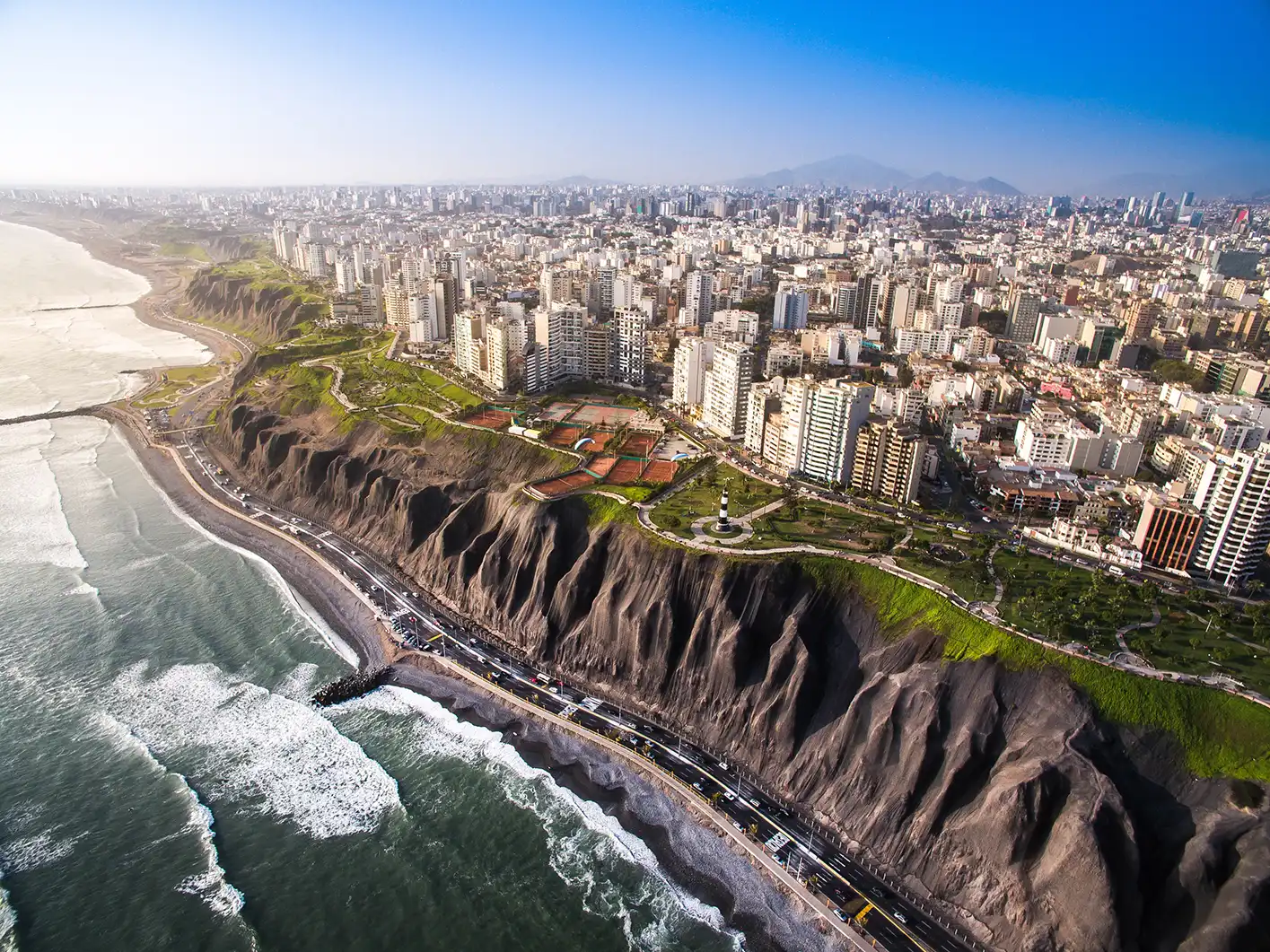
The Miraflores malecón — Lima's clifftop parks above the Pacific.
© Christian Vinces / Adobe Stock
History
Francisco Pizarro founded Lima on January 18, 1535 as La Ciudad de los Reyes (City of Kings) on the banks of the Rímac River, selecting the Pacific coastal site for its proximity to the port of Callao and the flat terrain that would ease supply logistics for the Spanish colonial administration. Lima became the capital of the Viceroyalty of Peru in 1542 — the most powerful administrative unit in Spanish South America, controlling silver shipments from Potosí, judicial oversight of the continent, and church authority from the Archbishop. The historic center retains this institutional density: the Cathedral, Archbishop's Palace, Government Palace, major convents, and the Universidad de San Marcos (founded 1551, the oldest continuously operating university in the Americas) are all concentrated within a few blocks of the Plaza Mayor. The 1746 earthquake destroyed much of the colonial city, producing the rebuilt 18th-century ensemble visible today. In the 20th century, massive Andean rural-to-urban migration transformed Lima from a city of roughly 500,000 in 1940 to a metropolis of over 10 million, with the peripheral conos and pueblos jóvenes growing faster than any formal city planning could address. The historic center was declared UNESCO World Heritage Site in 1988.
Culture
Lima's food hierarchy runs from street stalls to globally ranked tasting menus, and value exists across the full range. Ceviche is the standard lunch dish — mixed seafood, firm white fish, or clams marinated in ají amarillo leche de tigre with corn and sweet potato. La Mar (Av. La Mar 770, Miraflores, lunch only) is the benchmark ceviche restaurant, mid-tier by Lima standards. Anticuchos de la Grimanesa (Av. Ignacio Merino 466, Miraflores, evenings only) is the city's most celebrated anticucho address — beef heart skewers, at street-stall prices. Chifa (Peruvian-Chinese fusion, from the large 19th-century Chinese immigration) is the everyman cuisine: Barrio Chino on Jr. Capon near the historic center concentrates the oldest chifas. For markets: Mercado de Surquillo No. 1 (Av. Paseo de la República, Miraflores edge) for fresh ingredients and lunch plates; Mercado Central (historic center) for Andean produce and chicharrón. Central (Av. Pedro de Osma 301, Barranco) and Maido (Calle San Martín 399, Miraflores) require advance reservations of several weeks. Festivals: Señor de los Milagros processions (October 18, 28, November 1) — world's largest Catholic street procession after Rome, with hundreds of thousands walking through the historic center in purple robes behind the 17th-century painted canvas, Anniversary of Lima (January 18) — city foundation celebrations with civic parades, concerts, and free museum entry in the historic center, Fiestas Patrias (July 28–29) — Peru's independence days, with military parade on Av. Brasil and traditional food and music events at the Campo de Marte, Mistura (September, Parque de la Exposición) — Latin America's largest food fair, showcasing Peru's regional cuisines, artisan producers, and top restaurant chefs. Museums: Museo Larco (Av. Bolívar 1515, Pueblo Libre) — 45,000+ pre-Columbian objects from coastal Peru, open daily including evenings; the city's steepest museum admission, MALI — Museo de Arte de Lima (Av. Paseo Colón 125, Parque de la Exposición) — Peruvian art from 3,000 years of history through contemporary, closed Mondays, Museo de Sitio Huaca Pucllana (Calle General Borgoño, Miraflores) — active excavations at a Lima culture pyramid, evening visits Wed–Sun, MATE — Museo Mario Testino (Av. Pedro de Osma 409, Barranco) — fashion and portrait photography, rotating contemporary exhibitions, Museo Nacional de Arqueología, Antropología e Historia del Perú (Plazuela Bolívar, Pueblo Libre) — national pre-Columbian and republican collection, a third of the Larco's ticket, Museo del Banco Central de Reserva (Jirón de la Unión 291, historic center) — free, colonial gold and silver objects from the national reserve collection.
Practical Info
Safety: Miraflores and Barranco are generally safe for walking during the day and evening. The historic center is safe during daylight hours in the main tourist circuit but requires more care at night; use taxis or ride-apps rather than walking between center and Miraflores after dark. Callao Monumental should be visited only with a guide or organized tour. Use registered transport (Uber, InDriver, hotel taxis) for airport transfers and night movements. Keep phones out of sight in crowded public spaces — the Mercado Central and Gamarra areas require particular attention. Language: Spanish is dominant throughout. English is available at Miraflores and Barranco hotels, upscale restaurants, and most tour agencies; limited in the historic center's street-level commerce, local markets, and Callao. Currency: Peruvian sol (PEN). Cards widely accepted in Miraflores and Barranco hotels, restaurants, and supermarkets. Cash is expected at Mercado de Surquillo, street-food stalls, and local taxis. ATMs are dense in Miraflores (Av. Larco, Av. Diagonal) and on Jirón de la Unión in the historic center. Dollars are accepted at some hotels and tour operators but at worse rates than soles.
Travel
Lima occupies a 30-km coastal strip on the Pacific at sea level, with the city rising inland through concrete and colonial layers. The UNESCO-listed historic center — declared a World Heritage Site in 1988 — concentrates the colonial cathedral, vice-regal palaces, San Francisco convent with its 17th-century catacombs, and the main museums of republican governance. For most international visitors, however, the practical base is Miraflores or Barranco: both districts sit on Pacific cliffs 10–12 km southwest of the center, offer the strongest concentration of hotels, walkable restaurants, and evening options, and present easier street-level safety conditions. Lima's most internationally recognized draw is its food ecosystem — from the Mercado de Surquillo fish stalls to the multi-course tasting menus at Central (repeatedly ranked Latin America's best restaurant) and Maido — but depth of value runs through cevicherias, anticucho stalls, chifa canteens, and the neighbourhood lunchtime menú, which costs a small fraction of a tasting menu and is where most of the city actually eats. The city's seasonality surprises first-time visitors: winters (May–October) are cool, humid, and often overcast under coastal garúa sea mist; summers (December–March) are sunnier and warmer. Lima is also the practical springboard for Andean circuits — Cusco, Arequipa, and the north coast are all accessible by 1.5-h domestic flight — and for coastal day trips to Paracas (3.5 h south) and the Ballestas Islands.
Historic Center — Plaza Mayor and San Francisco catacombs
Lima's Plaza Mayor is flanked by the Cathedral (begun 1535, rebuilt after the 1746 earthquake, containing the tomb of Francisco Pizarro), the Government Palace, the Archbishop's Palace, and the Municipal Building — a coherent colonial ensemble of similar scale to Lima's vice-regal ambition. The Convento de San Francisco (Jr. Ancash 471, daily 09:30–17:30) includes access to the catacombs beneath the church — a multi-chamber ossuary holding the remains of approximately 70,000 colonial-era Limeños, stacked in bone-pattern arrangements visible from walkways. The nearby Municipalidad, Palacio Torre Tagle (foreign ministry, exterior only), and Casa de la Gastronomía Peruana (free, Jr. Conde de Superunda 170) complete a half-day circuit manageable on foot from the plaza within a 4-block radius.
Miraflores — cliffside base and Huaca Pucllana
Miraflores is the preferred base for most visitors: concentrated hotels across all price ranges, a walkable Malecón (cliff-edge promenade) stretching 4 km south from Parque Salazar to Costa Verde, and the highest density of restaurants, cafés, and tour agencies in the city. Parque del Amor (on the Malecón, free) features a large ceramic-tile mosaic by artist Víctor Delfín and constant Pacific views. Larcomar (Malecón de la Reserva 610, free entry to complex) is a shopping and restaurant complex carved into the cliffs. Huaca Pucllana (Calle General Borgoño, within Miraflores, Tue–Sun 09:00–17:00, evening visits Wed–Sun) is a large adobe pyramid of the Lima culture (400–700 CE) actively excavated within the modern district — entry includes a site museum and guided walk around the preserved pyramid structure.
Barranco — arts quarter and Pacific bohemia
Barranco (2 km south of Miraflores along the clifftop) has a quieter, lower-rise character built around a ravine running to the Pacific — the Puente de los Suspiros (Bridge of Sighs, 1876) crosses the ravine and is one of Lima's most photographed spots. MATE — Museo Mario Testino (Av. Pedro de Osma 409, Tue–Sun 11:00–20:00) exhibits the internationally celebrated Peruvian photographer's fashion and portrait work alongside rotating contemporary exhibitions. The district's weekend arts market (Plaza de Barranco area), independent music venues, and concentrated bar-and-restaurant strip along Av. Sáenz Peña are the strongest evening economy in the city for independent travelers. Barranco is 10 minutes by taxi from Miraflores, for small change.
Museo Larco — Peru's pre-Columbian benchmark
The Museo Larco (Av. Bolívar 1515, Pueblo Libre, daily 09:00–22:00 including evenings) holds over 45,000 pre-Columbian objects from coastal cultures spanning 3,000 years — the largest private collection in the world of Peruvian archaeology. Founded by Rafael Larco Hoyle in 1926, the museum occupies an 18th-century mansion on a pre-Columbian huaca in Pueblo Libre. The galleries sequence Cupisnique, Chavín, Mochica, Chimú, and Inca material; an open storage vault makes the full collection accessible. The museum café in the garden terrace is well-regarded as a lunch destination in itself. Pueblo Libre also contains the Museo Nacional de Arqueología, Antropología e Historia del Perú (Plazuela Bolívar, a third of the Larco's admission), consolidating the two into a half-day museum circuit 15 min from Miraflores by taxi.
Lima's food ecosystem — from Surquillo to Central
Lima's food identity operates at every price level. Mercado de Surquillo (Mercado No. 1, Av. Paseo de la República at Av. Angamos, Miraflores edge) is the most visitor-accessible wet market — fresh ceviche ingredients, Amazonian fruit, and full lunch plates for a few soles. Grimanesa Vargas Anticuchos (Av. Ignacio Merino 466, Miraflores, evenings only) is the city's most celebrated anticucho stall, where beef heart marinated in ají panca and cumin is grilled over charcoal on the pavement. La Mar Cebichería (Av. La Mar 770, Miraflores, lunch only) is Gastón Acurio's benchmark ceviche restaurant, and sits in the middle tier — several times a market lunch, a fraction of a tasting menu. Central (Av. Pedro de Osma 301, Barranco, dinner only, reservation required weeks ahead) is the tasting-menu restaurant of chef Virgilio Martínez, built around Peruvian altitude zones as a tasting taxonomy — repeatedly ranked Latin America's best restaurant. Same-week reservations at Central are rarely available; plan early.
Callao Monumental and La Punta
Callao Monumental (15 min northwest of the historic center by taxi, near the airport) is Lima's most visible urban arts project — a former port-city slum district transformed from around 2015 through large-scale mural interventions, gallery openings, and café installations in restored colonial buildings. The FUGAZ contemporary arts center and numerous open-air murals by international and Peruvian artists occupy the main blocks around the Mercado del Callao. La Punta, a residential peninsula extending into the Pacific at the end of the Callao district (30 min from the airport), has a cluster of seafood restaurants on its waterfront promenade favored by Limeños for Sunday ceviche lunches. Both Callao sub-districts are visited only with a guide or in a group; independent walking is not recommended without local orientation.
Day trips — Paracas, Ballestas, and Inca coast
Paracas National Reserve (250 km south of Lima, 3.5 h on the Panamericana Sur or 1 h by domestic flight to Pisco/Ica) protects Peru's most significant Pacific coastal desert ecosystem — flamingos, sea lions, and Humboldt penguins at the Ballestas Islands (boat tour from Paracas port, 2 h circuit, inexpensive). The nearby Huacachina oasis (near Ica, 4 h) and the Nazca Lines (6 h, where the overflight from the Nazca aerodrome is the single largest line-item on a coastal trip) extend the coastal excursion into one or two nights. Cruz del Sur and Soyuz run Lima–Ica–Nazca buses daily from the Lima bus terminal complex (Av. Javier Prado Este, La Victoria district, 20 min from Miraflores).
Jorge Chávez Airport and Lima city transport
Jorge Chávez International Airport (LIM) is in Callao — 35–45 min from Miraflores by Uber or taxi, 15 min from the historic centre (variable). The Airport Express Lima bus (departure level, hourly) connects to Miraflores hotels in 70 min outside peak hours and costs a fraction of the car, which is the reason to look for it before joining the taxi queue. In-city transport: Uber and InDriver are the safest options for cross-district movement; taxi meters are not standard, so agree the fare before entering a street taxi. Metro Line 1 (Av. Grau in the center to Javier Prado and Villa El Salvador) is useful for reaching Gamarra textile market and the Estadio Nacional area. Long-distance buses to Cusco (~21 h), Arequipa (~15 h), and the north coast depart from terminals near Av. Javier Prado Este — Cruz del Sur, Oltursa, and Tepsa are the established operators.
Frequently asked questions
Is Lima worth staying in, or just a stop on the way?
When is the best time to visit Lima?
How many days do you need in Lima?
How do I get from Jorge Chávez Airport to the city?
Is Lima safe, and how do I pay?
Transport & airports
Official airport information portal — terminal maps, arrivals and departures, ground transport options, and Airport Express Lima bus service details.
Urban transport authority for Metropolitan Lima — Metro Line 1 routes, bus corridor maps, and public transport updates for the Lima–Callao conurbation.
Tourism & destination guides
Diplomatic missions in Lima
30 embassies based in this city, grouped by region.
Europe13
- Austrian Embassy in Lima
- French Embassy in Lima
- German Embassy in Lima
- Iceland Honorary Consulate in Lima
- Italian Embassy in Lima
- Embassy of the Netherlands in Lima
- Embassy of Poland in Lima
- Embassy of Portugal in Lima
- Consulate General of Spain in Lima
- Spanish Embassy in Lima
- Honorary Consulate of Sweden in Lima
- Swiss Embassy in Lima
- British Embassy in Lima
Americas11
- Consulate General of Argentina in Lima
- Argentine Embassy in Lima
- Brazilian Embassy in Lima
- Canadian Embassy in Lima
- Consulate General of Chile in Lima
- Chilean Embassy in Lima
- Colombian Embassy in Lima
- Dominican Republic Embassy in Lima
- Guatemalan Embassy in Lima
- Mexican Embassy in Lima
- United States Embassy in Lima
Asia4
Oceania1
Africa1
This overview comes from Visaja's worldwide missions database (visaja.com), checked against official government sources; for binding answers, the mission itself always has the final word.