- Population:2M (2025)
- Area:415 km²
- Elevation:151 m
- Timezone:CET/CEST
- IATA:VIE
- Currency:The euro. Cards and contactless payment are taken in most shops and restaurants, but some wine taverns, sausage stands and market stalls prefer cash.
- Key Areas:Innere Stadt (1st District) · MuseumsQuartier (7th) · Naschmarkt area (4th-6th) · Spittelberg (7th)
Overview
Vienna, Austria's capital on the Danube, gathers imperial palaces, great art collections, concert halls and coffeehouses around a compact old centre, keeps vineyards inside its city limits, and regularly ranks among the world's most liveable cities.
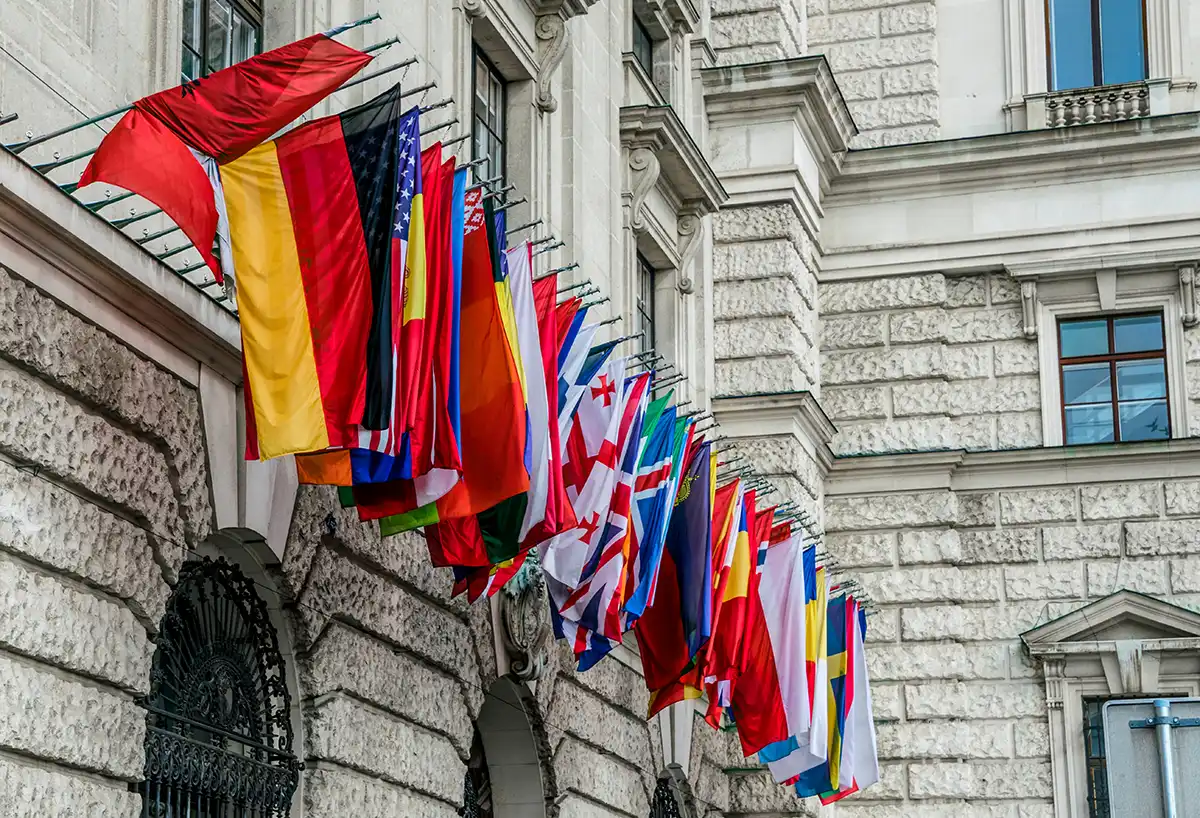
National flags along a wing of the Hofburg.
Practical Info
Language: German, spoken with Austrian words and accent; “Grüß Gott” is the everyday greeting. English is widely spoken in hotels, restaurants and at the sights. Currency: The euro. Cards and contactless payment are taken in most shops and restaurants, but some wine taverns, sausage stands and market stalls prefer cash.
Travel
Vienna is a city to take slowly. The old centre inside the Ring is crossed on foot in half an hour, and the U-Bahn and trams reach the palaces, parks and vineyards beyond it in a short ride. The day keeps its own rhythm — palaces and museums in the morning, an hour in a coffeehouse in the afternoon, and for most of the year an evening of opera or concerts. From the main station, fast trains leave for the rest of Austria and the neighbouring capitals.
St Stephen's Cathedral
The Stephansdom, St Stephen's Cathedral, stands on its own square at the heart of the Innere Stadt, the 1st district. Its Gothic south tower, 136 metres high, is climbed by 343 steps to the old watchman's room, and the steep roof below is laid with glazed tiles in a zigzag pattern, with the double-headed imperial eagle picked out on its southern side. The west front, with the Romanesque Giant's Door between two smaller towers, is the oldest part of the church.
The Graben, the Kohlmarkt and the Old Lanes
From the cathedral square, the Graben, a broad pedestrian street, runs past the baroque Plague Column, raised after the epidemic of 1679, and just off it St Peter's Church hides a green oval dome. At its end the Kohlmarkt, lined with jewellers and fashion houses, leads to the Michaelerplatz and the domed gate of the Hofburg. Around the cathedral the lanes are older and quieter: Bäckerstraße and Schönlaterngasse with their courtyards; the Judenplatz, where the Shoah memorial is a concrete library cast with the spines of its books turned inward; and the Hoher Markt, whose art nouveau Anker Clock sends figures from the city's past across its dial through the day, all of them together at noon. Most shops, here as across the city, are closed on Sundays.
The Hofburg
The Hofburg, the Habsburgs' palace in the city, spreads in wings and courtyards from the Michaelerplatz to the Heldenplatz; in the middle of the Michaelerplatz, an open excavation shows Roman and later walls below the square. Under the domed Michaelertor, the Imperial Apartments, where Franz Joseph and Elisabeth lived, are shown on one route with the Sisi Museum and the court silver. In the Swiss Court, the oldest part of the palace, the Imperial Treasury keeps the crown of the Holy Roman Empire and that of the Austrian emperors, and on Sunday mornings outside the summer months the Vienna Boys' Choir sings Mass in the palace chapel beside it. Beyond, the Heldenplatz opens under the curved front of the Neue Burg, between the Burggarten, with its glass Palm House and Mozart monument, and the rose beds of the Volksgarten.
Josefsplatz and the Albertina
A few steps from the Michaelerplatz, the Josefsplatz is closed on three sides by palace wings around an equestrian statue of Joseph II. On the square, the State Hall of the National Library, a baroque hall of books under a frescoed dome, has a marble statue of Charles VI at its centre, and beside it, in the white Winter Riding School with its galleries and chandeliers, the Lipizzaner stallions of the Spanish Riding School perform classical dressage. Augustinerstraße leads on past the Augustinian Church to the Albertina, a palace on a surviving bastion of the city wall. It holds one of the great collections of drawings and prints, shown in changing exhibitions, alongside its restored Habsburg state rooms; Dürer's Hare belongs to it but is shown only rarely, as light harms it.
The State Opera and the Ringstrasse
The State Opera, opened in 1869, stands on the Ringstrasse, the boulevard laid out from the 1860s where the city walls had stood. Its season runs from September to June, with subtitles on a small screen at every seat; guided tours show it by day, and in July and August the house is closed. From the Opera the Ring circles the Innere Stadt past the Hofburg to the Parliament, a temple front with a fountain of Pallas Athene before it, then the neo-Gothic City Hall, facing the Burgtheater across its park, and the University, with the twin spires of the Votivkirche a block beyond. On the Ring's eastern side, the Stadtpark keeps a gilded statue of Johann Strauss playing the violin. The full circle is a walk of little more than an hour, and trams run along most of it.
The Kunsthistorisches and Natural History Museums
Across the Ring from the Heldenplatz, two domed museums face each other across the Maria-Theresien-Platz, with a monument to the empress between them. The Kunsthistorisches Museum holds the Habsburgs' picture collection, with the largest group of paintings by Pieter Bruegel the Elder anywhere, among them The Hunters in the Snow and The Tower of Babel, as well as Vermeer's The Art of Painting, Raphael's Madonna of the Meadow, Caravaggio, and Velázquez's portraits of the young Infanta Margarita. Its grand staircase rises past Canova's marble Theseus, with paintings by the young Gustav Klimt between the columns above. The Natural History Museum opposite keeps the Venus of Willendorf, a limestone figure about 30,000 years old, among its meteorites, minerals and dinosaur skeletons.
The MuseumsQuartier and Spittelberg
Behind the two museums, the long baroque front of the former court stables opens into the MuseumsQuartier, where modern buildings stand in the old courtyards. The white limestone block of the Leopold Museum holds the largest collection of Egon Schiele's work, with Klimt's Death and Life and paintings by Kokoschka; the dark basalt block facing it is the mumok, the museum of modern art, and the Kunsthalle between them shows contemporary exhibitions. A few steps away, the cobbled lanes of Spittelberg keep 18th- and 19th-century houses with restaurants and small shops, and in Advent one of the city's Christmas markets.
Karlsplatz and the Musikverein
South of the Opera, the Karlskirche fills one side of the Karlsplatz: a baroque church whose green dome rises between two columns wound with spiral reliefs, mirrored in a pool before it. On the square stand two of Otto Wagner's pavilions for the old city railway, of green iron and white marble with gilded sunflowers. Across the square, the Musikverein is the home of the Vienna Philharmonic, and its Golden Hall, lined with gilded caryatids, is the hall from which the orchestra's New Year's Concert is broadcast. The Konzerthaus, a few minutes' walk away, has a broader programme, jazz included.
The Secession and the Naschmarkt
Where the Naschmarkt begins, the Secession, the exhibition house built for Klimt's circle, carries a dome of gilded laurel leaves above the motto “To every age its art, to art its freedom”; in its basement Klimt's Beethoven Frieze runs around three walls. From here the market stretches along the Wienzeile, above the vaulted-over river Wien: stalls of fruit, spices, cheese, olives and fish, with snack bars and restaurants cooking Viennese, Turkish, Middle Eastern and Asian food between them. The market is closed on Sundays, and on Saturdays a flea market spreads beyond its far end at Kettenbrückengasse. On the Linke Wienzeile, two apartment houses by Otto Wagner face the stalls, one tiled with majolica flowers, the other hung with gilded medallions, and near the market's first stalls stands the Theater an der Wien, where Beethoven's Fidelio was first performed.
The Belvedere
South-east of the Ring, the Belvedere is a pair of baroque palaces built for Prince Eugene of Savoy, joined by a terraced garden of fountains, statues and clipped hedges. The Upper Belvedere at the top holds Austrian art from the Middle Ages to the early 20th century, and its Klimt rooms show The Kiss, the gold-leafed couple on a meadow of flowers, beside his Judith. From the top of the garden, the view runs down over the rooftops to the spire of St Stephen's. The Lower Belvedere at the foot of the garden has the prince's state rooms and changing exhibitions.
The Hundertwasser House
In Landstrasse, the 3rd district, the Hundertwasser House on the corner of Löwengasse and Kegelgasse is a block of municipal flats designed by the painter Friedensreich Hundertwasser and finished in the 1980s: patches of bright colour, windows of every shape, trees growing from balconies and the roof, and a gilded onion dome. The flats are lived in, so the house is seen from the street.
The Danube Canal and the Prater
The Danube Canal, an arm of the river, runs along the edge of the Innere Stadt at Schwedenplatz; its walls are covered in sprayed murals, and in summer bars open along its quays. Across it lies Leopoldstadt, the 2nd district, and at its far end the Prater. By Praterstern station, the Wurstelprater is an amusement park of rides and stalls beneath the Giant Ferris Wheel, the Riesenrad, built in 1897, whose red wooden cabins turn slowly above the park and which played its part in “The Third Man”. Beyond, the Hauptallee, a straight avenue of chestnut trees for walkers, runners and cyclists, runs for kilometres through meadows and riverside woods.
The Danube Island and the Old Danube
Beyond Leopoldstadt, the Danube Island, a strip about 21 kilometres long built as part of the flood defences, runs between the river and the New Danube, a parallel relief channel. In summer it is the city's beach, with bathing places along the water, lawns, and paths for cycling and skating, reached by U-Bahn at the Donauinsel station on the bridge. On the far side, the Old Danube, a former arm of the river now cut off as a lake, has bathing beaches, rowing and sailing on its calm water.
Schönbrunn Palace and Park
Schönbrunn, the Habsburgs' summer palace in the west of the city, is a UNESCO World Heritage Site together with its park: a long baroque front in imperial yellow, a short walk from the U-Bahn station of the same name. The state rooms are entered at the time printed on the ticket, among them the Hall of Mirrors, where the six-year-old Mozart played for Maria Theresa, the Great Gallery under its painted ceilings, and the plain rooms where Franz Joseph worked and slept; on summer days, come at opening time. Behind the palace, the park climbs from the formal parterre and the Neptune Fountain to the Gloriette, a hilltop colonnade with a view back over the palace to the city; a Roman ruin, a maze and the iron-and-glass Palm House lie along its paths. The zoo inside the park, founded in 1752 as the imperial menagerie, is the oldest zoo still open.
The Central Cemetery
The Central Cemetery, on the city's south-eastern edge and reached by tram, is a park of long avenues and old trees. Along the main avenue from the main gate, a group of honorary graves gathers Beethoven, Schubert, Brahms and the two Johann Strausses, father and son, around a memorial to Mozart, whose exact grave in the St Marx Cemetery is unknown. Beyond them rises the domed art nouveau church of St Charles Borromeo.
The Wine Villages and the Kahlenberg
Vineyards cover the slopes where the Vienna Woods reach the city's north-western edge, and more lie across the Danube around Stammersdorf. In villages such as Grinzing, Nussdorf and Neustift am Walde, the Heuriger, a wine tavern run by its winemaker, pours the house's own wine in a garden or a vaulted room, beside a buffet of cold meats, spreads and roast pork; a bundle of pine twigs over the door shows it is open. The wine to ask for is Gemischter Satz, Vienna's own white from several grape varieties grown and pressed together, or a Grüner Veltliner, and in early autumn Sturm, the half-fermented young wine. Above the vineyards, the Kahlenberg, reached by bus from Heiligenstadt station, has a terrace with a view over the city and the Danube.
Frequently asked questions
When is the best time to visit Vienna?
How many days do you need in Vienna?
How does a Viennese coffeehouse work?
What should I eat in Vienna?
Where should I stay in Vienna?
How do I get around Vienna?
Which composers' homes can be visited in Vienna?
What day trips can I make from Vienna?
Transport & airports
The operator of Vienna's U-Bahn, trams and buses: live departures, the route planner and network maps.
Timetables and tickets for the S-Bahn around Vienna, long-distance trains across Austria and to neighbouring countries, and the Nightjet sleepers.
Flight information, terminal maps and the trains and coaches between the airport and the city.
The non-stop train between the airport and Wien Mitte: timetables and booking.
Catamarans on the Danube between Vienna and Bratislava: sailing season, timetables and booking.
Tourism & destination guides
Culture & festivals
Guided tours of the Vienna International Centre, booked ahead; a photo ID is checked at the entrance.
Programme, tickets and guided tours of the opera house on the Ring.
Vienna's annual May–June theatre, opera and contemporary-arts festival across the city's stages.
Diplomatic missions in Vienna
144 embassies based in this city, grouped by region.
Europe48
- Albanian Embassy in Vienna
- Belarusian Embassy in Vienna
- Belgian Embassy in Vienna
- Bosnia and Herzegovina Embassy in Vienna
- Bosnia and Herzegovina Honorary Consulate in Vienna
- Bulgarian Embassy in Vienna
- Croatia Embassy in Vienna
- Cyprus Embassy in Vienna
- Czech Republic Embassy in Vienna
- Royal Danish Embassy in Vienna
- Estonia Embassy in Vienna
- Estonia Honorary Consulate in Vienna
- Finnish Embassy in Vienna
- Finnish Honorary Consulate in Vienna
- French Consulate in Vienna
- French Embassy in Vienna
- German Embassy in Vienna
- Greek Embassy in Vienna
- Hungary Embassy in Vienna
- Iceland Embassy in Vienna
- Iceland Honorary Consulate in Vienna
- Ireland Embassy in Vienna
- Italian Embassy in Vienna
- Kosovo Embassy in Vienna
- Kosovo Honorary Consulate in Vienna
- Latvian Embassy in Vienna
- Liechtenstein Embassy in Vienna
- Lithuanian Embassy in Vienna
- Lithuanian Honorary Consulate General in Vienna
- Luxembourg Embassy in Vienna
- Malta Embassy in Vienna
- Moldova Embassy in Vienna
- Monaco Honorary Consulate General in Vienna
- Montenegro Embassy in Vienna
- Dutch Embassy in Vienna
- North Macedonian Embassy in Vienna
- Polish Embassy in Vienna
- Portuguese Embassy in Vienna
- Romanian Embassy in Vienna
- Russian Embassy in Vienna
- Serbian Embassy in Vienna
- Slovak Embassy in Vienna
- Slovenian Embassy in Vienna
- Spanish Embassy in Vienna
- Swedish Embassy in Vienna
- Swiss Embassy in Vienna
- Ukrainian Embassy in Vienna
- British Embassy Vienna
Asia37
- Afghan Embassy in Vienna
- Armenian Embassy in Vienna
- Azerbaijani Embassy in Vienna
- Bhutan Honorary Consulate in Vienna
- Honorary Consulate of Cambodia in Vienna
- Chinese Embassy in Vienna
- Georgian Embassy in Vienna
- Embassy of India in Vienna
- Indonesian Embassy in Vienna
- Iran Embassy in Vienna
- Iraq Embassy in Vienna
- Israel Embassy in Vienna
- Japanese Embassy in Vienna
- Jordanian Embassy in Vienna
- Kazakhstan Embassy in Vienna
- Kuwaiti Embassy in Vienna
- Kyrgyz Embassy in Vienna
- Lao Embassy in Vienna
- Lebanese Embassy in Vienna
- Malaysian Embassy in Vienna
- Maldives Honorary Consulate in Vienna
- Mongolia Embassy in Vienna
- Mongolia Honorary Consulate in Vienna
- North Korea Embassy in Vienna
- Omani Embassy in Vienna
- Pakistani Embassy in Vienna
- Philippine Embassy in Vienna
- Saudi Arabian Embassy in Vienna
- South Korean Embassy in Vienna
- Syrian Embassy in Vienna
- Royal Thai Embassy in Vienna
- Turkish Consulate General in Vienna
- Turkish Embassy in Vienna
- UAE Embassy in Vienna
- Uzbek Embassy in Vienna
- Vietnamese Embassy in Vienna
- Yemeni Embassy in Vienna
Africa31
- Algerian Embassy in Vienna
- Angolan Embassy in Vienna
- Benin Honorary Consulate in Vienna
- Botswana Honorary Consulate in Vienna
- Burkina Faso Embassy in Vienna
- Honorary Consulate of Burundi in Vienna
- Honorary Consulate of Cameroon in Vienna
- Cabo Verde Honorary Consulate in Vienna
- DRC Honorary Consulate in Vienna
- Djibouti Honorary Consulate in Vienna
- Egyptian Embassy in Vienna
- Eritrea Honorary Consulate in Vienna
- Eswatini Honorary Consulate in Vienna
- Ghana Embassy in Vienna
- Guinea Honorary Consulate in Vienna
- Ivory Coast Embassy in Vienna
- Kenyan Embassy in Vienna
- Lesotho Honorary Consulate in Vienna
- Liberian Honorary Consulate in Vienna
- Libyan Embassy in Vienna
- Mali Honorary Consulate in Vienna
- Mauritius Honorary Consulate in Vienna
- Moroccan Embassy in Vienna
- Mozambique Honorary Consulate in Vienna
- Namibian Embassy in Vienna
- Nigerian Embassy in Vienna
- Republic of Congo Honorary Consulate in Vienna
- South African Embassy in Vienna
- Sudanese Embassy in Vienna
- Gambia Honorary Consulate in Vienna
- Tunisian Embassy in Vienna
Americas25
- Argentine Embassy in Vienna
- Barbados Honorary Consulate General in Vienna
- Bolivian Embassy in Vienna
- Brazilian Embassy in Vienna
- Canadian Embassy in Vienna
- Chilean Embassy in Vienna
- Colombian Embassy in Vienna
- Costa Rica Embassy in Vienna
- Cuba Embassy in Vienna
- Dominican Republic Embassy in Vienna
- Embassy of Ecuador in Vienna
- El Salvador Embassy in Vienna
- El Salvador Honorary Consulate in Vienna
- Grenada Honorary Consulate in Vienna
- Guatemalan Embassy in Vienna
- Haiti Consulate General in Vienna
- Honduras Consulate General in Vienna
- Jamaican Honorary Consulate General in Vienna
- Mexican Embassy in Vienna
- Nicaraguan Embassy in Vienna
- Panamanian Embassy in Vienna
- Peruvian Embassy in Vienna
- United States Embassy Vienna
- Uruguayan Embassy in Vienna
- Venezuelan Embassy in Vienna
Visaja keeps this page's contact details and visa guidance under continuous review — still, requirements can change at short notice, so confirm the essentials with the mission or the official government portal before you travel.