- Population:2M (2025)
- Area:415 km²
- Elevation:151 m
- Timezone:CET/CEST
- IATA:VIE
- Currency:EUR. Cards widely accepted, including contactless. Some traditional Heurigen and market stalls still prefer cash.
- Key Areas:Innere Stadt (1st District) · MuseumsQuartier (7th) · Naschmarkt area (4th-6th) · Spittelberg (7th)
Overview
Vienna is the imperial capital where Habsburg palaces, world-class opera houses, and legendary coffeehouses create a city that perfected the art of living well—and that regularly ranks among the world's most liveable cities.
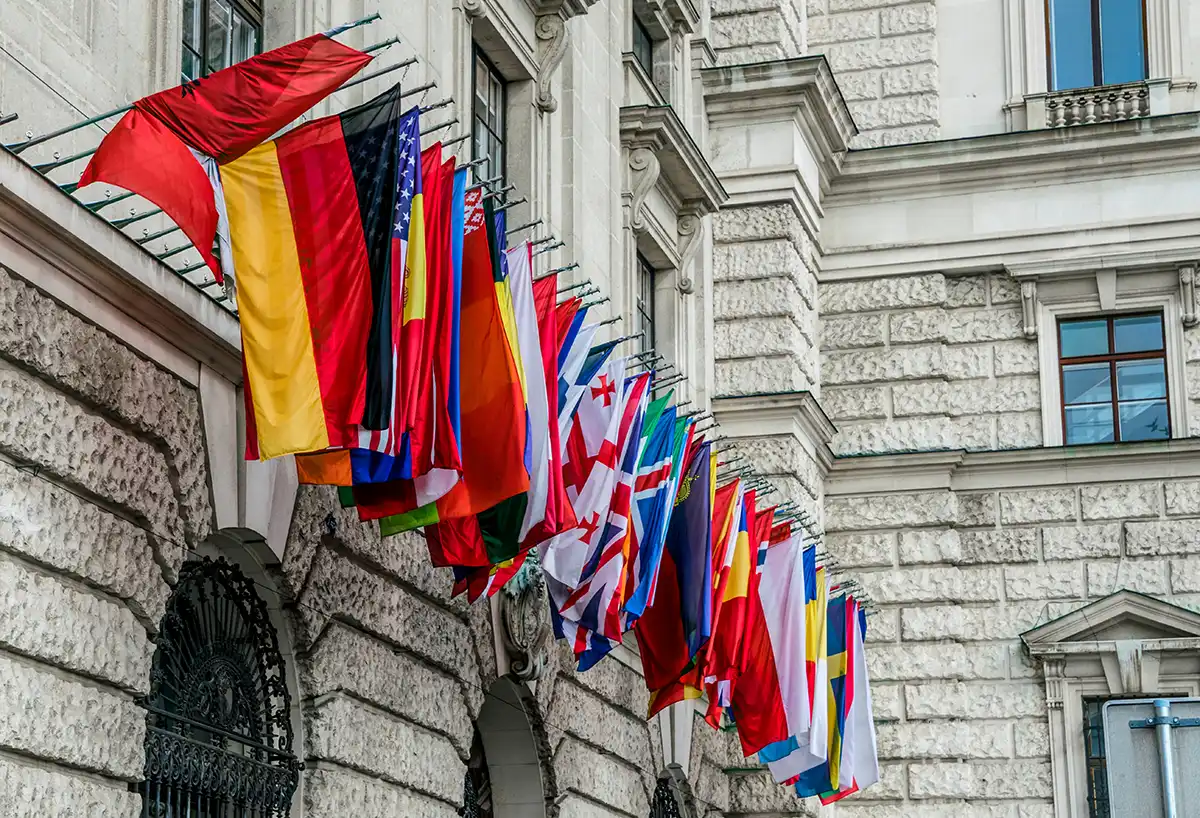
Flags at the Hofburg's OSCE seat — Vienna hosts one of the world's densest diplomatic quarters.
History
Vienna's strategic position at the Danube crossing made it a Celtic, Roman (Vindobona), and medieval trading center before the Habsburgs established it as their capital in 1440—beginning a 480-year reign that made Vienna the seat of the Holy Roman Empire, the Austrian Empire, and Austria-Hungary. The Congress of Vienna (1815) redrew the European map, and the late-19th-century Ringstraße era created the monumental city visible today. Through the upheavals and rebuilding of the 20th century, Vienna reclaimed its standing as a cultural capital and became a major international hub, hosting the UN, OPEC, and OSCE.
Culture
Viennese cuisine is comfort food elevated to an art form. Wiener Schnitzel (veal, not pork, in traditional restaurants) is the city's signature. Coffeehouse culture (UNESCO heritage) revolves around melange and cake—the Sachertorte dates from 1832, and Sacher and Demel long fought over whose is the “original”. Naschmarkt hosts 120+ food stalls. Heurigen wine taverns in hillside vineyards complete the picture. Traditional meal rhythms: Jause (afternoon coffee and cake) is as important as lunch. Festivals: Vienna Opera Ball (February — Austria's most prestigious ball), Donauinselfest (June — Europe's largest free open-air festival), Vienna Film Festival (Rathausplatz, July-August), Christmas Markets (November-December — Rathaus, Schönbrunn, Belvedere). Museums: Kunsthistorisches Museum, Belvedere, Leopold Museum, Albertina, Natural History Museum.
Practical Info
Safety: Vienna is exceptionally safe—consistently ranked among the world's safest major cities. Petty crime is minimal by European standards. Standard precautions at tourist sites and on public transport are sufficient. Emergency: 112 (EU), 133 (police), 122 (fire), 144 (ambulance). Language: German (Austrian German, with distinct vocabulary and accent from Germany). English is widely spoken especially in tourist areas and by younger Viennese. “Grüß Gott” is the local greeting (more common than “Hallo”). Currency: EUR. Cards widely accepted, including contactless. Some traditional Heurigen and market stalls still prefer cash.
Travel
Vienna radiates imperial confidence and cultural refinement in equal measure. The Habsburg dynasty's 640-year reign left a city of extraordinary palaces, museums, and institutions: Schönbrunn Palace rivals Versailles, the Hofburg Imperial Palace complex sprawls across the Innere Stadt, and the Kunsthistorisches Museum houses one of Europe's finest art collections beneath a ceiling you could admire for hours without looking at a single painting. Music is Vienna's defining art—Mozart, Beethoven, Schubert, Brahms, Strauss, and Mahler all lived and composed here, and the Vienna Philharmonic, Vienna State Opera, and Musikverein concert hall maintain standards that set the global benchmark for classical performance. The Ringstraße, the grand boulevard encircling the Innere Stadt, passes the Opera, Parliament, City Hall, Burgtheater, and university in an architectural parade of 19th-century ambition. But Vienna is not a museum: its coffeehouse culture (UNESCO Intangible Heritage) thrives in hundreds of Kaffeehäuser where reading newspapers, lingering over melange and Sachertorte, and simply existing slowly is the entire point. The Naschmarkt's 120+ stalls blend Viennese, Turkish, and international food culture, the MuseumsQuartier houses contemporary art in former imperial stables, and the wine taverns (Heurigen) in the outer districts serve young wine with vineyard views over the city. Vienna's efficient U-Bahn, tram network, and compact walkable center make navigation effortless, and the city's safety, cleanliness, and quality of life regularly place it at or near the top of international liveability rankings.
Schönbrunn Palace & Imperial Heritage
Schönbrunn Palace, the Habsburgs' 1,441-room summer residence, is Austria's most visited attraction and a UNESCO World Heritage Site. The Grand Tour passes through 40 rooms of rococo splendor—the Great Gallery where the Congress of Vienna waltzed in 1815, Maria Theresa's bedroom, and the Hall of Mirrors where the six-year-old Mozart performed for the Empress. The palace gardens stretch across 1.2 kilometers of formal parterre, the Gloriette hilltop colonnade offers city views, and the world's oldest zoo (Tiergarten, founded 1752) occupies the grounds. Arrive when doors open at 8:30 AM to beat bus tours. The Hofburg Imperial Palace in the city center served as the winter residence for over six centuries—today it houses the Imperial Apartments, the Sisi Museum (dedicated to Empress Elisabeth), the Spanish Riding School (where Lipizzaner stallions perform classical dressage), and the Imperial Treasury holding the crown of the Holy Roman Empire. Between these two palaces, the Belvedere complex houses Gustav Klimt's The Kiss and Austrian art spanning medieval to contemporary periods in two baroque palaces connected by terraced gardens with views across the city to the Alps.
Classical Music & Opera
Vienna's musical heritage is without parallel—no other city can claim Mozart, Haydn, Beethoven, Schubert, Brahms, Johann Strauss II, Mahler, and Schoenberg as residents. The Vienna State Opera (Wiener Staatsoper) stages world-class productions 300 nights per year; standing-room tickets (from €4-15, on sale 80 minutes before curtain) provide access to performances that seated tickets price at €200+. The Musikverein's Golden Hall, home of the Vienna Philharmonic and the internationally televised New Year's Concert, is considered the world's finest acoustic space for orchestral music. The Konzerthaus offers a broader program from jazz to contemporary classical. Smaller venues bring intimacy: the Theater an der Wien premiered Beethoven's Fidelio, and house concerts in Mozarthaus Vienna (the composer's only surviving Vienna apartment) create a direct connection to his life. The building where Brahms lived was demolished in 1907, but a room in the Haydnhaus, Haydn's last home, keeps Brahms's furniture. Even casual encounters with music permeate the city—buskers in the U-Bahn play Mozart, café pianists improvise Schubert, and the Vienna Boys' Choir performs at the Hofburg's chapel on Sundays.
Coffeehouse Culture & Viennese Cuisine
Vienna's coffeehouse tradition, recognized as UNESCO Intangible Cultural Heritage, isn't about coffee—it's about a way of being. A Kaffeehaus is your living room, reading room, and meeting place where a single melange (Vienna's milky coffee) buys you unlimited time with newspapers on wooden rods, marble-topped tables, and an atmosphere unchanged for a century. Café Central (where Trotsky played chess), Café Sperl (wood-paneled 1880s authenticity), Café Hawelka (bohemian artists' haunt), and Café Landtmann (politicians' favorite near the Burgtheater) each offer distinct atmospheres. The pastry culture is equally serious: Sachertorte (created in 1832; Hotel Sacher and Café Demel long fought over which of them may call its cake the “original”), Apfelstrudel (watch it stretched paper-thin at Schönbrunn or Café Residenz), and Kaiserschmarrn (shredded pancake with plum compote). Savory Viennese cuisine centers on Wiener Schnitzel (veal, pounded thin, bread-crumbed, pan-fried in butter), Tafelspitz (boiled beef with horseradish, Emperor Franz Joseph's daily dish), and Gulasch. The Naschmarkt, a 1.5-kilometer market strip, blends traditional Viennese delicatessen with Turkish, Middle Eastern, and Asian food stalls.
Art & Museums: From Klimt to Contemporary
Vienna's museum density rivals any city on earth. The Kunsthistorisches Museum (Museum of Art History) holds one of Europe's supreme collections: Bruegel's masterpieces (the world's largest collection), Vermeer, Raphael, Caravaggio, and Velázquez in a building whose interior decoration matches the art for grandeur. The Belvedere's Upper Palace is home to Klimt's The Kiss and a comprehensive Austrian art survey from medieval to modern. The Leopold Museum in the MuseumsQuartier holds the world's largest Egon Schiele collection alongside Klimt and Kokoschka, while the nearby MUMOK (Museum of Modern Art) covers Pop Art to contemporary installation. The Albertina houses one of the world's greatest graphic art collections (Dürer's Hare, Klimt drawings, Monet) in Habsburg state rooms. The Secession Building, with its golden cabbage dome, displays Klimt's Beethoven Frieze, while the contemporary Kunsthalle and smaller galleries in the 4th and 7th districts keep Vienna's art scene vital. A combined Vienna Pass covers most museums and saves significantly over individual tickets.
The Ringstraße & Innere Stadt
The Ringstraße, the grand boulevard built in the 1860s after the medieval walls were demolished, is Vienna's architectural showpiece—a 5.3-kilometer loop past the neo-Renaissance Opera, the Greek-temple Parliament, the Gothic Rathaus, the baroque Burgtheater, and the University, each building attempting to outdo the next in monumental ambition. Walking or taking Tram 1 or 2 around the complete Ring is an essential orientation. Inside the Ring, the Innere Stadt (1st District) concentrates Vienna's historic core: Stephansdom (St. Stephen's Cathedral, climb 343 steps to the south tower for panoramic views), the Graben and Kohlmarkt pedestrian streets (luxury shopping and coffeehouse row), the Hoher Markt's Ankeruhr art nouveau clock, and the narrow lanes around Bäckerstraße where medieval Vienna survives. The district is compact and entirely walkable—two hours of wandering reveals hidden courtyards, Renaissance doorways, and church interiors that any other city would charge admission to enter.
Heurigen, Wine & Outer Districts
Vienna is the only world capital with significant wine production within its city limits—vineyards cover the western and northern hillsides in districts like Grinzing, Nussdorf, Stammerdorf, and Neustift am Walde. Heurigen (wine taverns) serve the current vintage directly from the producer, traditionally signaled by a pine branch over the door, alongside cold buffets of bread, spreads, pickles, and roast meats. The experience is quintessentially Viennese: sitting in a garden overlooking the Danube valley, drinking a glass of Grüner Veltliner or Gemischter Satz as the sun sets over the city. Outside the center, the Prater amusement park's Giant Ferris Wheel (Riesenrad, in operation since 1897 and featured in “The Third Man”) offers iconic views, while the park itself provides kilometers of tree-lined avenues for running and cycling. The Danube Island (Donauinsel), a 21-kilometer artificial island, hosts swimming, cycling, and the annual Donauinselfest—Europe's largest open-air music festival (3 million visitors, free entry, late June).
Day Trips: Wachau, Bratislava & the Alps
Vienna's location at the eastern edge of the Alps and the intersection of Central European cultures enables exceptional day trips. The Wachau Valley (1 hour west by train, UNESCO World Heritage) follows the Danube through terraced vineyards, apricot orchards, and medieval towns—Dürnstein (where Richard the Lionheart was imprisoned) and Melk (whose hilltop Benedictine abbey is one of Europe's finest baroque buildings) anchor a scenic day. Bratislava, the Slovak capital, is just one hour by train (or 75 minutes by Twin City Liner boat along the Danube)—an easy cross-border excursion. Salzburg, Mozart's birthplace and the Sound of Music setting, requires 2.5 hours by train. The Semmering Railway (UNESCO, the world's first mountain railway over an alpine pass) offers a scenic engineering marvel just 90 minutes south. For Alpine scenery without long travel, the Schneeberg (Vienna's local mountain) and the Rax, with its cable car, provide hiking and mountain views in under two hours.
Practical Vienna
Vienna's public transport (Wiener Linien) is excellent—five U-Bahn lines, a comprehensive tram network, and buses cover the entire city. The 24/48/72-hour Vienna Card includes unlimited transport plus museum discounts. Vienna International Airport (VIE) connects to Wien Mitte station via the City Airport Train (CAT, 16 minutes) or cheaper S-Bahn S7 (25 minutes). The city is very safe with negligible tourist-targeted crime. Vienna is moderately expensive by Western European standards—expect €12-18 for a café lunch, €25-45 for a restaurant dinner, and €100-250 for central hotels. Tipping: round up or add 5-10% at restaurants; leave small change at cafés. German is the language, but English is widely spoken especially by younger Viennese. Vienna is best visited in spring (April-June) for garden blooms and outdoor café season, or during the Christmas market period (mid-November to December) when the Rathaus, Schönbrunn, and Belvedere host atmospheric markets. Summer (July-August) brings outdoor festivals but many Viennese flee for vacation; winter offers opera season and ball season (January-February, when the city hosts 450+ formal balls).
Frequently asked questions
Do I need a visa to visit Vienna?
When is the best time to visit Vienna?
How many days do you need in Vienna?
How do I get from Vienna Airport to the city centre?
Can I see the Vienna State Opera affordably?
Transport & airports
U-Bahn, tram and bus operator across the city. Live timetables, route planner, and the 24/48/72-hour Vienna ticket.
Schnellbahn (S-Bahn) regional services, Westbahn and Südbahn long-distance, Railjet to Bratislava, Budapest, Prague and Zurich, plus the Nightjet sleeper network.
Schwechat airport — flight information, transit options, terminal maps, and the City Airport Train and S7 connections to the centre.
Non-stop premium rail service between VIE airport and Wien Mitte/Landstraße in 16 minutes. Booking and timetables.
Catamaran service between Vienna's Schwedenplatz dock and Bratislava in 75 minutes. Seasonal April–October; books out on summer weekends.
Tourism & destination guides
Culture & festivals
Vienna International Centre public guided tours, run by UNIS Vienna (UN Information Service). Tours run weekdays at fixed slots; valid photo ID and advance booking required.
Programme, ticket sales, and the standing-room queue (Stehplätze on sale 80 minutes before curtain) for one of the world's flagship opera houses.
Vienna's annual May–June theatre, opera and contemporary-arts festival across the city's stages.
Diplomatic missions in Vienna
144 embassies based in this city, grouped by region.
Europe48
- Albanian Embassy in Vienna
- Belarusian Embassy in Vienna
- Belgian Embassy in Vienna
- Bosnia and Herzegovina Embassy in Vienna
- Bosnia and Herzegovina Honorary Consulate in Vienna
- Bulgarian Embassy in Vienna
- Croatia Embassy in Vienna
- Cyprus Embassy in Vienna
- Czech Republic Embassy in Vienna
- Royal Danish Embassy in Vienna
- Estonia Embassy in Vienna
- Estonia Honorary Consulate in Vienna
- Finnish Embassy in Vienna
- Finnish Honorary Consulate in Vienna
- French Consulate in Vienna
- French Embassy in Vienna
- German Embassy in Vienna
- Greek Embassy in Vienna
- Hungary Embassy in Vienna
- Iceland Embassy in Vienna
- Iceland Honorary Consulate in Vienna
- Ireland Embassy in Vienna
- Italian Embassy in Vienna
- Kosovo Embassy in Vienna
- Kosovo Honorary Consulate in Vienna
- Latvian Embassy in Vienna
- Liechtenstein Embassy in Vienna
- Lithuanian Embassy in Vienna
- Lithuanian Honorary Consulate General in Vienna
- Luxembourg Embassy in Vienna
- Malta Embassy in Vienna
- Moldova Embassy in Vienna
- Monaco Honorary Consulate General in Vienna
- Montenegro Embassy in Vienna
- Dutch Embassy in Vienna
- North Macedonian Embassy in Vienna
- Polish Embassy in Vienna
- Portuguese Embassy in Vienna
- Romanian Embassy in Vienna
- Russian Embassy in Vienna
- Serbian Embassy in Vienna
- Slovak Embassy in Vienna
- Slovenian Embassy in Vienna
- Spanish Embassy in Vienna
- Swedish Embassy in Vienna
- Swiss Embassy in Vienna
- Ukrainian Embassy in Vienna
- British Embassy Vienna
Asia37
- Afghan Embassy in Vienna
- Armenian Embassy in Vienna
- Azerbaijani Embassy in Vienna
- Bhutan Honorary Consulate in Vienna
- Honorary Consulate of Cambodia in Vienna
- Chinese Embassy in Vienna
- Georgian Embassy in Vienna
- Embassy of India in Vienna
- Indonesian Embassy in Vienna
- Iran Embassy in Vienna
- Iraq Embassy in Vienna
- Israel Embassy in Vienna
- Japanese Embassy in Vienna
- Jordanian Embassy in Vienna
- Kazakhstan Embassy in Vienna
- Kuwaiti Embassy in Vienna
- Kyrgyz Embassy in Vienna
- Lao Embassy in Vienna
- Lebanese Embassy in Vienna
- Malaysian Embassy in Vienna
- Maldives Honorary Consulate in Vienna
- Mongolia Embassy in Vienna
- Mongolia Honorary Consulate in Vienna
- North Korea Embassy in Vienna
- Omani Embassy in Vienna
- Pakistani Embassy in Vienna
- Philippine Embassy in Vienna
- Saudi Arabian Embassy in Vienna
- South Korean Embassy in Vienna
- Syrian Embassy in Vienna
- Royal Thai Embassy in Vienna
- Turkish Consulate General in Vienna
- Turkish Embassy in Vienna
- UAE Embassy in Vienna
- Uzbek Embassy in Vienna
- Vietnamese Embassy in Vienna
- Yemeni Embassy in Vienna
Africa31
- Algerian Embassy in Vienna
- Angolan Embassy in Vienna
- Benin Honorary Consulate in Vienna
- Botswana Honorary Consulate in Vienna
- Burkina Faso Embassy in Vienna
- Honorary Consulate of Burundi in Vienna
- Honorary Consulate of Cameroon in Vienna
- Cabo Verde Honorary Consulate in Vienna
- DRC Honorary Consulate in Vienna
- Djibouti Honorary Consulate in Vienna
- Egyptian Embassy in Vienna
- Eritrea Honorary Consulate in Vienna
- Eswatini Honorary Consulate in Vienna
- Ghana Embassy in Vienna
- Guinea Honorary Consulate in Vienna
- Ivory Coast Embassy in Vienna
- Kenyan Embassy in Vienna
- Lesotho Honorary Consulate in Vienna
- Liberian Honorary Consulate in Vienna
- Libyan Embassy in Vienna
- Mali Honorary Consulate in Vienna
- Mauritius Honorary Consulate in Vienna
- Moroccan Embassy in Vienna
- Mozambique Honorary Consulate in Vienna
- Namibian Embassy in Vienna
- Nigerian Embassy in Vienna
- Republic of Congo Honorary Consulate in Vienna
- South African Embassy in Vienna
- Sudanese Embassy in Vienna
- Gambia Honorary Consulate in Vienna
- Tunisian Embassy in Vienna
Americas25
- Argentine Embassy in Vienna
- Barbados Honorary Consulate General in Vienna
- Bolivian Embassy in Vienna
- Brazilian Embassy in Vienna
- Canadian Embassy in Vienna
- Chilean Embassy in Vienna
- Colombian Embassy in Vienna
- Costa Rica Embassy in Vienna
- Cuba Embassy in Vienna
- Dominican Republic Embassy in Vienna
- Embassy of Ecuador in Vienna
- El Salvador Embassy in Vienna
- El Salvador Honorary Consulate in Vienna
- Grenada Honorary Consulate in Vienna
- Guatemalan Embassy in Vienna
- Haiti Consulate General in Vienna
- Honduras Consulate General in Vienna
- Jamaican Honorary Consulate General in Vienna
- Mexican Embassy in Vienna
- Nicaraguan Embassy in Vienna
- Panamanian Embassy in Vienna
- Peruvian Embassy in Vienna
- United States Embassy Vienna
- Uruguayan Embassy in Vienna
- Venezuelan Embassy in Vienna
Visaja keeps this page's contact details and visa guidance under continuous review — still, requirements can change at short notice, so confirm the essentials with the mission or the official government portal before you travel.