- Population:2.8M
- Timezone:CET/CEST
- IATA:ROM
- Currency:EUR. Cards widely accepted but some trattorias and pizza al taglio shops prefer cash. ATMs (bancomat) are everywhere.
- Key Areas:Trastevere · Monti · Centro Storico · Jewish Ghetto
Overview
Rome layers 2,700 years of history in a living city where ancient ruins sit beside baroque churches, trattorias serve the same recipes for generations, and every neighborhood conceals masterpieces that other cities would build museums around.
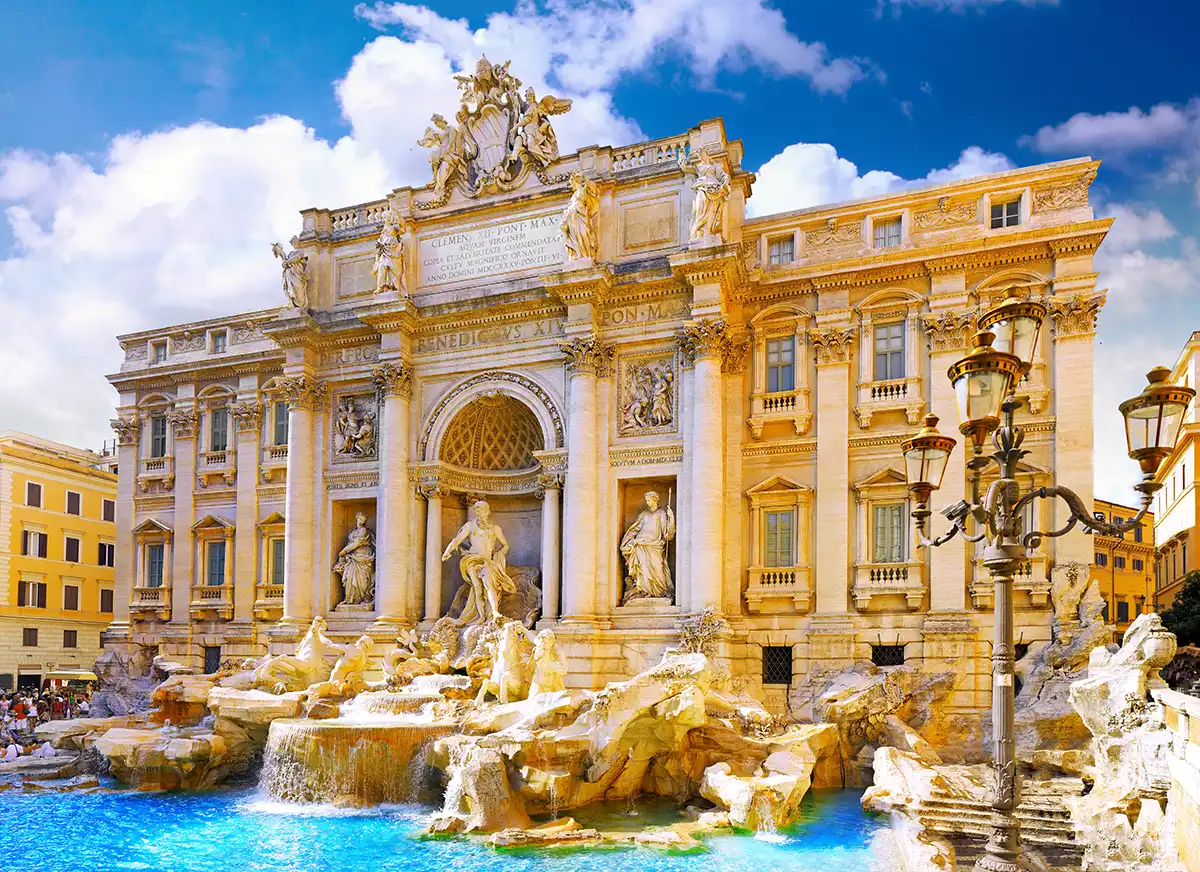
The Trevi Fountain — Rome's baroque showpiece, at its calmest before 8 AM.
© Brian Kinney / Adobe Stock
History
Founded (traditionally) in 753 BC by Romulus, Rome grew from a hilltop settlement to the capital of an empire spanning from Britain to Mesopotamia. The Republic gave way to the Empire, which fell in 476 AD but left infrastructure, law, and architecture that defined Western civilization. Medieval Rome became the seat of papal power, the Renaissance made it an artistic capital (Michelangelo, Raphael, Bramante), the baroque era added Bernini's fountains and piazzas, and the Risorgimento (1871) made it capital of unified Italy. Today's Rome lives among all these layers simultaneously—a 21st-century city whose daily life unfolds among ruins, churches, and palaces spanning nearly three millennia.
Culture
Roman cuisine centers on four canonical pastas: cacio e pepe, carbonara, amatriciana, and gricia—all built on pecorino romano and guanciale. Pizza in Rome is thin-crust and sold al taglio (by weight). Supplì are the Roman answer to arancini. Espresso is drunk standing at the bar — a seated table on a tourist piazza costs a multiple of the counter price. Aperitivo hour brings generous buffets with your drink. Testaccio market and Jewish Ghetto restaurants represent the most authentic food experiences. Romans eat late: dinner rarely before 8:30 PM. Festivals: Easter Week & Papal Mass (Vatican), Estate Romana (summer cultural festival), Festa de' Noantri (July — Trastevere), Rome Film Fest (October). Museums: Vatican Museums, Borghese Gallery, Capitoline Museums, Palazzo Doria Pamphilj, MAXXI (contemporary art).
Practical Info
Safety: Rome is generally safe. Pickpocketing is the main concern—bus 64 (Termini-Vatican route), crowded Metro, and areas around the Colosseum and Trevi Fountain are hotspots. Unofficial taxi drivers outside Termini overcharge; use only white licensed taxis. Some restaurants near major sights are tourist traps with inflated prices; walk a few blocks for authenticity. Emergency: 112 or 113. Language: Italian. English is spoken in hotels and tourist restaurants but less common than expected—basic Italian helps significantly and is greatly appreciated. Currency: EUR. Cards widely accepted but some trattorias and pizza al taglio shops prefer cash. ATMs (bancomat) are everywhere.
Travel
Rome is the Eternal City in the most literal sense—a place where you walk on 2,000-year-old roads, eat lunch in a piazza designed by Bernini, and pass a Caravaggio hanging in a dimly lit chapel on your way to dinner. The Colosseum, Roman Forum, and Palatine Hill anchor the ancient world in the very heart of the modern city, while the Vatican Museums house one of humanity's greatest art collections culminating in the Sistine Chapel ceiling. But Rome rewards those who wander beyond the headlines: Trastevere's cobblestone lanes and ivy-draped trattorias, the Aventine Hill's secret keyhole framing St. Peter's dome, the Appian Way's ancient tombs stretching into the countryside, and neighborhood markets where Romans buy their daily produce. The food is deceptively simple and extraordinary—cacio e pepe, carbonara, supplì, and thin-crust Roman pizza perfected over centuries. Espresso at the bar is a ritual taken standing and finished in seconds, gelato is an art form, and aperitivo hour fills piazzas with Aperol spritzes and free snacks at sunset. Rome's public transport is functional if imperfect (two Metro lines, extensive buses), but the centro storico is best explored on foot—getting lost among the tangle of streets between the Pantheon and Piazza Navona is how you find Rome's real magic.
The Colosseum, Forum & Ancient Rome
The Colosseum remains the most visceral connection to the ancient world—standing inside the arena where 50,000 spectators watched gladiatorial combat 2,000 years ago, with the underground hypogeum now open revealing the lifting mechanisms and animal cages that staged the spectacles. Combined tickets include the adjacent Roman Forum, where temples, triumphal arches, and senate buildings line the Via Sacra creating an open-air museum of Republican and Imperial Rome, and the Palatine Hill above, where emperors built their palaces overlooking the Circus Maximus chariot racing track. Advance timed-entry tickets are essential—they sell out days ahead in peak season. Beyond the iconic trio, ancient Rome appears throughout the city: the perfectly preserved Pantheon (a small entry fee since 2023) with its 2,000-year-old unreinforced concrete dome and oculus, the Baths of Caracalla that once accommodated 1,600 bathers, the catacombs along the Appian Way housing early Christian burial sites, and Trajan's Markets considered the world's first shopping mall.
Vatican City & St. Peter's Basilica
Vatican City, the world's smallest independent state, contains artistic and spiritual treasures unmatched anywhere. The Vatican Museums' miles of galleries lead through the Raphael Rooms, the Gallery of Maps, and ancient sculpture collections to the Sistine Chapel—Michelangelo's ceiling frescoes and Last Judgment remain as staggering today as when Pope Julius II first saw them in 1512. Lines can exceed four hours without advance tickets; book time-slot reservations weeks ahead, or consider early-morning or Friday evening openings. St. Peter's Basilica, the world's largest church, houses Michelangelo's Pietà (behind glass since a 1972 attack), Bernini's 29-meter bronze baldachin over the papal altar, and the dome (climb 551 steps) offering views across Rome from 136 meters. St. Peter's Square, Bernini's masterful colonnade embracing an elliptical piazza, stages papal audiences on Wednesdays and the Angelus blessing on Sundays. The dress code is strictly enforced—covered shoulders and knees for both sexes.
Baroque Rome: Fountains, Piazzas & Churches
Rome's baroque heritage, largely the legacy of rivals Bernini and Borromini in the 17th century, enriches the city at every turn. The Trevi Fountain, recently restored to gleaming white travertine, draws crowds tossing coins over their shoulders (everything collected each day goes to charity). Piazza Navona, built over Domitian's stadium, showcases Bernini's Fountain of the Four Rivers opposite Borromini's Sant'Agnese church—the two architects' works face each other in eternal artistic rivalry. The Spanish Steps cascade down from Trinità dei Monti to the designer shopping of Via Condotti below. But Rome's greatest baroque surprises hide in its 900+ churches: Caravaggio's masterpieces hang in near-darkness in San Luigi dei Francesi and Santa Maria del Popolo (free entry), Borromini's San Carlo alle Quattro Fontane achieves impossible optical illusions with its tiny oval dome, and Sant'Ignazio's ceiling fresco creates a convincing three-dimensional dome where none exists. These discoveries, stumbled upon while wandering between gelato stops, define the Roman experience.
Roman Cuisine & Food Culture
Roman cuisine is built on a handful of ingredients perfected over centuries. The four canonical pasta dishes—cacio e pepe (pecorino and black pepper), carbonara (guanciale, egg, pecorino), amatriciana (guanciale, tomato, pecorino), and gricia (guanciale, pecorino)—appear on every trattoria menu and vary subtly from kitchen to kitchen. Supplì (fried rice balls with mozzarella) and pizza al taglio (rectangular pizza sold by weight from glass-fronted counters) fuel quick lunches. The Jewish-Roman kitchen in the Ghetto neighborhood contributes carciofi alla giudia (deep-fried whole artichokes) and filetti di baccalà (fried salt cod). Aperitivo culture peaks in neighborhoods like Trastevere, Monti, and Pigneto, where an Aperol spritz comes with a generous buffet spread. Espresso standing at the bar costs a fraction of what the same cup costs seated at a table on a tourist piazza — the gap is large enough to explain why Romans drink it standing. Testaccio's market and the Flavio al Velavevodetto restaurant in a Monte Testaccio cave represent Roman food culture at its most authentic. Romans eat late: lunch at 1-2 PM, dinner at 8:30-9:30 PM.
Trastevere, Monti & Neighborhood Life
Trastevere, across the Tiber from the historic center, is Rome's most atmospheric neighborhood—narrow cobblestone lanes, ochre and sienna buildings draped in ivy, trattorias spilling onto tiny piazzas, and a lively night scene that mixes tourists and locals. The Basilica di Santa Maria in Trastevere, with its shimmering 12th-century mosaics, anchors the main square. Monti, Rome's oldest rione (neighborhood) between the Colosseum and Termini, has evolved from working-class quarter to the city's trendiest address—vintage shops, craft cocktail bars, and intimate restaurants line Via del Boschetto and Via Panisperna. The Jewish Ghetto, one of Europe's oldest (established 1555), preserves a poignant history alongside excellent restaurants. Testaccio, once the slaughterhouse district, is now a food destination centered on its covered market and innovative restaurants. Pigneto, further east, attracts a younger crowd with street art, aperitivo bars, and Pasolini's former haunts. Each neighborhood has its own rhythm—discovering it means eating, drinking, and walking like a local.
Galleries, Villas & Hidden Treasures
Beyond the Vatican and ancient sites, Rome hides extraordinary collections in aristocratic villas and palaces. The Borghese Gallery (advance reservation mandatory—they limit visitors to 360 per two-hour session) holds Bernini's most dynamic sculptures (Apollo and Daphne, The Rape of Proserpina) alongside Caravaggio paintings in a villa surrounded by Rome's most elegant park. Palazzo Doria Pamphilj, still privately owned by the family, houses Velázquez's portrait of Pope Innocent X and works by Caravaggio and Raphael in lavish rococo galleries. The Capitoline Museums on the Campidoglio (designed by Michelangelo) contain the iconic She-Wolf bronze and the equestrian Marcus Aurelius. Villa Farnesina preserves Raphael's frescoes of the myth of Cupid and Psyche, while MAXXI, Zaha Hadid's swooping contemporary art museum in the Flaminio district, anchors Rome's modern art scene alongside the MACRO gallery in a converted brewery in Testaccio.
Day Trips & Beyond
Rome's surroundings offer compelling excursions. Tivoli (30 minutes by train) holds two UNESCO sites: Hadrian's Villa, the vast 2nd-century imperial retreat, and the Renaissance Villa d'Este with its spectacular terraced gardens and hundreds of fountains. Ostia Antica, Rome's ancient port (30 minutes by Metro/train), is a remarkably preserved Roman city rivaling Pompeii but with far fewer crowds. The Castelli Romani hill towns—Frascati, Castel Gandolfo, Nemi—offer wine, porchetta, and lake views just 30 minutes south. Naples and Pompeii are reachable in 70 minutes by high-speed train, while Florence is under 90 minutes by Frecciarossa. Orvieto's dramatic cliff-top Duomo, the Etruscan tombs of Cerveteri, and the beaches of Sperlonga provide variety within easy reach. For a unique experience, the volcanic Lago di Bracciano offers swimming and a medieval Orsini-Odescalchi castle just north of the city.
Practical Rome
Rome has two Metro lines (A and B) that cross at Termini station—useful for major sites but limited coverage. Buses fill the gaps but can be slow in traffic and confusing to navigate. Walking is the best way to experience the centro storico—most major attractions lie within a 30-minute walk of each other. Buy BIT tickets (100 minutes) or 24/48/72-hour passes. Fiumicino Airport (FCO) connects to Termini via the Leonardo Express train in about half an hour. Rome is hot in July-August (35°C+) and tourist sites are crowded; spring (April-May) and autumn (September-October) offer ideal conditions. The city is generally safe—pickpocketing on bus 64 (Vatican route) and around Termini is the main concern. Restaurant tourist traps cluster near major sights—walk two blocks in any direction for better quality and prices. Dress modestly for churches (covered shoulders and knees). Many museums close on Mondays. Tap water is safe—use Rome's 2,500+ nasoni (street fountains) to refill bottles.
Frequently asked questions
How many days should I spend in Rome?
Do I need to book Colosseum and Vatican tickets in advance?
What's the best time of year to visit Rome?
Is Rome safe for visitors?
What should I wear to visit St. Peter's Basilica?
How do I get from Fiumicino Airport into central Rome?
Diplomatic missions in Rome
142 embassies based in this city, grouped by region.
Europe43
- Albanian Embassy in Rome
- Embassy of Austria in Rome
- Belarusian Embassy in Rome
- Belgian Embassy in Rome
- Embassy of Bosnia and Herzegovina in Rome
- Bulgarian Embassy in Rome
- Embassy of Croatia in Rome
- Embassy of Cyprus in Rome
- Embassy of the Czech Republic in Rome
- Royal Danish Embassy in Rome
- Embassy of Estonia in Rome
- Embassy of Finland in Rome
- Consulate-General of France in Rome
- Embassy of France in Rome
- German Embassy in Rome
- Embassy of Greece in Rome
- Embassy of Hungary in Rome
- Iceland Embassy in Rome
- Embassy of Ireland in Rome
- Embassy of the Republic of Kosovo in Rome
- Embassy of Latvia in Rome
- Embassy of Lithuania in Rome
- Embassy of Luxembourg in Rome
- Embassy of Malta in Rome
- Embassy of Moldova in Rome
- Monaco Embassy in Rome
- Montenegro Embassy in Rome
- Embassy of the Netherlands in Rome
- Embassy of North Macedonia in Rome
- Royal Norwegian Embassy in Rome
- Embassy of Poland in Rome
- Embassy of Portugal in Rome
- Embassy of Romania in Rome
- Russian Embassy in Rome
- Embassy of San Marino in Rome
- Embassy of Serbia in Rome
- Embassy of Slovakia in Rome
- Embassy of Slovenia in Rome
- Embassy of Spain in Rome
- Embassy of Sweden in Rome
- Embassy of Switzerland in Rome
- Ukrainian Embassy in Rome
- British Embassy in Rome
Asia37
- Afghan Embassy in Rome
- Armenian Embassy in Rome
- Azerbaijani Embassy in Rome
- Bahraini Embassy in Rome
- Bangladeshi Embassy in Rome
- Chinese Embassy in Rome
- Embassy of Georgia in Rome
- Embassy of India in Rome
- Indonesian Embassy in Rome
- Embassy of the Islamic Republic of Iran in Rome
- Embassy of the Republic of Iraq in Rome
- Embassy of Israel in Rome
- Embassy of Japan in Rome
- Embassy of Jordan in Rome
- Embassy of Kazakhstan in Rome
- Embassy of the State of Kuwait in Rome
- Embassy of the Kyrgyz Republic in Rome
- Embassy of Lebanon in Rome
- Embassy of Malaysia in Rome
- Embassy of Mongolia in Rome
- Embassy of Myanmar in Rome
- Embassy of the Democratic People's Republic of Korea in Rome
- Embassy of the Sultanate of Oman in Rome
- Embassy of Pakistan in Rome
- Mission of Palestine in Rome
- Embassy of the Philippines in Rome
- Embassy of the State of Qatar in Rome
- Saudi Arabian Embassy in Rome
- Embassy of the Republic of Korea in Rome
- Embassy of Sri Lanka in Rome
- Royal Thai Embassy in Rome
- Turkish Embassy in Rome
- Embassy of Turkmenistan in Rome
- Embassy of the United Arab Emirates in Rome
- Embassy of Uzbekistan in Rome
- Embassy of Vietnam in Rome
- Embassy of Yemen in Rome
Africa37
- Algerian Embassy in Rome
- Angolan Embassy in Rome
- Embassy of Burkina Faso in Rome
- Embassy of Burundi in Rome
- Embassy of Cameroon in Rome
- Embassy of Cape Verde in Rome
- Embassy of the Democratic Republic of the Congo in Rome
- Egyptian Embassy in Rome
- Embassy of Equatorial Guinea in Rome
- Embassy of Eritrea in Rome
- Embassy of Ethiopia in Rome
- Embassy of Gabon in Rome
- Embassy of Ghana in Rome
- Embassy of Guinea in Rome
- Embassy of Ivory Coast in Rome
- Embassy of Kenya in Rome
- Embassy of the Kingdom of Lesotho in Rome
- Embassy of Liberia in Rome
- Embassy of Libya in Rome
- Embassy of Madagascar in Rome
- Embassy of Mali in Rome
- Embassy of Mauritania in Rome
- Moroccan Embassy in Rome
- Mozambique Embassy in Rome
- Embassy of Niger in Rome
- Embassy of Nigeria in Rome
- Embassy of the Republic of the Congo in Rome
- Embassy of Senegal in Rome
- Embassy of Somalia in Rome
- Embassy of South Africa in Rome
- Embassy of South Sudan in Rome
- Embassy of Sudan in Rome
- Embassy of Tanzania in Rome
- Embassy of Tunisia in Rome
- Embassy of Uganda in Rome
- Embassy of Zambia in Rome
- Embassy of Zimbabwe in Rome
Americas22
- Embassy of Argentina in Rome
- Bolivian Embassy in Rome
- Embassy of Brazil in Rome
- Embassy of Canada in Rome
- Chilean Embassy in Rome
- Embassy of Colombia in Rome
- Embassy of Costa Rica in Rome
- Embassy of Cuba in Rome
- Embassy of the Dominican Republic in Rome
- Embassy of Ecuador in Rome
- Embassy of El Salvador in Rome
- Guatemalan Embassy in Rome
- Embassy of Haiti in Rome
- Embassy of Honduras in Rome
- Embassy of Mexico in Rome
- Embassy of Nicaragua in Rome
- Embassy of Panama in Rome
- Embassy of Paraguay in Rome
- Embassy of Peru in Rome
- United States Embassy in Rome
- Embassy of Uruguay in Rome
- Embassy of Venezuela in Rome
This overview comes from Visaja's worldwide missions database (visaja.com), checked against official government sources; for binding answers, the mission itself always has the final word.