- Population:2.8M
- Timezone:CET/CEST
- IATA:ROM
- Currency:The euro. Cards are widely accepted; a little cash helps at small bars, market stalls and pizza counters.
- Key Areas:Centro Storico · Monti · Trastevere · Jewish Quarter
Overview
Rome, the capital of Italy, gathers its ancient ruins, baroque piazzas and great basilicas in a compact centre on the Tiber, with the Vatican and Trastevere on the far bank.
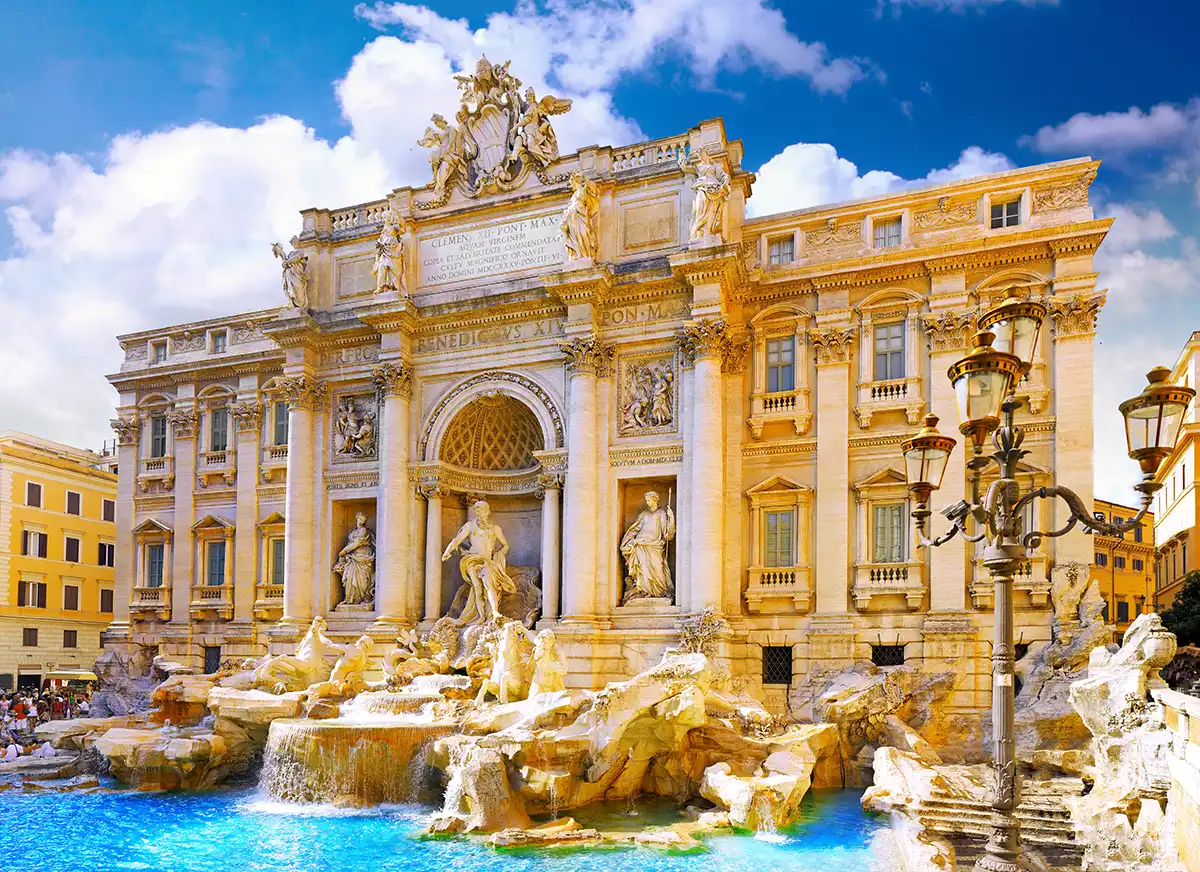
The Trevi Fountain against the back of Palazzo Poli — quietest early in the morning.
© Brian Kinney / Adobe Stock
Practical Info
Language: Italian. English is common in hotels and around the main sights, less so in neighbourhood bars and trattorias. Currency: The euro. Cards are widely accepted; a little cash helps at small bars, market stalls and pizza counters.
Travel
Rome is where most journeys through Italy begin, and it is a city walked in layers: medieval houses lean on Roman walls, churches stand on top of older churches, and ancient columns turn up in the fronts of later buildings. The historic centre fills a bend on the east bank of the Tiber, with the ancient core at its south-eastern edge, while the Vatican and Trastevere face it from the west bank. Most of it lies within walking distance, and the time between the famous sights — in small piazzas, in churches entered on the way past — is a large part of any visit. The days work best built around one timed entry in the morning, with the rest left to the streets.
The Colosseum and the Arch of Constantine
The Colosseum stands at the eastern end of the Forum valley, across the road from the Colosseo stop on metro line B, with the Arch of Constantine beside it on the way to the Palatine. Completed in AD 80, the amphitheatre held some 50,000 spectators; a visit follows the ground-floor arcades and the tier above, looking down into the maze of walls that once lay under the wooden arena floor. Entry is by a timed booking made ahead, and the first hour of the day is the calmest. The hypogeum beneath the arena is seen on a separate ticket.
The Roman Forum and the Palatine
West of the Colosseum, the Roman Forum fills the hollow between the Palatine and Capitoline hills: temples, basilicas and the senate house along the Via Sacra, from the Arch of Titus at the Colosseum end to the Arch of Septimius Severus below the Capitoline. The Palatine rises from the Forum's south side, with the brick shells of the imperial palaces among umbrella pines and the terraced Farnese Gardens, and its far edge looks down on the long grassy hollow of the Circus Maximus. Neither has much shade; in summer both are morning visits.
Piazza Venezia, the Capitoline and the Imperial Forums
Piazza Venezia, under the white marble bulk of the Vittoriano, is the hinge of the centre. Beside it, Michelangelo's cordonata, a ramp of broad, shallow steps, climbs the Capitoline to the piazza he designed, with a copy of the bronze Marcus Aurelius on horseback at its centre. The Capitoline Museums fill the palaces on two sides — the original horseman, the bronze She-Wolf, the marble head and hand of a colossal Constantine — and the passage between them runs through the Tabularium, whose arcade looks down the length of the Forum. Via dei Fori Imperiali leads back toward the Colosseum past the Imperial Forums, with Trajan's Column at the Piazza Venezia end and the brick hemicycle of Trajan's Markets, home to the Museum of the Imperial Forums, on the slope above.
Monti and Santa Maria Maggiore
Monti climbs from the Imperial Forums toward the Esquiline: narrow streets such as Via del Boschetto and Via Panisperna, small shops, wine bars and trattorias, and the fountain steps of Piazza della Madonna dei Monti, which fill on summer evenings. A stair under an arch off Via Cavour leads up to San Pietro in Vincoli, where Michelangelo's Moses sits on the tomb of Pope Julius II. At the quarter's upper edge, Santa Maria Maggiore, one of the four papal basilicas, keeps fifth-century mosaics along its nave under a gilded coffered ceiling and holds the tomb of Pope Francis.
San Clemente and San Giovanni in Laterano
A few minutes east of the Colosseum, San Clemente is three buildings deep: a twelfth-century basilica with a gold-ground apse mosaic, a fourth-century church beneath it, and at the bottom Roman rooms and a temple of Mithras, where running water can be heard behind the walls. The lower levels are a separate ticket. The same street leads on to San Giovanni in Laterano, the cathedral of Rome, with a nave remodelled by Borromini and a façade crowned by giant statues of Christ and the saints; across the square, pilgrims climb the Scala Santa, the holy stair, on their knees.
The Jewish Quarter and the Tiber Island
Between the Capitoline and the river lies the Jewish quarter, the area of the former ghetto. The Great Synagogue stands on the Tiber embankment, with the Jewish Museum of Rome in the same complex, and Via del Portico d'Ottavia runs past the columns of the ancient Portico of Octavia to the arches of the Theatre of Marcellus. The street is lined with restaurants of the Jewish-Roman kitchen, where carciofi alla giudia — whole artichokes fried until the leaves open — are the dish of the winter and spring season. From the embankment by the synagogue, the Roman Ponte Fabricio crosses to the Tiber Island and on toward Trastevere.
Campo de' Fiori and Piazza Navona
Campo de' Fiori holds a morning market of fruit, vegetables and flowers around the hooded bronze statue of Giordano Bruno, and becomes a square of bars after dark; Palazzo Farnese closes the next piazza to the south-west. Piazza Navona, a few minutes north across Corso Vittorio Emanuele II, keeps the long oval of the Stadium of Domitian it is built on, and the stadium's arches can be seen below street level at its northern end. At the centre stands Bernini's Fountain of the Four Rivers, crowned by an obelisk, facing Borromini's church of Sant'Agnese in Agone.
The Pantheon and the Churches Around It
The Pantheon, rebuilt under the emperor Hadrian and a church since the seventh century, has stood roofed and in use for close to nineteen centuries. Its concrete dome is as wide as it is high, about 43 metres, and open to the sky at the oculus, so a disc of sunlight moves across the coffers through the day; Raphael is buried inside. Behind it, Bernini's marble elephant carries an obelisk in front of Santa Maria sopra Minerva, and to the west the Contarelli Chapel of San Luigi dei Francesi holds three Caravaggio paintings of St Matthew. East of the Pantheon, Sant'Ignazio's flat ceiling carries a painted dome by Andrea Pozzo, best seen from the disc set in the nave floor, and on Via del Corso the Doria Pamphilj gallery, still owned by the family, hangs Velázquez's portrait of Pope Innocent X.
The Trevi Fountain and the Quirinal
The Trevi Fountain fills a small square against the back of Palazzo Poli: Oceanus on his shell chariot over a cascade of carved travertine rock, finished in 1762 to the design of Nicola Salvi. The square is crowded from mid-morning into the night, and early morning is the quiet hour; the coins thrown over the shoulder into the basin are collected for the charity Caritas. Uphill, the Quirinal Palace, the residence of Italy's president, faces a piazza with a view over the rooftops to St Peter's, and along Via del Quirinale two small churches stand a short walk apart: Bernini's Sant'Andrea al Quirinale and Borromini's San Carlo alle Quattro Fontane under its oval dome.
The Spanish Steps, the Pincio and the Borghese Gallery
The Spanish Steps climb from Piazza di Spagna and the Barcaccia, a fountain shaped like a half-sunken boat, to the church of Trinità dei Monti; sitting on the steps is not allowed, and Via Condotti with its fashion houses runs from their foot. From the top, a road along the ridge leads to the Pincio terrace, which looks down on Piazza del Popolo, its obelisk and twin churches; by the city gate, Santa Maria del Popolo holds two Caravaggios in the Cerasi Chapel and the Chigi Chapel designed by Raphael. Behind the Pincio spread the gardens of Villa Borghese, and at their far side the Borghese Gallery shows Bernini's Apollo and Daphne and Rape of Proserpina, Canova's reclining Pauline Borghese and a run of Caravaggios, entered only on a timed booking made ahead. MAXXI, Zaha Hadid's museum of contemporary art and architecture, lies north of the park in the Flaminio quarter.
Castel Sant'Angelo
Across Ponte Sant'Angelo, lined with angels carved to Bernini's designs, Castel Sant'Angelo began as the tomb of the emperor Hadrian and became a papal fortress and prison. A Roman ramp spirals up through the drum of the mausoleum to the papal apartments and a terrace under the bronze archangel, with a view along the river to the dome of St Peter's. From the castle, Via della Conciliazione runs straight to St Peter's Square.
The Vatican Museums and the Sistine Chapel
The Vatican Museums are the collection of the popes, grown from a sculpture courtyard into kilometres of galleries: the Laocoön and the Apollo Belvedere in the Pio-Clementino, the long painted Gallery of Maps, the Raphael Rooms with the School of Athens, and at the end the Sistine Chapel, with Michelangelo's ceiling of 1508 to 1512 and the Last Judgment he painted on the altar wall from 1536 to 1541. The route runs largely one way and takes most of a morning. The chapel is kept quiet, and photographs are not allowed in it. Entry is by a timed booking made ahead, and the first slot of the day meets the thinnest crowds.
St Peter's Basilica and Its Square
St Peter's Square, held in the two curved arms of Bernini's colonnade, lies in Vatican City, an independent state inside Rome; the basilica is entered through a security check under the colonnade. Michelangelo's Pietà is behind glass in the first chapel on the right, and Bernini's bronze canopy rises over the papal altar, above the place venerated as St Peter's tomb, under Michelangelo's dome. The climb to the dome, 551 steps on foot or fewer with the lift to the roof, ends on a narrow, sloping stair between its two shells and a gallery around the lantern. Shoulders and knees must be covered, a rule enforced at the door. When the pope is in Rome, he holds a general audience on Wednesday mornings, for which a ticket is requested ahead, and leads the Angelus at noon on Sundays before the crowd in the square.
Trastevere and the Janiculum
Trastevere, across the river from the Jewish quarter, keeps the lanes, ochre houses and small piazzas of a medieval quarter and is busiest in the evening, when its trattorias set tables outside. Santa Maria in Trastevere, on its main square, glows with twelfth-century apse mosaics. On Via della Lungara, Villa Farnesina, built for a Renaissance banker, holds Raphael's Galatea and the loggia of Cupid and Psyche painted to his design. Via Garibaldi climbs from the quarter past Bramante's round Tempietto at San Pietro in Montorio and the great Acqua Paola fountain to the Janiculum, whose terrace looks over the whole centre, best near sunset.
The Aventine and Testaccio
The Aventine, above the Circus Maximus, is a quiet hill of villas and gardens. The Orange Garden looks over the Tiber to St Peter's; Santa Sabina beside it is a fifth-century basilica with carved cypress-wood doors; and further along, a keyhole in the door of the Knights of Malta's priory frames the dome of St Peter's at the end of a garden avenue. Below the hill, Testaccio is a working quarter built around its covered market hall and Monte Testaccio, a hill of broken Roman amphorae with trattorias dug into its flanks. At its edge the Pyramid of Cestius stands in the city wall beside the Non-Catholic Cemetery, where Keats and Shelley are buried.
The Baths of Caracalla and the Appian Way
South of the Circus Maximus, the high brick walls of the Baths of Caracalla enclose the bath halls of an emperor's leisure complex and serve as the stage of the Rome Opera's summer season. Beyond the Aurelian Walls at Porta San Sebastiano, the Via Appia Antica runs out between tombs, pines and fields, in stretches on its original basalt paving, and walking or cycling part of it is a half-day away from the traffic. The catacombs of San Callisto and San Sebastiano open off the road, and their underground burial galleries are always visited with a guide. The paving is uneven, and good shoes matter.
Frequently asked questions
How many days does Rome need?
When is the best time to visit Rome?
Which dates in the Roman year are worth planning around?
Where should I stay in Rome?
Can I see the Vatican Museums and St Peter's on the same day?
How do I get around Rome?
What should I eat in Rome?
What day trips can I make from Rome?
Diplomatic missions in Rome
142 embassies based in this city, grouped by region.
Europe43
- Albanian Embassy in Rome
- Embassy of Austria in Rome
- Belarusian Embassy in Rome
- Belgian Embassy in Rome
- Embassy of Bosnia and Herzegovina in Rome
- Bulgarian Embassy in Rome
- Embassy of Croatia in Rome
- Embassy of Cyprus in Rome
- Embassy of the Czech Republic in Rome
- Royal Danish Embassy in Rome
- Embassy of Estonia in Rome
- Embassy of Finland in Rome
- Consulate-General of France in Rome
- Embassy of France in Rome
- German Embassy in Rome
- Embassy of Greece in Rome
- Embassy of Hungary in Rome
- Iceland Embassy in Rome
- Embassy of Ireland in Rome
- Embassy of the Republic of Kosovo in Rome
- Embassy of Latvia in Rome
- Embassy of Lithuania in Rome
- Embassy of Luxembourg in Rome
- Embassy of Malta in Rome
- Embassy of Moldova in Rome
- Monaco Embassy in Rome
- Montenegro Embassy in Rome
- Embassy of the Netherlands in Rome
- Embassy of North Macedonia in Rome
- Royal Norwegian Embassy in Rome
- Embassy of Poland in Rome
- Embassy of Portugal in Rome
- Embassy of Romania in Rome
- Russian Embassy in Rome
- Embassy of San Marino in Rome
- Embassy of Serbia in Rome
- Embassy of Slovakia in Rome
- Embassy of Slovenia in Rome
- Embassy of Spain in Rome
- Embassy of Sweden in Rome
- Embassy of Switzerland in Rome
- Ukrainian Embassy in Rome
- British Embassy in Rome
Asia37
- Afghan Embassy in Rome
- Armenian Embassy in Rome
- Azerbaijani Embassy in Rome
- Bahraini Embassy in Rome
- Bangladeshi Embassy in Rome
- Chinese Embassy in Rome
- Embassy of Georgia in Rome
- Embassy of India in Rome
- Indonesian Embassy in Rome
- Embassy of the Islamic Republic of Iran in Rome
- Embassy of the Republic of Iraq in Rome
- Embassy of Israel in Rome
- Embassy of Japan in Rome
- Embassy of Jordan in Rome
- Embassy of Kazakhstan in Rome
- Embassy of the State of Kuwait in Rome
- Embassy of the Kyrgyz Republic in Rome
- Embassy of Lebanon in Rome
- Embassy of Malaysia in Rome
- Embassy of Mongolia in Rome
- Embassy of Myanmar in Rome
- Embassy of the Democratic People's Republic of Korea in Rome
- Embassy of the Sultanate of Oman in Rome
- Embassy of Pakistan in Rome
- Mission of Palestine in Rome
- Embassy of the Philippines in Rome
- Embassy of the State of Qatar in Rome
- Saudi Arabian Embassy in Rome
- Embassy of the Republic of Korea in Rome
- Embassy of Sri Lanka in Rome
- Royal Thai Embassy in Rome
- Turkish Embassy in Rome
- Embassy of Turkmenistan in Rome
- Embassy of the United Arab Emirates in Rome
- Embassy of Uzbekistan in Rome
- Embassy of Vietnam in Rome
- Embassy of Yemen in Rome
Africa37
- Algerian Embassy in Rome
- Angolan Embassy in Rome
- Embassy of Burkina Faso in Rome
- Embassy of Burundi in Rome
- Embassy of Cameroon in Rome
- Embassy of Cape Verde in Rome
- Embassy of the Democratic Republic of the Congo in Rome
- Egyptian Embassy in Rome
- Embassy of Equatorial Guinea in Rome
- Embassy of Eritrea in Rome
- Embassy of Ethiopia in Rome
- Embassy of Gabon in Rome
- Embassy of Ghana in Rome
- Embassy of Guinea in Rome
- Embassy of Ivory Coast in Rome
- Embassy of Kenya in Rome
- Embassy of the Kingdom of Lesotho in Rome
- Embassy of Liberia in Rome
- Embassy of Libya in Rome
- Embassy of Madagascar in Rome
- Embassy of Mali in Rome
- Embassy of Mauritania in Rome
- Moroccan Embassy in Rome
- Mozambique Embassy in Rome
- Embassy of Niger in Rome
- Embassy of Nigeria in Rome
- Embassy of the Republic of the Congo in Rome
- Embassy of Senegal in Rome
- Embassy of Somalia in Rome
- Embassy of South Africa in Rome
- Embassy of South Sudan in Rome
- Embassy of Sudan in Rome
- Embassy of Tanzania in Rome
- Embassy of Tunisia in Rome
- Embassy of Uganda in Rome
- Embassy of Zambia in Rome
- Embassy of Zimbabwe in Rome
Americas22
- Embassy of Argentina in Rome
- Bolivian Embassy in Rome
- Embassy of Brazil in Rome
- Embassy of Canada in Rome
- Chilean Embassy in Rome
- Embassy of Colombia in Rome
- Embassy of Costa Rica in Rome
- Embassy of Cuba in Rome
- Embassy of the Dominican Republic in Rome
- Embassy of Ecuador in Rome
- Embassy of El Salvador in Rome
- Guatemalan Embassy in Rome
- Embassy of Haiti in Rome
- Embassy of Honduras in Rome
- Embassy of Mexico in Rome
- Embassy of Nicaragua in Rome
- Embassy of Panama in Rome
- Embassy of Paraguay in Rome
- Embassy of Peru in Rome
- United States Embassy in Rome
- Embassy of Uruguay in Rome
- Embassy of Venezuela in Rome
This overview comes from Visaja's worldwide missions database (visaja.com), checked against official government sources; for binding answers, the mission itself always has the final word.